Most people think a cholesterol test gives one neat answer. It does not.
It gives clues. Several of them. And some of the most useful clues are not the ones most people know by name.
If you have ever looked at a lipid report and thought, Right… I recognise LDL, but what am I actually meant to do with this? — this guide is for you. We will walk through the standard cholesterol panel, explain where ApoB and Lp(a) fit in, and show how markers like HbA1c, fasting glucose and hs-CRP can add context to your heart health picture.
The aim is simple: help you arrive informed for your next GP appointment. Not replace it. Not outguess it. Just make the conversation sharper.
TL;DR:
- A standard cholesterol blood test usually looks at total cholesterol, HDL, LDL, non-HDL and triglycerides.
- LDL-C tells you how much cholesterol is being carried inside LDL particles. ApoB gives a better sense of how many potentially artery-entering particles are circulating.
- Lp(a) is a mostly genetic cholesterol-related marker. For many people, one test in adult life is enough to know whether it may be adding extra cardiovascular risk.
- A cholesterol result is more useful when viewed alongside blood sugar markers like HbA1c and fasting glucose, plus inflammation markers such as hs-CRP.
- In the UK, heart risk is often discussed using overall risk, not one number alone. That is where the NHS Health Check and QRISK3-style assessment come in.
- Fasting guidance varies. Some lipid tests are fine without fasting, but triglycerides and calculated LDL can be affected in some situations.
- To get the clearest sample possible: stay hydrated, avoid very heavy exercise beforehand, and follow your collection guide exactly.
- At-home blood testing can help you gather data quickly, but it should be used to support better conversations with your GP, not replace medical care.
What’s a cholesterol blood test in the UK, and why do ApoB and Lp(a) matter? A cholesterol blood test measures different blood fats linked to cardiovascular risk, including total cholesterol, HDL, LDL, non-HDL and triglycerides. ApoB can give a clearer picture of how many potentially harmful particles are circulating, while Lp(a) is a largely genetic marker that can raise risk even when a standard cholesterol panel looks unremarkable.
What a cholesterol blood test actually measures
A cholesterol blood test is really a lipid test. Lipids are fats that move around your bloodstream. Think of them like passengers travelling on different types of transport. Looking only at one part of the trip can miss the bigger traffic pattern.
A standard lipid panel usually includes:
- Total cholesterol
- HDL cholesterol
- LDL cholesterol
- Non-HDL cholesterol
- Triglycerides
The NHS explains that cholesterol results are usually interpreted alongside your age, blood pressure and other factors rather than in isolation: NHS cholesterol levels.
Total cholesterol
This is the broad headline number. It adds together different cholesterol fractions in your blood.
Useful? Yes.
Enough on its own? Not really.
Total cholesterol is a bit like knowing the total number of people in a car park without knowing whether they arrived in bicycles, vans or lorries. The detail matters.
HDL cholesterol
HDL is often called “good” cholesterol. That nickname is a simplification, but it helps. HDL acts more like a clean-up and transport system, helping move cholesterol away from tissues and back towards the liver.
Higher HDL is generally seen as more favourable in overall risk assessment, but HDL is not a magic shield. A good HDL result does not cancel out everything else.
LDL cholesterol
LDL is the result most people have heard of. It is often framed as “bad” cholesterol because LDL particles can contribute to plaque build-up in artery walls.
But here is the catch: LDL-C measures the cholesterol carried inside LDL particles, not the number of particles themselves.
That distinction matters. Two people can have the same LDL-C result while carrying a different number of LDL-type particles. One person may have fewer large particles. Another may have more smaller ones. Same cholesterol cargo. Different number of vehicles on the road.
Non-HDL cholesterol
Non-HDL cholesterol is your total cholesterol minus HDL.
Why does that help? Because it captures all the cholesterol carried by particles linked to plaque build-up, not just LDL. NICE uses total cholesterol and HDL when estimating cardiovascular risk, and non-HDL is widely used in lipid management because it gives a broader view of atherogenic particles: NICE NG238 recommendations.
If LDL is one lane of traffic, non-HDL is closer to counting the whole busy motorway.
Triglycerides
Triglycerides are another type of blood fat. They are linked to how your body handles energy from food, especially excess calories, alcohol and refined carbohydrates.
Raised triglycerides can sit alongside insulin resistance, fatty liver, metabolic syndrome and type 2 diabetes risk. They can also affect how accurately LDL is calculated in some lab methods. Gloucestershire Hospitals NHS notes that calculated LDL may not be reported in non-fasting samples or where triglycerides are high: Lipids (cholesterol, triglycerides, HDL, LDL).
Why a standard lipid panel is useful — but not the whole story
A standard lipid test is still a strong starting point. It is accessible, familiar and built into how cardiovascular risk is assessed across the UK.
It also fits into the NHS Health Check, which is offered to eligible adults aged 40 to 74 in England to help assess risk of heart disease, stroke, kidney disease and type 2 diabetes: NHS Health Check and GOV.UK review of the NHS Health Check programme.
But standard lipids do not explain everything.
That is where ApoB and Lp(a) often come into the conversation.
LDL-C vs ApoB: what’s the difference?
This is one of the most important parts of the whole topic.
LDL-C tells you the cholesterol load
LDL-C estimates how much cholesterol is being carried inside LDL particles.
That is helpful, because LDL particles are strongly linked to atherosclerosis — the process where fatty plaque builds in artery walls.
ApoB tells you the particle count
Apolipoprotein B, or ApoB, is a protein found on atherogenic lipoproteins. In simple terms, each of these particles carries one ApoB “tag”. That means ApoB can act as a practical proxy for the number of cholesterol-carrying particles that can enter artery walls.
Why might that be more informative?
Because arteries do not get clogged by “cholesterol amount” in the abstract. They are exposed to particles. More particles means more chances for those particles to cross into the artery wall.
Think of LDL-C as the total amount of cargo being shipped. ApoB is closer to counting the number of vans making deliveries. If you are trying to understand road congestion, the van count can matter more than the total weight of parcels.
A review in the Journal of Clinical Pathology (BMJ group) notes that ApoB is often a stronger predictor of cardiovascular risk than LDL-C, especially when triglycerides are raised: LDL-C – when to calculate and when to measure?.
When LDL-C and ApoB can point in different directions
This matters most when your results are discordant — meaning LDL-C looks one way and ApoB suggests something else.
That can happen in people with:
- higher triglycerides
- insulin resistance
- type 2 diabetes
- central weight gain
- metabolic syndrome
In those cases, LDL-C can make the picture look calmer than it really is.
It is a bit like judging a queue by its length without noticing how tightly packed people are standing. Same queue length. Different number of people.
Does ApoB replace LDL-C?
Not in routine UK care for everyone.
LDL-C and non-HDL are still central in NHS and NICE pathways. But ApoB can be particularly useful when you want extra clarity, especially if your standard lipid picture does not seem to match the rest of your health profile.
For a data-driven patient, ApoB is often the marker that answers the question: How many risky particles are actually in circulation?
What is Lp(a), and why is it worth testing at least once?
Lipoprotein(a), written as Lp(a), is one of those markers many people have never heard of until it turns up in a health article or after a relative has an early heart event.
It matters because Lp(a) is mostly inherited.
Lp(a) is different from standard LDL
Lp(a) is structurally similar to LDL, but it has an extra protein attached called apolipoprotein(a). That extra attachment changes its behaviour. It is associated with higher cardiovascular risk and has also been linked with calcific aortic valve disease.
The important point: you can have a fairly ordinary-looking standard cholesterol panel and still have raised Lp(a).
That is why it catches people off guard.
A BMJ Heart review describes Lp(a) as an independent and causal cardiovascular risk factor: Lipoprotein(a): the underestimated cardiovascular risk factor. A later review reinforces that Lp(a) is linked to atherosclerosis and is increasingly recognised as an important risk marker: Lipoprotein(a): a risk factor for atherosclerosis and an emerging therapeutic target.
Why many people only need to test Lp(a) once
Unlike triglycerides, which can swing with food, alcohol, illness or lifestyle changes, Lp(a) is largely stable across life because it is genetically determined.
That is why many experts and societies support once-in-adulthood testing, especially if you have:
- a family history of early heart disease or stroke
- a personal history that seems “out of proportion” to standard risk factors
- a strong family history of high cholesterol
- unclear cardiovascular risk despite otherwise unremarkable results
It is less like checking the weather and more like checking your postcode. You do it because it tells you something fixed about your starting position.
What do you do with an Lp(a) result?
You do not use it to self-diagnose.
You use it to add context to a risk discussion with your GP or clinician. If Lp(a) is raised, that may shape how seriously the rest of your modifiable risk factors are taken.
That is the key theme of this whole guide: context beats one isolated number.
The wider heart-health picture: why glucose and inflammation markers matter
A cholesterol panel tells you about blood fats. But cardiovascular risk is not just a “cholesterol problem”.
It is more like a house issue than a single leaky tap. You need to know what is happening with the wiring, the damp and the boiler too.
HbA1c
HbA1c shows average blood sugar exposure over the past two to three months.
Why does that matter for the heart? Because blood sugar and lipid problems often travel together. Insulin resistance can push triglycerides up, HDL down and create a more atherogenic pattern overall.
NHS guidance explains HbA1c is used to diagnose and monitor diabetes: HbA1c test.
If your lipid results are borderline or puzzling, HbA1c can help show whether blood sugar handling may be part of the story.
Fasting glucose
Fasting glucose is a point-in-time measure of blood sugar after not eating for a set period.
It is useful because it can flag issues with glucose regulation that may not be obvious from lipids alone. NICE and NHS pathways frequently consider blood sugar markers alongside lipid risk in broader cardiovascular assessment.
hs-CRP
High-sensitivity C-reactive protein, or hs-CRP, is an inflammation marker.
It is not a cholesterol marker, but it can help add background context. Inflammation is involved in atherosclerosis, and in some cases hs-CRP helps explain why risk may be higher than a standard lipid panel suggests.
That said, hs-CRP is not specific. It can rise with infection, injury, hard training and other inflammatory states. For athletes and regular gym-goers, that matters. A brutal training block can muddy the water, just like trying to judge your resting heart rate right after sprint intervals.
Why these markers work better together
One marker is a snapshot.
A group of markers is closer to a map.
When lipids, glucose handling and inflammation are reviewed together, your results are more useful for a real-world GP conversation. That is also why broader panels can be helpful if you want more than a single headline number.
If you want to explore related testing options, the Heart Health Blood Tests category is a useful starting point. For wider cardiovascular and metabolic context, readers often also compare the Basic Health Check Blood Test with the Complete Health & Performance Blood Test depending on how much context they want from one sample.
How the NHS Health Check and QRISK-style thinking fit in
This is where many people get tripped up.
They expect one cholesterol number to tell them whether they are “fine” or “not fine”. That is not how UK cardiovascular risk assessment usually works.
The NHS looks at overall risk
The NHS Health Check looks at several factors together, including cholesterol, blood pressure, weight, lifestyle and sometimes blood sugar. The idea is to estimate your chance of developing heart or circulation problems over the next 10 years, then decide what to do with that information: NHS Health Check.
QRISK3 is about probability, not certainty
NICE recommends using QRISK3 to estimate 10-year cardiovascular risk in adults without established cardiovascular disease in many primary prevention settings: NICE NG238 full guidance PDF.
QRISK3 considers factors such as:
- age
- sex
- smoking status
- blood pressure
- cholesterol measures
- diabetes
- ethnicity
- some other health conditions and medicines
So if you are asking, Do I need to care about this cholesterol result? the honest answer is usually: it depends on the rest of your picture.
That is not vague. It is better medicine.
A cholesterol result is one chapter. QRISK-style assessment is the whole book.
Why this matters for healthy-looking people
You can look fit, train hard and still have a risk factor worth knowing about.
That is especially true for:
- people with a strong family history
- people with inherited Lp(a)
- athletes whose “healthy lifestyle” can hide a family-driven lipid issue
- busy professionals who eat reasonably well but have creeping metabolic risk from stress, poor sleep or weight gain around the middle
For some athletes, biomarkers also need careful context. For example, heavy training can temporarily affect inflammation markers, and body composition can influence how results are interpreted. That does not mean you ignore abnormal findings. It means you interpret them sensibly and discuss them properly.
How to prepare for a cholesterol blood test in the UK
Preparation matters more than most people realise.
Not because you need to perform for the test. You do not. But because you want the sample to reflect your usual physiology as cleanly as possible.
Does fasting matter?
Sometimes.
The NHS notes that some cholesterol tests may require you to fast for up to 12 hours beforehand, especially depending on the type of test and setting: NHS getting tested for high cholesterol.
At the same time, NICE guidance has supported non-fasting lipid testing in many routine settings. Non-fasting results are often suitable for initial cardiovascular risk assessment. But fasting may still be requested when:
- triglycerides need closer assessment
- LDL calculation needs to be more reliable
- previous non-fasting triglycerides were raised
- a clinician wants a fuller metabolic picture
So the best answer is simple: follow the instructions for the exact test you are taking.
Hydrate well
Drink water as normal unless told otherwise.
Hydration helps blood flow and can make sample collection easier, especially with finger-prick testing. Think of it like watering a plant before taking a cutting. Everything tends to move more smoothly.
Avoid very heavy exercise beforehand
Do not do an all-out training session right before your sample.
Hard exercise can temporarily affect some markers, especially triglycerides, glucose handling and inflammatory markers like hs-CRP. If you are doing a finger-prick sample, intense exercise can also leave you hot, stressed or harder to sample cleanly.
For athletes and gym regulars: a normal walk is fine. A heavy leg session, hard intervals or long endurance effort right before testing is not ideal.
Keep timing consistent if you are repeating tests
If you are comparing results over time, try to collect samples under similar conditions.
Same general time of day. Similar hydration. Similar fasting status. Similar training load in the 24 hours before.
Otherwise, you are comparing apples with oranges. And blood data is confusing enough without changing the rules every time.
Follow the sample collection guide exactly
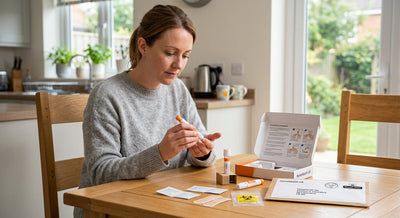
If you are using an at-home finger-prick test, preparation matters.
Warm hands. Good hydration. A calm setup. The correct collection steps. These small things can make the difference between a smooth sample and an annoying do-over.
Vitall Check provides an official collection guide, and it is worth following closely for the best chance of a usable sample. Finger-prick testing is convenient, but some people do find collection fiddly at first. That is normal.
For broader background reading, our How to Do a Home Blood Test guide can help you prepare. If you are building out the bigger cardiovascular picture, this article should also sit alongside our main cluster pillar, Heart Health Blood Tests: How to Understand Your Numbers and Arrive Informed for Your GP Appointment.
What your results can and cannot tell you
A cholesterol blood test can help you:
- understand the shape of your lipid profile
- spot patterns worth discussing
- identify whether extra context markers like ApoB or Lp(a) may be useful
- prepare for a more productive GP conversation
- track changes over time when testing conditions are consistent
It cannot:
- diagnose blocked arteries
- replace a full cardiovascular assessment
- tell you, by itself, what treatment you need
- replace your GP, NHS Health Check or specialist review
That distinction matters.
Vitall Check results are designed to make raw data easier to understand — more like a manual than a mystery spreadsheet. They translate figures into plain English so you can see what is worth following up. They do not diagnose, prescribe or replace medical care.
When it makes sense to look beyond standard cholesterol
You may want a wider conversation about ApoB, Lp(a), glucose markers or hs-CRP if:
- you have a family history of early heart disease
- your standard cholesterol results do not match your lifestyle
- your triglycerides are raised
- you have features of insulin resistance
- you are a data-driven patient who wants a clearer baseline
- you want to arrive better prepared for a GP appointment
For some people, the standard panel is enough. For others, adding ApoB or Lp(a) is like switching from a blurry map to sat nav. Same journey. Better visibility.
Summary
A cholesterol blood test is not one number with one meaning.
It is a set of signals.
The standard lipid panel — total cholesterol, HDL, LDL, non-HDL and triglycerides — remains the foundation. But if you want a more complete picture, ApoB can help show how many potentially harmful particles are in circulation, while Lp(a) can uncover an inherited risk factor that standard cholesterol tests may miss.
Add in HbA1c, fasting glucose and hs-CRP, and you start to see the wider cardiovascular context rather than just one corner of it.
That is the real value of testing: not using results to play doctor at home, but using them to arrive informed for your next GP conversation.
FAQ
Q: Can an at-home cholesterol blood test replace an NHS Health Check or GP visit?
A: No. An at-home test can help you understand your lipid profile and prepare for a more informed discussion, but it does not replace an NHS Health Check, medical diagnosis or advice from your GP.
Q: Is ApoB better than LDL for heart risk?
A: ApoB can be more informative in some people because it reflects the number of atherogenic particles, not just the cholesterol inside them. It is especially useful when triglycerides are raised or when standard lipid results do not match the rest of the health picture.
Q: Do I need to fast before a cholesterol blood test in the UK?
A: Not always. Many routine lipid tests can be done non-fasting, but fasting may still be recommended in some situations, especially if triglycerides or calculated LDL need closer assessment. Always follow the instructions for your specific test.
Author
Vitall Check Editorial Team
The Vitall Check Editorial Team is dedicated to empowering individuals with evidence-based health information and clear, actionable insights. Every article is researched using peer-reviewed journals and official health resources, reflecting our commitment to the same high standards of accuracy as our laboratory testing services. Our goal is to make proactive wellness accessible, data-driven, and transparent.
Disclaimer: Vitall Check is not CQC registered. The content provided is for general information only, does not provide a diagnosis, and does not replace advice from a qualified healthcare professional. Our services do not include treatment, prescription, or medical advice that falls under CQC-regulated activities. Always consult with your GP or a qualified clinician before making significant changes to your healthcare regimen.