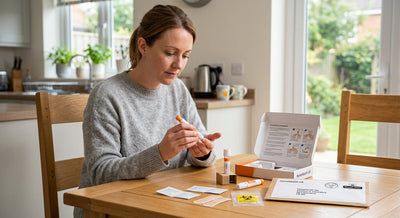
You can now order an at-home blood test in minutes. The harder part is choosing one that gives you useful information rather than an expensive list of numbers.
The best at-home blood test kit in the UK should do more than arrive quickly. It should use a properly accredited laboratory, explain what your results mean, show the full cost clearly and help you prepare for a better conversation with your GP.
TL;DR:
- Check whether the laboratory is UKAS-accredited to ISO 15189.
- Confirm when the results clock starts. Vitall Check provides lab-verified results within 48 hours of laboratory receipt.
- Choose a panel that matches your question, whether that is metabolic, hormonal, organ, immunity or nutritional health.
- Look for an Insight Report written in plain English, not just raw biomarker data.
- Check sample requirements, delivery, return postage and replacement policies.
- Read the privacy policy before sharing sensitive health information.
- At-home testing can support an informed GP conversation. It does not diagnose or replace medical care.
What's the best at-home blood test kit in the UK? The best kit is one processed by a UKAS-accredited laboratory, covers the biomarkers relevant to your goals, provides clear plain-English reporting, explains the full cost and protects your personal health data.
1. Start with the laboratory, not the marketing
A polished website is useful. It is not proof of laboratory quality.
The first question to ask is: Which laboratory processes the sample, and is the relevant testing covered by UKAS accreditation to ISO 15189?
UKAS explains that ISO 15189 accreditation assesses medical laboratories for quality and technical competence. It also checks that specific activities are carried out against the requirements of the standard. In simple terms, accreditation is like a safety inspection for the laboratory process, not just a shiny badge on a website.
You can read the UKAS explanation of medical laboratory accreditation for more detail.
UKAS also says accreditation gives patients extra assurance that blood, urine and tissue tests are independently assessed for consistency and confidence in results. That does not mean an at-home kit diagnoses a condition. It means the sample is being handled within a recognised quality framework.
What to check
- UKAS accreditation: Is it clearly stated?
- ISO 15189: Is the medical laboratory standard named?
- Scope: Does the accreditation cover the tests being offered?
- Laboratory location: Is the sample processed in a UK laboratory?
- Transparency: Can the provider explain who processes the sample?
Vitall Check states that samples are processed by UKAS-accredited partner laboratories holding ISO 15189 accreditation, using NHS-grade laboratory standards.
That is the foundation. Everything else comes afterwards.
2. Look for results that arrive quickly , with a clear starting point
“Results in 48 hours” sounds simple. It is worth checking 48 hours from when.
Some providers count from the day you post the sample. Others count from the day the laboratory receives it. Those are not the same thing.
Vitall Check provides lab-verified digital results within 48 hours of laboratory receipt. Samples should be posted on the same day they are collected, from Monday to Thursday, so weekend delays are less likely.
This is important if you are planning a GP appointment or want to discuss a result while the details are still fresh.
The NHS explains that blood samples are sent to a laboratory for testing and that results can take from a few days to a few weeks, depending on the test. You can read the NHS guide to what blood tests involve and how results are handled.
A good provider should tell you:
- When the turnaround time begins.
- Whether weekends affect processing.
- How results are delivered.
- What happens if a sample cannot be processed.
- Whether return postage is prepaid and tracked.
3. Choose the right range of biomarkers
A larger panel is not automatically a better panel.
Think of biomarkers like instruments on a car dashboard. The speedometer is useful, but it cannot tell you what is happening with the fuel, engine temperature or oil pressure. You need the right group of measures for the question you are asking.
If you want a broad health overview, look for coverage across areas such as:
- Metabolic health: blood sugar and related markers.
- Hormonal health: thyroid and sex hormone markers.
- Organ health: liver and kidney markers.
- Nutritional health: iron, ferritin, B12, folate and other nutrients.
- Immunity and inflammation: selected blood cell and inflammation markers.
Vitall Check’s Complete Health & Performance Blood Test includes 50 biomarkers across eight health systems, including liver, kidney, cholesterol, blood sugar, hormones, thyroid, nutrients and blood count markers.
That may suit someone seeking a broad baseline. It may be more than you need if you have one narrow question. In that case, a focused panel may be easier to understand and more cost-effective.
Before buying, ask:
- What do I want to understand?
- Which markers are included?
- Are the results relevant to my age, sex and situation?
- Will the panel give useful context, or just more numbers?
4. Read the report before you buy
Raw data is not the same as useful information.
A result such as “ALT: 45 IU/L” may be clear to a laboratory professional. It is not automatically clear to everyone else. A useful report should explain the marker, show where it sits against the laboratory reference range and describe factors that may affect it.
The report should work like an instruction manual. It should help you understand the controls without pretending to repair the engine for you.
Look for:
- Plain-English explanations.
- Clear reference-range information.
- Grouping by health area.
- A summary of the main findings.
- Context around factors such as training, hydration, sleep or recent illness.
- Practical prompts for what to discuss with your GP.
Vitall Check’s Insight Report is designed to translate raw laboratory data into clearly explained results and a personalised health action plan. It is educational and lifestyle-focused. It does not diagnose, prescribe or provide medical advice.
For more on why context matters, read the Health Hub guide: Biohacking Blood Test Results: Why Context Matters More Than the Number.
5. Check how easy the sample collection really is
Finger-prick testing is convenient, but it is not completely effort-free.
Cold hands, poor hydration or rushing the process can make collection harder. Some people collect enough blood quickly. Others need patience and careful preparation (that is normal).
Before collecting your sample:
- Drink water as instructed.
- Warm your hands.
- Follow any fasting instructions for your panel.
- Avoid unusual or intense exercise if the instructions advise this.
- Use a clean, well-lit surface.
- Post the sample on the same day.
Always follow the official Vitall Check sample collection guide. It explains how to prepare, where to use the lancet, how to fill the tube and how to package the sample.
Think of the sample as the starting ingredient in a recipe. Even an excellent kitchen cannot produce a reliable meal if the ingredient is missing, contaminated or poorly stored.
If collection is difficult, do not keep repeating the same attempt indefinitely. Use the spare lancet only as instructed, switch fingers if needed and contact the provider if you need help or a replacement.
6. Compare the full price, not just the headline price
The cheapest kit is not always the lowest-cost option once delivery, return postage and extras are included.
Check:
- Kit price.
- Delivery charge.
- Return postage.
- Whether tracked postage is included.
- Replacement-kit fees.
- Optional clinic or venous collection costs.
- Subscription requirements.
- Whether the report is included.
Vitall Check offers free delivery on orders over £100, and return postage to the laboratory is prepaid. For example, the Complete Health & Performance Blood Test is listed at £199 when checked for this guide. Prices can change, so confirm the current amount before ordering.
You can also use the Vitall Check comparison page to review which biomarkers appear in different panels.
7. Treat privacy as a buying decision
Blood test results are sensitive personal information. Privacy should not be a footnote.
The Information Commissioner’s Office classifies health information, including test results, as special category data under UK GDPR. This means it needs extra protection. Read the ICO’s guidance on what counts as health data.
Before ordering, check:
- How your results are stored.
- Who can access them.
- Whether results are shared with laboratories or other suppliers.
- How long information is kept.
- Whether you can close your account or request data deletion.
- Whether results are delivered through a secure portal.
- How marketing consent is handled.
Vitall Check delivers results through a secure digital portal and provides discreet delivery. Still, read the privacy and GDPR information so you understand how your information is handled.
Privacy is a bit like a lockbox. You want to know who has the key, where the box is kept and what happens if you stop using the service.
Is Vitall Check the best at-home blood test kit in the UK?
There is no single best option for every person.
The right choice depends on what you want to measure, how much interpretation you need and how quickly you want your results. For someone looking for a broad panel, UKAS-accredited laboratory processing, 48-hour lab-verified results, a plain-English Insight Report and home collection, Vitall Check is a strong option to consider.
It is also designed for people who want more than a dashboard. Athletes, professionals and data-driven health seekers can use the results as a clearer starting point for a GP conversation, while remembering that training load, hydration, supplements and timing can affect some markers.
FAQ
Q: Are at-home blood test kits accurate in the UK? A: They can provide useful laboratory results when the sample is collected correctly and processed by an appropriately accredited laboratory. Check for UKAS accreditation and follow the official collection instructions carefully.
Q: How quickly do Vitall Check blood test results arrive? A: Vitall Check provides lab-verified digital results within 48 hours of the laboratory receiving your sample. Post your sample on the same day you collect it to help avoid delays.
Q: Can an at-home blood test replace a GP appointment? A: No. It can help you arrive informed with organised data to discuss with your GP, but it does not provide a diagnosis or replace medical care.
Summary
When choosing the best blood test kit UK customers can buy in 2026, look past the adverts.
Check the laboratory accreditation. Confirm the result timeline. Review the biomarkers. Read the report description. Understand the collection process. Compare the complete price. Then check how your health data is protected.
A good at-home blood test should leave you with clearer information, not more confusion. Use it as a practical starting point for better questions and a more informed conversation with your GP.
Author
Vitall Check Editorial Team
The Vitall Check Editorial Team is dedicated to empowering individuals with evidence-based health information and clear, actionable insights. Every article is researched using peer-reviewed journals and official health resources, reflecting our commitment to the same high standards of accuracy as our laboratory testing services. Our goal is to make proactive wellness accessible, data-driven, and transparent.
Disclaimer: Vitall Check is not CQC registered. The content provided is for general information only, does not provide a diagnosis, and does not replace advice from a qualified healthcare professional. Our services do not include treatment, prescription, or medical advice that falls under CQC-regulated activities. Always consult with your GP or a qualified clinician before making significant changes to your healthcare regimen.