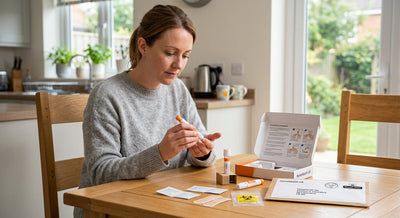
Your thyroid is tiny. The effect it has on your day is not.
When this small gland slows down, life can feel like someone quietly turned the dimmer switch down on your energy, mood and body temperature. You might feel tired all the time, colder than everyone else, more constipated, more flat, or like your weight has changed without any obvious reason. The annoying part? Those symptoms can creep in slowly, so it is easy to blame stress, poor sleep or “just being busy”.
That is why thyroid testing matters. But a basic thyroid check is not always the full story. If you only look at TSH, you may miss useful context about what your thyroid is actually producing and whether the immune system may be involved.
This guide walks you through TSH, free T4, free T3, TPO antibodies and thyroglobulin antibodies in plain English. You will also learn why thyroid symptoms overlap with iron, vitamin B12, vitamin D and cortisol issues, how the NHS usually approaches testing, and how to arrive prepared for a better GP conversation.
Vitall Check provides clinical-grade at-home blood testing kits processed by UKAS-accredited laboratories to NHS-grade standards, with results translated into plain English so you can better understand your numbers before your next clinical conversation. Diagnosing and treating thyroid conditions, however, is a clinical matter for your GP or another qualified clinician.
TL;DR:
- Your thyroid works like your body’s speed controller. When it slows down, many systems slow with it.
- TSH is the pituitary’s signal to the thyroid. It is useful, but it is not the whole story on its own.
- Free T4 and free T3 are the actual thyroid hormones your body uses.
- TPO and thyroglobulin antibodies can point towards autoimmune thyroid disease, including Hashimoto’s thyroiditis.
- Symptoms can overlap with low iron, low vitamin B12, low vitamin D and stress-related issues, which is why those are often checked alongside thyroid markers.
- The NHS commonly starts with TSH and may add free T4, free T3 or antibodies depending on the result and your symptoms.
- Consistency matters when retesting. Morning collection is sensible where possible, and high-dose biotin supplements can interfere with thyroid blood tests.
- A blood test does not diagnose itself. Results need to be interpreted in clinical context by a GP.
What’s an underactive thyroid test in the UK? An underactive thyroid test in the UK is a blood test that usually measures TSH and often free T4, with free T3 and thyroid antibodies added when needed, to check whether your thyroid is underactive and whether an autoimmune process may be involved.
What does the thyroid actually do?
Your thyroid is a butterfly-shaped gland in the front of your neck. It makes hormones that help control how fast or slow your body works. That includes energy use, temperature, digestion, heart rate, menstrual function, skin and hair health, and brain function.
A simple way to think about it: your thyroid is like the speed controller on a boiler. If it is set too low, the whole house still runs, but everything feels sluggish and less responsive. You still have heating. It just is not doing enough.
The main hormones involved are:
- T4 (thyroxine): the main hormone your thyroid makes
- T3 (triiodothyronine): the more active hormone, much of which is made by converting T4 into T3 in tissues around the body
- TSH (thyroid-stimulating hormone): a hormone from the pituitary gland in your brain that tells your thyroid how hard to work
So, while people often say “thyroid test”, what they really mean is a set of linked signals.
According to the NHS page on underactive thyroid, hypothyroidism can affect many parts of the body and commonly causes tiredness, sensitivity to cold, weight gain and constipation.
Why the thyroid is often called the body’s speed controller
That phrase is popular because it fits. When thyroid output drops, things can slow across multiple systems at once.
Think of your metabolism like a city transport network. If the central control room starts sending weaker instructions, buses still move, trains still run, but everything gets delayed. You notice the knock-on effect everywhere, not just in one place.
That is why underactive thyroid symptoms can seem random at first:
- Low energy
- Feeling cold
- Constipation
- Dry skin
- Low mood
- Hair thinning
- Weight change
- Heavy periods
- Brain fog or slower thinking
None of these symptoms “belong” only to the thyroid. That is part of what makes thyroid issues easy to miss and easy to confuse with other causes.
What is TSH and why does it matter?
TSH stands for thyroid-stimulating hormone. It is made by the pituitary gland, which sits at the base of the brain.
Its job is simple: if the body senses thyroid hormone is low, the pituitary sends out more TSH to tell the thyroid to work harder.
That makes TSH a bit like a manager sending more emails when a team is falling behind. A high TSH can suggest the thyroid is not keeping up. A low TSH can suggest the opposite.
NICE guidance on thyroid disease assessment and management recommends TSH as the first-line test for most adults with suspected thyroid dysfunction, with free T4 added if TSH is raised. If pituitary disease is suspected, NICE advises measuring TSH and free T4 together because TSH alone may not be enough.
What a raised TSH can mean
If TSH is above the reference range, it often means the pituitary is trying harder to stimulate the thyroid.
That may fit with:
- Overt hypothyroidism: TSH high and free T4 low
- Subclinical hypothyroidism: TSH high but free T4 still within the reference range
- Early thyroid dysfunction
- A recovery phase after illness in some cases
- Variation related to medicines, supplements or testing context
What a normal TSH does not always guarantee
A normal TSH is reassuring in many cases, but it does not automatically mean “nothing thyroid-related is going on”.
This matters because TSH is a signal, not the end product. It tells you what the pituitary is asking for. It does not directly tell you what free hormone is available in the bloodstream right now.
Free T4 and free T3: the actual hormones
If TSH is the instruction, free T4 and free T3 are the hormone output.
- Free T4 is the unbound thyroxine available for use by the body
- Free T3 is the unbound triiodothyronine, the more active hormone at tissue level
The “free” part matters. These are the portions not stuck to proteins in the blood, so they better reflect what is available to tissues.
Think of it like a warehouse and delivery system. TSH is the order form. Free T4 is the stock leaving the warehouse. Free T3 is what finally reaches the front door ready to be used.
The NCBI Bookshelf summary of NICE thyroid function testing explains that TSH is sensitive, but free thyroid hormones are important because TSH alone can be misleading in some settings, including suspected pituitary disease and during certain treatment or adjustment phases.
Why free T4 is commonly checked alongside TSH
If TSH is raised, checking free T4 helps show whether the thyroid is still producing enough hormone.
A common pattern is:
- High TSH + low free T4: consistent with underactive thyroid
- High TSH + normal free T4: may fit subclinical hypothyroidism
- Normal or low TSH + low free T4: may need further clinical investigation because the pattern is not typical of simple primary hypothyroidism
What about free T3?
Free T3 is not always the first add-on in suspected underactive thyroid, but it can still add context in some cases.
It helps to know that your body often tries to keep T3 steady for as long as possible. That means free T3 can stay within range even when other parts of the picture are starting to shift. This is one reason it is not usually the first marker used to diagnose hypothyroidism.
Why TSH alone can miss part of the story
TSH is useful. It is just not the whole film.
If you only look at TSH, you are seeing one camera angle. Adding free T4, and sometimes free T3 and antibodies, gives you a fuller picture.
Reasons TSH alone can miss context include:
1. Pituitary issues can change the pattern
If the pituitary is not sending the right signal, TSH may not rise as expected even if thyroid hormone is low. NICE specifically advises checking TSH and free T4 together when secondary, or pituitary-related, thyroid dysfunction is suspected.
2. Symptoms do not always map neatly onto one number
Real people are not spreadsheets. Someone can have symptoms, borderline results, and an evolving pattern over time.
3. Autoimmune thyroid disease may be part of the picture
A raised TSH can tell you something may be slowing down. Antibody tests can help show whether the immune system is involved.
4. Results can be distorted by supplements or timing
NICE notes that biotin intake can falsely alter thyroid blood test results, so clinicians should ask about supplement use when thyroid dysfunction is suspected. That matters if you are taking high-dose hair, skin and nails supplements.
TPO and thyroglobulin antibodies: what they indicate
When people talk about thyroid antibodies, the two you will hear most often are:
- TPO antibodies (thyroid peroxidase antibodies)
- Thyroglobulin antibodies
These do not measure how much thyroid hormone you have. They look for signs that the immune system may be reacting against thyroid tissue.
That can matter because in the UK, one of the most common causes of underactive thyroid is Hashimoto’s thyroiditis, an autoimmune condition. The NHS notes that Hashimoto’s disease is the most common cause of underactive thyroid in the UK on its hypothyroidism overview.
TPO antibodies
TPO is an enzyme the thyroid uses to help make thyroid hormones. If TPO antibodies are raised, it can suggest the immune system is targeting part of the thyroid hormone production process.
NICE recommends considering TPO antibodies in adults with raised TSH, but says they are not usually repeated routinely in adults.
Thyroglobulin antibodies
Thyroglobulin is a protein involved in thyroid hormone production and storage. Thyroglobulin antibodies can also support the idea of autoimmune thyroid disease when interpreted alongside the rest of the thyroid picture.
The NICE evidence review on tests for people with confirmed primary hypothyroidism explains that thyroid autoantibodies, particularly TPO antibodies, can help confirm autoimmune thyroid disease and may indicate a higher chance of progression from subclinical to overt hypothyroidism in some people.
Important point about antibodies
A positive antibody result is not the same as a diagnosis on its own. Some people with antibodies do not have clear hormone changes yet. Some people with thyroid symptoms do not have raised antibodies. This is why the full pattern matters.
Common symptoms people report with an underactive thyroid
Symptoms vary from person to person. Some start gradually and build over months.
Common symptoms listed by the NHS and widely reported in practice include:
- Tiredness
- Feeling cold more than usual
- Weight change
- Constipation
- Low mood
- Dry skin
- Hair thinning
- Heavy or irregular periods
- Slower thinking or poor concentration
- Muscle aches
- Hoarse voice
A useful analogy here: an underactive thyroid can feel like trying to run your day with your phone stuck on low power mode. The phone still works, but background jobs slow down, brightness drops, and everything feels less responsive.
That said, symptoms alone cannot confirm a thyroid problem. They overlap with many other health issues.
Why thyroid symptoms overlap with iron, vitamin B12, vitamin D and cortisol issues
This is where things get messy.
Many thyroid-type symptoms are also seen with:
- Low iron or low ferritin
- Vitamin B12 deficiency
- Vitamin D deficiency
- Stress-related disruption, poor sleep and changing cortisol patterns
- Perimenopause or menstrual blood loss
- Depression
- Overtraining in some athletes
- Recovery from illness
That is why thyroid testing is often more useful when viewed as part of a wider check rather than a single isolated number.
For example:
- Iron and ferritin: low iron can cause tiredness, hair shedding, poor exercise tolerance and feeling washed out
- Vitamin B12: low B12 can affect energy, mood, memory and tingling sensations
- Vitamin D: low vitamin D can overlap with fatigue, low mood and general aches
- Cortisol: disrupted stress response and poor sleep can mimic “thyroid-y” fatigue
It is a bit like hearing a warning light in your car and assuming it must be the battery. Sometimes it is. Sometimes it is the alternator, wiring or something else entirely. Symptoms are clues, not conclusions.
If you are trying to build a fuller picture, relevant internal options may include the Hormone & Thyroid Blood Tests collection, the Energy & Fatigue category, and the Basic Health Check Blood Test. For related reading in the Health Hub cluster, link back to the main pillar post: Thyroid Health for Women.
The NHS approach: when a GP would repeat or extend testing
In the UK, a GP will usually start with your symptoms, history and an initial blood test. A common first step is TSH, with free T4 added if TSH is abnormal, following NICE guidance.
Depending on the result, symptoms and context, a GP may:
- Repeat testing after a period of time
- Add free T4 or free T3
- Check TPO antibodies
- Consider wider blood tests such as full blood count, ferritin, B12 or vitamin D
- Consider whether another condition could explain the symptoms
- Review medicines and supplements
- Consider referral if the pattern is unusual
The NICE guideline overview covers investigation and ongoing management of thyroid disease in adults. The BMJ Best Practice page on primary hypothyroidism also outlines the common approach: use TSH first, then free T4 to confirm overt hypothyroidism, with antibody testing considered where relevant.
When repeat testing may happen
A GP may repeat thyroid blood tests when:
- Results are borderline
- Symptoms persist
- There is a mismatch between symptoms and lab pattern
- A previous illness may have temporarily affected results
- There is suspicion of evolving autoimmune thyroid disease
- You have started or stopped a supplement that may interfere
NICE rationale notes that re-testing is not usually useful within six weeks of the last test unless there is a specific reason, because the system needs time to settle and show a meaningful trend.
How to prepare for a thyroid blood test
Good prep does not magically change the result. It helps make the result more reliable.
Aim for morning collection where possible
Thyroid tests are often more useful when done in the morning, especially if you plan to compare one result with another later. The key is not perfection. It is consistency.
If you are repeating a thyroid blood test, try to collect it at a similar time of day to the last one. Think of it like comparing two photos: if one is taken in bright daylight and one in a dark room, the comparison gets less clean.
Be consistent when retesting
Use similar conditions where you reasonably can:
- Similar time of day
- Similar supplement routine
- Similar timing in relation to medication, if your GP advises this
- Similar general health status where possible
Watch out for biotin supplements
This point matters more than many people realise.
NICE states that high biotin intake can cause falsely high or falsely low thyroid blood test results, so adults with suspected thyroid dysfunction should be asked about biotin use. Biotin is commonly found in hair, skin and nails supplements and in some high-dose B-complex formulas.
If you take biotin, tell your GP or testing provider before collection. Do not guess or make medication or supplement changes without proper advice. Follow the official sample collection instructions that come with your test.
Other practical steps
- Stay hydrated
- Collect calmly rather than after a frantic dash out the door
- Follow the official how to collect your sample guide closely
- If finger-prick collection is used, warm your hands first and take your time
Finger-prick testing can be convenient, but preparation matters. Warm hands and good technique are the difference between a smooth sample and a frustrating one.
How to interpret thyroid results within clinical reference ranges
This part needs care.
Blood tests are there to help you understand where your numbers sit in relation to the laboratory’s clinical reference ranges. They are not there to self-diagnose, self-prescribe or start adjusting treatment based on internet guesswork.
Here is the plain-English version:
TSH
- High TSH may suggest the thyroid is being pushed to work harder
- Low TSH may suggest the thyroid is being overstimulated or that something else in the signalling system is going on
- TSH within range is often reassuring, but still needs context
Free T4
- Low free T4 with high TSH commonly supports underactive thyroid
- Normal free T4 with raised TSH may fit subclinical hypothyroidism
- A pattern that does not fit neatly may need GP review
Free T3
- Adds context in selected cases
- Often not the first or most decisive marker for underactive thyroid
- Can stay within range even when other markers are shifting
TPO and thyroglobulin antibodies
- Raised antibodies can suggest an autoimmune process
- They do not, on their own, tell you how severe symptoms are
- They do not tell you what treatment should be
This is where a result report should act like a translation manual, not a diagnosis. Good reporting turns “TSH: X, FT4: Y” into plain English, helps you understand whether a pattern may deserve follow-up, and prepares you for a more focused GP appointment.
Diagnosing and treating thyroid conditions is a clinical matter for a GP. That includes deciding whether results support hypothyroidism, whether repeat testing is needed, and whether treatment is appropriate.
How to track thyroid results over time
One isolated thyroid result is a snapshot. A trend is more like a timeline.
Tracking matters because thyroid issues can develop gradually. Autoimmune activity can also evolve over time. A single normal-looking result may not settle the question if symptoms keep going.
What to track
Record:
- Date of test
- TSH
- Free T4
- Free T3, if tested
- TPO antibodies
- Thyroglobulin antibodies
- Your main symptoms at the time
- Supplements taken, especially biotin
- Any major illness, travel, poor sleep or training load around the test
Why trend data helps
Imagine trying to understand the weather from one afternoon only. You might catch sunshine and miss the storm pattern entirely. Thyroid tracking works the same way. A series of results can show whether things are stable, drifting or changing in a way that deserves medical follow-up.
This is especially useful for:
- Borderline or mixed results
- Ongoing symptoms
- Monitoring after a previous abnormal test
- Preparing for a GP review
- Understanding whether symptoms match the lab pattern
Arrive prepared for your GP appointment: practical checklist
You do not need to turn up with a lecture. You do want to turn up organised.
Before the appointment
- Write down your main symptoms
- Note when they started
- Track whether they are getting worse, staying the same or coming and going
- Bring any blood test results with dates and reference ranges
- List any supplements, especially biotin
- List any relevant medicines
- Note family history of thyroid disease or autoimmune conditions if known
- If periods are heavy, note that too, because it may matter for iron and fatigue
Questions worth asking
- Do my symptoms and blood results suggest that this needs repeating?
- Was free T4 checked, or only TSH?
- Would antibody testing help in my case?
- Could iron, ferritin, B12 or vitamin D also be contributing?
- When would repeat testing make sense?
- Is there anything I should stop or avoid before a repeat blood test?
If you are an athlete or train hard
Say so. Training load can affect how you feel and can overlap with fatigue patterns. It may not explain everything, but it is useful context. The goal is not to explain symptoms away. It is to give your GP the clearest possible picture.
When an at-home thyroid test can be useful
An at-home test can be helpful if you want to:
- Check thyroid markers conveniently from home
- Build a clearer picture before your GP visit
- Track results over time with consistent records
- Combine thyroid testing with related markers such as iron, B12 or vitamin D
Vitall Check tests are processed by UKAS-accredited partner laboratories working to NHS-grade standards, and your Insight Report translates raw biomarker data into plain English. That can help you arrive informed for your next GP appointment.
Useful internal resources include the Hormone & Thyroid Blood Tests collection, the Vitamin & Nutritional Deficiency Tests collection, and the Morning Cortisol Blood Test.
What it cannot do is diagnose, prescribe or replace clinical care. If a thyroid disorder is suspected, your GP is the person who diagnoses and manages that.
Summary
If you suspect an underactive thyroid, TSH is an important starting point, but it is not the whole story.
A fuller picture may include:
- TSH as the pituitary’s signal
- Free T4 and sometimes free T3 as the actual thyroid hormones
- TPO antibodies and thyroglobulin antibodies to check for autoimmune thyroid disease
- Related markers such as iron, vitamin B12, vitamin D and cortisol where symptoms overlap
The thyroid really does behave like a body-wide speed controller. When it slows, the effects can show up almost everywhere. But because the symptoms are broad and shared with other problems, context matters.
Use test results to understand where you sit within clinical reference ranges, spot patterns over time, and prepare for a more productive GP conversation. Do not use them to self-diagnose or self-treat.
FAQ
Q: Can an at-home thyroid blood test replace a GP visit?
A: No. An at-home thyroid blood test can help you arrive informed for your next GP appointment, but diagnosing and treating thyroid conditions is a clinical matter for a GP or another qualified clinician.
Q: Is TSH enough to check for an underactive thyroid?
A: Not always. TSH is a useful first-line marker, but free T4, and sometimes free T3 and thyroid antibodies, can add important context depending on your symptoms and results.
Q: Can biotin affect thyroid blood test results?
A: Yes. NICE notes that high biotin intake from supplements can interfere with thyroid blood test results, so always tell your GP or testing provider if you take biotin.
Author
Vitall Check Editorial Team
The Vitall Check Editorial Team is dedicated to empowering individuals with evidence-based health information and clear, actionable insights. Every article is researched using peer-reviewed journals and official health resources, reflecting our commitment to the same high standards of accuracy as our laboratory testing services. Our goal is to make proactive wellness accessible, data-driven, and transparent.
Disclaimer: Vitall Check is not CQC registered. The content provided is for general information only, does not provide a diagnosis, and does not replace advice from a qualified healthcare professional. Our services do not include treatment, prescription, or medical advice that falls under CQC-regulated activities. Always consult with your GP or a qualified clinician before making significant changes to your healthcare regimen.