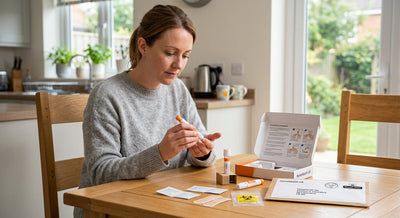
Feeling tired after a late night is normal. Feeling tired most days, despite sleeping, is different. If you are searching for a blood test for tiredness, a sensible shortlist can help you organise the next conversation with your GP.
A blood test gives you data, not a diagnosis. Think of it as a car dashboard: it may show that a warning light needs attention, but it does not explain the whole journey.
TL;DR:
- Persistent tiredness can have many causes, including sleep, stress, medication, diet and health conditions.
- Useful tests to discuss include ferritin, full blood count, vitamin B12, folate, vitamin D, thyroid markers, HbA1c or glucose, and CRP.
- Athletes should consider recent training, muscle mass, hydration and recovery when reading results.
- A finger-prick sample may need preparation. Warm your hands, drink water and follow the official collection guide.
- Use results to arrive informed for a better GP conversation, not to self-diagnose.
What blood tests should you get for tiredness in the UK? Common tests include a full blood count, ferritin, vitamin B12 and folate, vitamin D, thyroid function, HbA1c or glucose, and an inflammatory marker such as CRP. The right tests depend on your symptoms, history and clinical judgement.
Which blood tests are worth checking for persistent fatigue?
NICE guidance lists tests such as full blood count, thyroid function, CRP, HbA1c and ferritin when clinicians are investigating possible ME/CFS and excluding other causes. It also says vitamin D, vitamin B12 and folate may be added where appropriate. You can read the full NICE investigation recommendations.
Here is what each marker actually measures.
1. Ferritin and full blood count
Ferritin gives an indication of your stored iron. Imagine ferritin as your body’s iron savings account. When the account is running low, you may notice tiredness before other blood results change.
A full blood count, or FBC, looks at your red and white blood cells and platelets. It includes haemoglobin, the protein that carries oxygen around your body.
These tests can help identify patterns linked with anaemia or low iron stores. Iron deficiency anaemia may cause tiredness, low energy, breathlessness, headaches or noticeable heartbeats, according to the NHS guide to iron deficiency anaemia.
Heavy periods, restricted diets, pregnancy, blood loss and endurance training can all be relevant context. Do not assume tiredness is caused by iron deficiency simply because you train hard or eat little red meat. Your GP may need to investigate why a result is unusual.
2. Vitamin B12 and folate
Vitamin B12 and folate help your body make healthy red blood cells. B12 also supports normal nerve function.
Think of them as essential parts in a factory that makes oxygen-carrying cells. If one part is missing, production may become less effective.
Low levels can be linked with tiredness, weakness, pins and needles, mouth ulcers, poor concentration or memory problems. Importantly, symptoms can occur with or without anaemia. The NHS information on vitamin B12 or folate deficiency explains why these deficiencies should be assessed properly.
Your diet, medicines and absorption in the gut may all matter. Vegan and vegetarian diets can require particular attention to B12 intake, but diet is only one possible factor.
3. Vitamin D
Vitamin D helps regulate calcium and supports bones and muscles. In the UK, levels may be affected by limited sunlight, skin type, clothing, time spent indoors and diet.
A vitamin D result is not a complete explanation for fatigue. It is one piece of the puzzle, rather like checking the battery in a torch when the light looks dim. It may be relevant, but you still need to look at the bulb, switch and wiring.
NICE includes vitamin D among tests that may be considered based on clinical judgement. It is especially worth discussing if you have muscle or bone symptoms, limited sun exposure or other risk factors.
4. Thyroid: TSH and free T4
Your thyroid helps control how quickly many body processes run. TSH is the signal from the brain telling the thyroid how hard to work. Free T4 is one of the thyroid hormones circulating in your blood.
The thyroid system is a little like a home thermostat. If the system is not working as expected, you might feel unusually cold, tired, low in mood or mentally sluggish. These symptoms can also have many other causes.
The NHS explains that suspected underactive thyroid is assessed using blood tests for TSH and T4. Read the NHS guide to underactive thyroid for more detail.
Timing, medicines, supplements and recent illness may affect results. If you take thyroid medication or supplements containing biotin, tell your GP or test provider.
5. HbA1c and fasting glucose
HbA1c gives an estimate of your average blood sugar over roughly the previous two to three months. A fasting glucose test measures your blood sugar at one point in time, usually after not eating for a set period.
HbA1c is like a term-time report, while fasting glucose is more like a single test score. Both can be useful, but they answer slightly different questions.
Blood sugar problems may be associated with tiredness, thirst, passing urine more often or unexplained weight loss. The NHS guide to type 2 diabetes diagnosis explains how blood glucose testing is used.
One result does not confirm the cause of your fatigue. Your clinician may need repeat testing, additional checks or a wider review of your symptoms.
6. CRP or hs-CRP
CRP, or C-reactive protein, is a marker that can rise when there is inflammation somewhere in the body. It is more like a smoke alarm than a map: it may suggest that something is happening, but it cannot tell you exactly where or why.
A standard CRP is commonly used when investigating ongoing symptoms. High-sensitivity CRP, or hs-CRP, can measure smaller changes, but it is not the same as a diagnosis of long-term inflammation. It can also be affected by a recent infection, injury or hard training session.
Do not take a raised CRP result as proof of a serious condition. Do not dismiss it as “just training” either. It needs to be read alongside symptoms and other results.

Athlete context: training can change your results
If you lift weights, run, cycle or train intensely, write down your recent training before testing.
A hard session can temporarily shift inflammation-related markers. Resistance training can also affect muscle-related results. Creatinine, for example, is influenced by muscle mass, hydration and protein intake, so a muscular lifter may have a different result from someone with less muscle.
That does not mean an unusual result should be ignored. It means your training history is part of the context. Tell your GP:
- What training you completed in the previous few days
- Whether you had a recent race, heavy lifting session or injury
- How well you slept
- Whether you were hydrated
- Which supplements and medicines you take
For a broad set of markers, you can review the Complete Health & Performance Blood Test. If you are mainly checking nutritional markers, including iron, B12 and vitamin D, see the Essential Vitamins & Nutritional Health Test.
What tiredness blood tests cannot tell you
Not all fatigue comes from your blood.
Poor sleep, sleep apnoea, stress, low food intake, overtraining, depression, anxiety, alcohol, medication and recent infections can all affect energy. Your GP may ask about your sleep, mood, diet, periods, weight, medicines and daily routine.
If you have persistent tiredness, keep a short record for one or two weeks. Note when you sleep, train, eat and feel most tired. This gives your GP more than a single number.
Results should be treated as a starting point. They may help you arrive informed, but they do not replace a clinical assessment.
How to prepare for a finger-prick sample
Preparation can make collection easier, although some people find finger-prick sampling fiddly. That is common and not a personal failure.
STEP 1: Check the instructions. Confirm whether your panel requires fasting, a morning sample or a specific collection time.
STEP 2: Avoid hard training beforehand. Follow the provider’s instructions. If you have trained heavily, record it.
STEP 3: Drink water. Unless your instructions say otherwise, hydration may help blood flow.
STEP 4: Warm and dry your hands. Wash them in comfortably warm water, then dry them fully.
STEP 5: Follow the official guide. Use the official Vitall Check how-to-collect guide, not a random online video.
STEP 6: Fill the tube to the marked line. Do not rush or squeeze the finger aggressively. If you feel faint, stop and sit or lie down safely.
Vitall Check samples are processed by UKAS-accredited partner laboratories working to NHS-grade standards. Results are provided digitally after the laboratory receives a suitable sample, with an Insight Report that acts as a plain-English manual for your results.
When to speak to your GP
Arrange a GP appointment if tiredness is persistent, getting worse or affecting work, exercise, relationships or daily tasks. Seek prompt medical advice if fatigue comes with chest pain, severe breathlessness, fainting, unexplained weight loss, new neurological symptoms or other worrying changes.
If your results are outside the laboratory reference range, take the full report to your GP. Do not start high-dose supplements or stop prescribed medicine based on a home test alone.
Vitall Check is not CQC registered and does not diagnose, treat, prescribe or provide medical advice.
Summary: use testing to arrive informed
The most useful blood test for tiredness is rarely just one test. A practical shortlist may include ferritin and FBC, vitamin B12 and folate, vitamin D, TSH and free T4, HbA1c or glucose, and CRP.
Your results are data points, not a verdict. Use them with your symptoms, sleep, training history, medicines and diet to support a better conversation with your GP.
Frequently asked questions
Q: What is the best blood test for tiredness in the UK? A: There is no single best test. A GP may consider FBC, ferritin, thyroid function, HbA1c, CRP, vitamin B12, folate and vitamin D based on your symptoms and history.**
Q: Can low iron cause tiredness even without anaemia? A: Low iron stores may be relevant even when haemoglobin is not low. Ferritin helps assess stored iron, but your result should be interpreted using the laboratory range and your clinical context.**
Q: Can an at-home blood test replace a GP appointment? A: No. It can provide laboratory data and help you arrive informed, but it does not diagnose, treat or replace advice from a qualified healthcare professional.**
Author
Vitall Check Editorial Team
The Vitall Check Editorial Team is dedicated to empowering individuals with evidence-based health information and clear, actionable insights. Every article is researched using peer-reviewed journals and official health resources, reflecting our commitment to the same high standards of accuracy as our laboratory testing services. Our goal is to make proactive wellness accessible, data-driven, and transparent.
Disclaimer: Vitall Check is not CQC registered. The content provided is for general information only, does not provide a diagnosis, and does not replace advice from a qualified healthcare professional. Our services do not include treatment, prescription, or medical advice that falls under CQC-regulated activities. Always consult with your GP or a qualified clinician before making significant changes to your healthcare regimen.