The best at-home blood test kit in the UK is not automatically the one with the biggest biomarker list or the lowest price.
It is the one that matches your goal, uses a clearly identified UKAS-accredited laboratory, gives you realistic sample instructions and explains your results in plain English.
Use this guide to compare your options in 2026 without getting distracted by flashy claims or endless numbers.
TL;DR:
- Check which laboratory processes your sample and whether it is UKAS-accredited.
- Finger-prick testing can be suitable for many markers, but collection technique matters.
- Choose the panel for your goal, not simply the one with the most biomarkers.
- Check whether results arrive within a useful timeframe. Vitall Check provides results within 48 hours after laboratory processing.
- Look for tracked delivery, prepaid return postage and free delivery over £100 where available.
- Choose a report that explains your results, rather than sending you a confusing PDF of numbers.
- Use your results to arrive informed for your next GP appointment. An at-home test does not replace NHS care.
What's the best at-home blood test kit in the UK? The best kit is one processed by a UKAS-accredited laboratory, matched to your health goal, collected correctly and supported by clear, plain-English results.
1. Check the laboratory before the marketing
Start with the question many shoppers skip: Who actually processes the sample?
A provider may design the kit, collect payment and host your results. The laboratory performs the testing. Those are different roles.
Look for:
- The laboratory’s name, where available
- UKAS accreditation
- The relevant medical laboratory standard, such as ISO 15189
- Clear information about which tests are included in the accredited scope
UKAS explains how medical laboratory accreditation assesses laboratory quality and competence. Think of it like checking the engine room of a boat, rather than judging the paint on the outside.
Vitall Check samples are processed by UKAS-accredited partner laboratories working to NHS-grade standards. This gives you an important quality check before you even open the kit.
Be cautious if a provider talks about “accurate results” but does not clearly explain the laboratory behind them.
2. Understand finger-prick testing
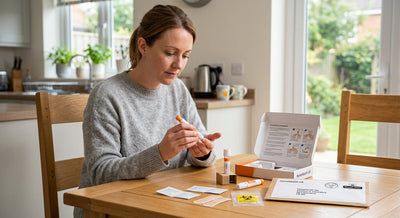
Most at-home blood test kits use a small finger-prick, also called a capillary sample.
A sterile lancet creates a small opening in your fingertip. You collect drops of blood into a tube, which is then sent to a laboratory.
Finger-prick testing can be suitable for many common health markers when:
- The panel is designed for capillary collection
- You prepare properly
- You collect enough blood
- The sample is labelled and returned correctly
- The laboratory uses suitable testing methods
It is not magic, and it is not completely effortless. Your finger is a small tap, not a full-size reservoir. If your hands are cold or you are dehydrated, the flow may be slow.
Before collecting, check whether you need to:
- Drink water
- Warm your hands
- Fast for a set period
- Collect the sample in the morning
- Avoid strenuous exercise
- Pause certain supplements, if the instructions say so
Do not stop prescribed medicines without speaking to your GP.
Some people find finger-prick collection fiddly. That is normal. Follow the official Vitall Check how-to-collect guide rather than relying on a random video or social media post.
The NHS blood test guide also explains that blood may be collected from a vein or through a finger-prick, depending on the test.

3. Match the panel to your goal
More biomarkers do not automatically mean a better test. A large panel is like buying a whole toolbox when you only need a screwdriver. It may contain useful tools, but only if they answer your question.
Fatigue and energy
If your main concern is low energy, look for panels that may include markers linked with:
- Iron stores
- Vitamin B12
- Folate
- Vitamin D
- Thyroid function
- Blood cells
Fatigue has many possible causes. A home test can give you useful information to discuss with your GP, but it cannot identify the cause on its own.
Training and performance
Athletes and fitness enthusiasts may want markers linked with:
- Iron and ferritin
- Blood cells
- Liver and kidney function
- Inflammation
- Muscle stress
- Hormones
- Blood sugar
Training context matters. Heavy resistance exercise can affect creatinine or muscle-related markers. A hard session, injury, poor sleep or recent illness may also influence inflammation-related results.
Record when you last trained and share that information during your GP conversation. Do not simply dismiss an unusual result as “just training”.
For a wider panel across health and performance markers, explore the Complete Health & Performance Blood Test.
Hormones and perimenopause
Hormone testing may be relevant if you want to understand markers connected with thyroid or reproductive health.
However, hormone levels can change with:
- Time of day
- Menstrual cycle stage
- Sleep
- Stress
- Medicines
- Recent illness
For perimenopause, symptoms and cycle history are important parts of the conversation. The NHS menopause and perimenopause guidance explains why experiences can vary widely.
A blood test may add information, but it does not confirm every cause of changing symptoms.
Metabolic health and blood sugar
If your goal is metabolic health, look for a panel that may include:
- HbA1c
- Cholesterol
- Triglycerides
- Liver markers
- Kidney markers
HbA1c gives a picture of average blood sugar over recent months. If a result raises concern, take it to your GP. The NHS explains how type 2 diabetes is diagnosed, including why formal diagnosis requires clinical follow-up.
Vitamins and immunity
If you follow a restricted diet, train regularly or want to check key nutritional markers, consider a focused nutritional panel.
The Essential Vitamins & Nutritional Health Test includes vitamin B12, active B12, vitamin D and folate.
A focused panel can be more useful than paying for markers unrelated to your question. It is like checking the batteries you actually use, rather than testing every battery in the drawer.
Organ health
If you want information about liver or kidney markers, choose a panel designed for that purpose.
Consider whether the test includes markers such as:
- Creatinine and estimated kidney filtration
- Urea
- Liver enzymes
- Bilirubin
- Albumin
- Total protein
Hydration, muscle mass, alcohol, medication, supplements and recent exercise can affect some results. Discuss results outside the laboratory reference range with your GP.
You can browse the Vitall Check All Tests collection to compare panels by health goal.
4. Compare turnaround, delivery and support
A low-cost kit may not be good value if you wait weeks for results or pay extra to return the sample.
Before ordering, check:
- How quickly results are issued
- Whether the turnaround starts from posting or laboratory receipt
- Whether return postage is prepaid
- Whether delivery is tracked
- Whether free delivery has a minimum spend
- What happens if the sample cannot be processed
Vitall Check provides lab-verified results within 48 hours, with prepaid tracked return postage. Delivery is free on orders over £100.
Read the timing carefully. Postal delays and an unsuitable sample can affect the overall experience.
5. Choose interpretation, not just data
A raw result can look more complicated than it really is.
For example:
ALT: 45 IU/L
That number needs a unit, a laboratory reference range and context. Without those details, it is like seeing a speedometer without knowing whether you are on a motorway or in a school zone.
A useful report should explain:
- What each marker measures
- Where your result sits against the stated reference range
- What everyday factors may affect it
- Which questions you may wish to raise with your GP
Vitall Check’s Insight Report is designed as a plain-English manual for your results. It translates raw laboratory data into clearly explained information and a personalised health action plan.
It does not diagnose, prescribe or provide medical advice. Its purpose is to make complex results easier to understand before a healthcare conversation.

Use testing to arrive informed
The best at-home blood test kit UK shoppers can choose is the one that fits their question and gives them information they can use responsibly.
Before you buy, ask:
- Is the laboratory clearly identified?
- Is it UKAS-accredited for medical laboratory testing?
- Is the panel suitable for a finger-prick sample?
- Does it match my health goal?
- Are preparation instructions clear?
- Is the turnaround realistic?
- Is return postage tracked or prepaid?
- Will I receive plain-English explanations?
- Can I take the report to my GP?
Vitall Check is designed to help you fast-track insights from home, then arrive better prepared for your next GP appointment. Use your results as a starting point for a better conversation, not as a final answer.
Summary
A good home blood test is more than a box and a list of numbers.
Choose a provider that offers:
- UKAS-accredited laboratory processing
- Clear finger-prick instructions
- Panels matched to specific goals
- Results within a useful timeframe
- Secure, discreet delivery
- Plain-English explanations
- A personalised health action plan
Frequently asked questions
Q: Are at-home finger-prick blood tests accurate in the UK? A: They can provide reliable results for suitable markers when collected correctly and processed by a competent, UKAS-accredited laboratory. Sample preparation and collection quality matter.
Q: How quickly do Vitall Check results arrive? A: Vitall Check provides lab-verified results within 48 hours after processing, provided the laboratory receives a suitable sample.
Q: Can an at-home blood test replace a GP appointment? A: No. It can help you arrive informed with useful laboratory information, but it does not diagnose, treat or replace NHS or GP care.
Author
Vitall Check Editorial Team
The Vitall Check Editorial Team is dedicated to empowering individuals with evidence-based health information and clear, actionable insights. Every article is researched using peer-reviewed journals and official health resources, reflecting our commitment to the same high standards of accuracy as our laboratory testing services. Our goal is to make proactive wellness accessible, data-driven, and transparent.
Disclaimer: Vitall Check is not CQC registered. The content provided is for general information only, does not provide a diagnosis, and does not replace advice from a qualified healthcare professional. Our services do not include treatment, prescription, or medical advice that falls under CQC-regulated activities. Always consult with your GP or a qualified clinician before making significant changes to your healthcare regimen.