Hormones rarely change one at a time. They behave more like an orchestra: each section has its own part, but the overall sound depends on how they work together.
That is why choosing a women’s hormone test at home is not simply about finding the longest list of markers. You need to know what each test can show, when to take it, and what the result can , and cannot , tell you.
TL;DR:
- FSH, LH, oestradiol and progesterone are linked to ovarian and menstrual activity.
- Testosterone and SHBG can help explore androgen-related patterns, including those seen with PCOS.
- Thyroid markers such as TSH and free T4 can be useful because thyroid changes may resemble menopause symptoms.
- Cortisol follows a daily rhythm and is not a standard menopause or PCOS marker.
- If you still have periods, timing matters. Day 2–5 is often used for some reproductive hormones, while progesterone is usually checked after ovulation.
- If you are 45 or over with typical menopause symptoms, NICE says diagnosis is usually based on symptoms and menstrual history, not routine hormone blood tests.
- An at-home kit can provide a useful data point. It does not diagnose a condition or replace a GP conversation.
What's the best female hormone test in the UK? A useful female hormone test should measure relevant markers for your question, explain when to test, use a UKAS-accredited laboratory, and provide results in plain English rather than raw numbers alone.
What should a women’s hormone test check?
The right panel depends on what you want to understand. Menopause, cycle changes, PCOS, thyroid symptoms and concerns about stress do not all call for the same tests.
1. FSH: the ovarian signal
Follicle-stimulating hormone, or FSH, is made by the pituitary gland. It sends instructions to the ovaries as part of the menstrual cycle.
FSH can be relevant when investigating:
- Changes in menstrual cycles
- Possible early menopause
- Suspected premature ovarian insufficiency
- Reduced ovarian activity in a younger person
FSH is not a fixed number. It can change across the cycle and may vary during perimenopause. One result is therefore a snapshot, not a final answer.
NICE states that people aged 45 or over with typical menopause-associated symptoms should generally be identified from symptoms and menstrual changes without laboratory tests. FSH may be considered in people aged 40–45 with symptoms and cycle changes, or in people under 40 where premature ovarian insufficiency is suspected. Read the NICE menopause recommendations for the full guidance.
2. LH: another reproductive signal
Luteinising hormone, or LH, works alongside FSH. In a regular cycle, an LH rise helps trigger ovulation.
LH may be included when looking at:
- Cycle patterns
- Ovulation-related changes
- Ovarian hormone activity
- Possible PCOS-related hormone patterns
LH can move quickly. Testing on different days can produce different results, rather like checking traffic at 8am compared with midnight. Both readings are real, but they describe different moments.
3. Oestradiol: the main oestrogen
Oestradiol is the main form of oestrogen during the reproductive years. It changes throughout the menstrual cycle and may fluctuate considerably during perimenopause.
It can help provide context around:
- Menstrual cycle stage
- Ovarian hormone activity
- Changes associated with perimenopause
- Possible early ovarian hormone changes
Oestradiol should not be treated as a stand-alone menopause diagnosis. NICE specifically advises against using oestradiol to identify perimenopause or menopause in people aged 45 or over.
4. Progesterone: timing is especially important
Progesterone rises after ovulation. A progesterone test is therefore highly dependent on when you take the sample.
If your cycle is predictable, progesterone is often checked around seven days before your expected period. The familiar “day 21” timing only fits a cycle of roughly 28 days. If your cycle is shorter, longer or irregular, day 21 may not be the right day.
Some female hormone panels do not include progesterone, so check the marker list before ordering. If progesterone is important to your question, confirm the required timing with the provider or your GP.
Think of progesterone like checking whether a train has left the station. Testing too early may show that it has not departed yet. Testing too late may miss the useful point in the journey.
Menopause blood test UK: what you need to know
If you are searching for a menopause blood test UK service, start with the reason you want to test.
For people aged 45 or over with typical symptoms such as hot flushes, night sweats and changing periods, NICE says perimenopause and menopause are usually identified from symptoms alone. Hormone levels naturally fluctuate during perimenopause, so a single FSH or oestradiol result may not settle the question.
Testing may have a clearer role when:
- You are under 45 and have symptoms with cycle changes.
- You are under 40 and premature ovarian insufficiency is being considered.
- Your periods cannot be used to guide the assessment, such as after a hysterectomy.
- Your symptoms are unclear or another cause needs to be considered.
The NICE menopause quality standard explains why routine confirmatory blood tests are not recommended for people aged 45 or over with typical symptoms.
This does not mean hormone testing is useless. It means the result needs to be used for the right question and interpreted in context.
Female hormone test UK: checking for PCOS-related patterns
There is no single blood test that confirms PCOS. NHS assessment can involve symptoms, menstrual history, blood tests and, where appropriate, an ultrasound scan.
A female hormone test may include:
Testosterone
Women naturally produce testosterone in smaller amounts than men. Raised testosterone or signs of increased androgen activity may be relevant when exploring symptoms such as:
- Irregular periods
- Acne
- Excess facial or body hair
- Scalp hair thinning
- Difficulty conceiving
A testosterone result by itself does not diagnose PCOS. Your symptoms and wider health picture matter too.
SHBG
Sex hormone-binding globulin, or SHBG, is a protein that carries sex hormones in the blood. It helps provide context for testosterone results.
Some services use testosterone and SHBG to calculate a free androgen index. This is a ratio used to estimate the amount of testosterone that may be available to act in the body.
The NHS information on PCOS explains that assessment may include blood tests for hormone levels and insulin resistance, alongside other investigations.
Prolactin, LH, FSH and thyroid markers
Depending on your symptoms, a wider assessment may also include prolactin, LH, FSH and thyroid tests. These markers can help a GP consider other reasons for irregular periods or hormone-related symptoms.
A private home test can help you collect information before an appointment. It should support an informed arrival, not become a self-diagnosis.

Why thyroid testing belongs in the conversation
Thyroid symptoms can overlap with menopause and PCOS symptoms. An underactive thyroid may be linked with tiredness, feeling cold, weight changes, low mood, difficulty concentrating, dry skin and irregular or heavy periods.
Common thyroid markers include:
- TSH: The pituitary signal that tells the thyroid how hard to work.
- Free T4: A main thyroid hormone circulating in the blood.
- Free T3: The active thyroid hormone, included in some wider panels.
The NHS guide to underactive thyroid explains that TSH and T4 blood tests are used when an underactive thyroid is being investigated.
Thyroid testing is not a menopause test. It is more like checking a home’s thermostat when the room feels too cold. The problem may be the thermostat, the heating system or something else entirely. The test gives you useful information, but it does not explain every symptom on its own.
Vitall Check’s Female Hormone Health & Balance Test includes reproductive hormone markers alongside TSH, free T4 and free T3. Always check the current marker list before ordering, as panels can change.
Where does cortisol fit?
Cortisol is often called the stress hormone, but it does much more than respond to stressful moments. It helps regulate processes linked to metabolism, immune activity and the body’s response to pressure.
Cortisol follows a daily rhythm. It is generally higher in the morning and falls throughout the day. That means a morning result cannot be compared casually with an afternoon result.
Cortisol is not a standard menopause marker and is not a routine PCOS test. It may be considered when a clinician is investigating a specific adrenal or endocrine concern.
The Society for Endocrinology’s cortisol information explains how cortisol changes across the day and why timing matters.
If you want to look at cortisol separately, Vitall Check’s Cortisol Levels & Daily Rhythm Test is designed around a morning sample and provides a plain-English report. It does not diagnose stress-related or adrenal conditions.
When should you take a female hormone test?
Timing depends on the marker and whether you still have periods.
If you still have regular periods
Many reproductive hormone panels recommend testing around cycle day 2–5, often day 3. Day 1 means the first day of proper bleeding, not light spotting.
Progesterone is different. It is usually checked after ovulation, often about seven days before your expected period.
Record the following before testing:
- The first day of your last period
- Your usual cycle length
- Whether your cycle is regular
- Any hormonal contraception or hormone treatment
- Medicines and supplements you take
If your periods are irregular or have stopped
Follow the specific instructions supplied with the kit. You may be able to test on any day, but the result may still need careful interpretation.
Tell your GP about hormonal contraception, HRT, fertility treatment, recent pregnancy, breastfeeding or a hysterectomy. These details can affect how hormone results are understood.
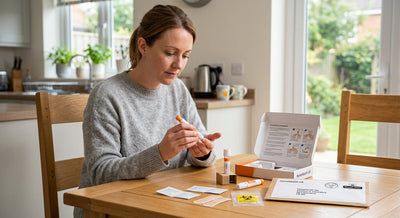
How at-home testing works
At-home testing is convenient, but finger-prick collection still needs preparation.
Before you collect your sample
- Read the official “how to collect your sample” guide first.
- Drink water and warm your hands.
- Follow the fasting instructions for your specific panel.
- Avoid strenuous exercise for the period stated in the instructions.
- Check whether you should pause non-prescribed biotin supplements.
- Take a morning sample if your kit requires one.
- Post the sample according to the return instructions, usually on the same day.
A finger-prick can feel uncomfortable, and some people find it difficult to collect enough blood. That is normal. If you feel faint or uneasy, stop, sit down and ask someone to stay with you. Use a new lancet on another finger only if the instructions allow it.
The Vitall Check sampling guide explains how to warm your hands, prepare the finger, fill the tube to the marked line, seal the sample and post it safely.
What makes an at-home kit worth considering?
Look for four practical things:
- Relevant markers: The panel should match your question.
- Clear timing instructions: Especially for cycle-related hormones.
- UKAS-accredited laboratory processing: This supports reliable laboratory standards.
- Plain-English reporting: You should receive a translation of raw data into understandable results, not just a spreadsheet of numbers.
Vitall Check samples are processed by UKAS-accredited partner laboratories, with digital results provided within 48 hours of laboratory receipt. The Insight Report is designed to explain where results sit within the laboratory reference ranges and help you prepare questions for your GP.
For wider context on using health data sensibly, read the Health Hub pillar guide: The Ultimate Guide to Women’s Longevity.
Safety reminders
⚠️ Do not use a home hormone test to diagnose yourself.
⚠️ Speak to your GP if symptoms are severe, persistent or affecting daily life.
⚠️ Discuss results with your GP if they are outside the laboratory reference range or do not fit how you feel.
⚠️ Seek medical support for unusual bleeding, severe pelvic pain, sudden vision changes or other worrying symptoms.
⚠️ If you are pregnant, trying to conceive, taking HRT or using hormonal contraception, ask your GP how this affects testing.
Summary
A female hormone test at home can help you organise useful information about reproductive hormones, thyroid function and, where relevant, cortisol. The value comes from choosing the right markers and taking the sample at the right time.
FSH, LH, oestradiol and progesterone are affected by cycle timing. Testosterone and SHBG may provide context when PCOS-related symptoms are being explored. Thyroid markers can help distinguish overlapping symptoms. Cortisol needs careful attention to the time of day.
Use your report as a clear manual for your results. Then take the useful questions to your GP. That is the safest way to turn a home blood test into a better healthcare conversation.
FAQ
Q: Can I use a menopause blood test at home to confirm menopause? A: Not always. NICE says people aged 45 or over with typical symptoms are usually assessed from symptoms and menstrual history, without confirmatory hormone testing. Blood tests may have a role in younger people or more complex situations.
Q: When should I take a female hormone test in the UK? A: If you still have periods, many reproductive hormone panels suggest cycle days 2–5, while progesterone is often checked around seven days before your expected period. Always follow the instructions for your specific kit.
Q: Is an at-home female hormone test as accurate as a clinic test? A: A correctly collected finger-prick sample can be suitable for laboratory analysis. Choose a service that uses a UKAS-accredited laboratory and follow the official collection guide carefully.
Q: Does Vitall Check diagnose PCOS, menopause or thyroid conditions? A: No. Vitall Check provides laboratory results and plain-English Insight Reports. It does not diagnose, treat, prescribe or provide medical advice.
Author
Vitall Check Editorial Team
The Vitall Check Editorial Team is dedicated to empowering individuals with evidence-based health information and clear, actionable insights. Every article is researched using peer-reviewed journals and official health resources, reflecting our commitment to the same high standards of accuracy as our laboratory testing services. Our goal is to make proactive wellness accessible, data-driven, and transparent.
Disclaimer: Vitall Check is not CQC registered. The content provided is for general information only, does not provide a diagnosis, and does not replace advice from a qualified healthcare professional. Our services do not include treatment, prescription, or medical advice that falls under CQC-regulated activities. Always consult with your GP or a qualified clinician before making significant changes to your healthcare regimen.