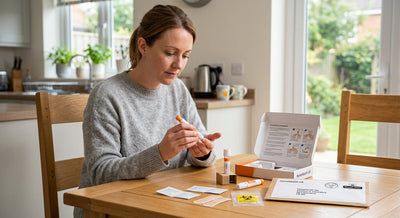
A private blood test can give you useful health information without turning your week into a game of appointment telephone tennis. But not every test offers the same value.
The headline price is only one part of the decision. You also need to check which biomarkers are included, where your sample is analysed, how quickly results arrive and whether anyone explains the numbers in plain English.
This guide explains what to look for when choosing a private blood test in the UK, including at-home and clinic options.
TL;DR:
- Simple private blood tests often cost less than broad health panels.
- At-home finger-prick kits are convenient, but sample collection must be done carefully.
- UKAS-accredited laboratory processing is an important quality check.
- Clinic venous draws may suit tests that need a larger sample.
- Check for delivery, phlebotomy, return postage and report fees before buying.
- A useful report should translate results into understandable context and help you prepare for a better GP conversation.
What's the best private blood test in the UK? The best option is one that matches your health goal, uses a UKAS-accredited laboratory, clearly shows what's included and gives you understandable results without replacing professional medical care.
How much does a private blood test cost in the UK?
There is no single standard price. Private testing costs depend on the number of biomarkers, the type of sample, the laboratory used and whether a consultation is included.
As a general shopping guide, you will usually see these bands:
- Single-marker tests: roughly £30–£70
- Small vitamin or hormone panels: roughly £70–£150
- General health panels: roughly £100–£250
- Large multi-system panels: roughly £175–£400 or more
- Clinic venous collection: often an additional fee, commonly around £30–£50
These are guide prices, not a fixed UK tariff. Always check the provider’s current product page before ordering.
For example, Vitall Check’s Essential Vitamins & Nutritional Health Test is listed at £95 and measures four nutritional biomarkers. Its Baseline Internal Health & Function Screen is listed at £105 and includes 14 biomarkers across areas such as liver, kidney and blood sugar markers.
A broader option, the Complete Health & Performance Blood Test, is listed at £199 and includes 50 biomarkers.
Think of a blood panel like a supermarket basket. Buying one item is cheaper, but a larger basket can offer better value when you actually need the full range. It is not better simply because it is bigger. You should pay for information that matches your question.

What can increase the price?
The advertised price does not always tell the whole story. Before you buy, check whether the following are included:
- Sample collection: Is the test at home, or must you pay for a clinic appointment?
- Phlebotomy: A clinic may charge separately for taking blood from your arm.
- Delivery: Is the kit delivered free, or added at checkout?
- Return postage: Is the sample return tracked and prepaid?
- Report fees: Is an explanation included, or do you receive numbers only?
- Repeat samples: What happens if the sample cannot be processed?
- Follow-up consultations: Is a GP or clinician appointment part of the package?
This is the difference between the price on the label and the price in the basket.
Vitall Check includes tracked delivery on orders over £100 and prepaid return postage for at-home samples. Its product pages also state that a clinic venous draw is available for an additional fee where clinic collection is suitable.
Are private blood tests accurate?
Accuracy depends on more than the brand name. It depends on:
- The sample type
- How the sample is collected
- How quickly it reaches the laboratory
- The laboratory’s equipment and quality systems
- Whether the test has been validated for that sample type
The NHS blood test guide explains that blood is usually taken from a vein in your arm, although finger-prick samples are used for some tests.
At-home finger-prick testing can be useful for screening and health monitoring. However, it is not identical to a clinic venous draw. You may collect less blood, and poor technique can affect the sample. Squeezing the finger too hard, using cold hands or failing to fill the tube to the marked line can create problems.
That does not make at-home testing unreliable. It means you need to follow the instructions properly and understand what the test can and cannot tell you.
A clinic draw is a little like using a full-sized camera instead of a phone camera. Both can produce a useful picture, but the larger setup may be preferred when more blood or more controlled collection is needed.
For some specialist, complex or clinically important tests, a clinician may recommend venous testing. If a home result is unexpected, discuss it with your GP rather than making healthcare decisions from one number.
Why UKAS accreditation matters
UKAS is the UK’s national accreditation body. Its medical laboratory accreditation is based on ISO 15189, a standard covering laboratory quality and competence.
You can read more about UKAS medical laboratory accreditation and the ISO 15189 medical laboratory standard.
In simple terms, UKAS accreditation is an external quality check. It relates to the laboratory’s processes, equipment, staff competence, sample handling and reporting systems. It is not just a claim that a company has printed on a website.
When comparing an at-home blood test UK provider, ask:
- Which laboratory processes the sample?
- Is the laboratory UKAS-accredited?
- Is the relevant test covered by its accredited scope?
- Are any tests sent elsewhere?
- How are samples tracked and reported?
- What happens if the sample is unsuitable?
Vitall Check says its samples are processed by independent UKAS-accredited partner laboratories using NHS-grade standards. The laboratory work is separate from Vitall Check’s educational reporting service.

At-home blood test UK or clinic test: which is better?
Neither option is automatically best. The right choice depends on your needs.
Choose an at-home test if you value:
- No travel to a clinic
- Privacy and convenience
- A flexible collection time
- Prepaid return postage
- A clear screening snapshot
- Monitoring changes over time
You may need to prepare first. Warm your hands, drink water, follow any fasting instructions and avoid collecting immediately after intense exercise if your kit guidance says not to. Some people find finger-prick collection difficult, so allow enough time and use the official how to collect your sample guide.
Choose a clinic draw if you prefer:
- A trained professional collecting the sample
- A larger venous sample
- Less responsibility for the collection process
- Testing that requires more specialised handling
Clinic testing can be more suitable for certain hormone or specialist investigations. If you have a medical condition, take medication or need a test for a specific clinical concern, speak with your GP or another qualified healthcare professional first.
What turnaround time should you expect?
Turnaround times vary. Some clinics offer same-day or next-day results for selected tests. Postal kits usually take longer because you need to allow time for delivery, collection, postage and laboratory receipt.
Vitall Check states that results are available within 48 hours of the laboratory receiving a suitable sample. This is an important detail. The clock normally starts when the lab receives the sample, not necessarily when you place the order.
To improve the chance of a smooth turnaround:
- Order early enough for delivery.
- Collect according to the official instructions.
- Post the sample on the recommended days.
- Use the return method provided.
- Avoid sending samples just before a weekend or bank holiday unless instructed.
What makes a private blood test worth the money?
Raw numbers are not always useful on their own. A result such as “ALT: 45 IU/L” needs context. You need to know what ALT is, where the result sits against the laboratory’s reference range and what questions to raise with your GP.
This is where the report matters.
Vitall Check’s Insight Report is designed as a plain-English manual for your results. It translates laboratory data into understandable explanations, highlights the relevant context and provides a personalised health action plan. It does not diagnose or prescribe treatment.
A report should help you understand the data, not pretend to be a replacement for medical care. Think of it as a map, not the driver. It can show you where you are starting from and help you plan a more informed GP conversation, but it cannot make clinical decisions for you.
How to choose your private blood test
Before you click “buy”, use this checklist:
- ✅ Does the panel match your actual health goal?
- ✅ Are the biomarkers clearly listed?
- ✅ Is the laboratory UKAS-accredited?
- ✅ Is the sample type suitable for the tests included?
- ✅ Is the turnaround time clearly explained?
- ✅ Are delivery and return postage included?
- ✅ Are clinic fees shown separately?
- ✅ Do you receive plain-English explanations?
- ✅ Is there guidance for discussing results with your GP?
- ✅ Does the provider explain its medical boundaries?
The cheapest test is not always the best value. The most expensive panel is not automatically the most useful either. Look for a reliable laboratory process, a suitable panel, clear reporting and a straightforward customer journey.
Summary: is a private blood test in the UK worth it?
A private blood test can be worthwhile when you want structured health information, faster access to laboratory results and a clearer starting point for a GP discussion.
At-home testing offers convenience, but careful preparation matters. Clinic testing may be preferable when a venous sample or professional collection is needed. Whatever option you choose, check the laboratory, the full price and the quality of the report before ordering.
Vitall Check offers at-home blood testing with results processed by UKAS-accredited partner laboratories, results within 48 hours of suitable sample receipt and an Insight Report that explains the data in plain English.
FAQs
Q: How much does a private blood test cost in the UK? A: Simple tests may cost around £30–£70, while broader panels commonly cost £100–£250 or more. Clinic collection and follow-up fees may be extra.
Q: Is an at-home blood test in the UK as accurate as a clinic test? A: At-home tests can provide useful results when the sample is collected correctly and processed by a suitable accredited laboratory. Venous clinic testing may be preferred for some specialist or complex tests.
Q: How quickly do private blood test results arrive? A: Timing varies by provider and sample type. Vitall Check provides results within 48 hours of receiving a suitable sample at the laboratory.
Author
Vitall Check Editorial Team
The Vitall Check Editorial Team is dedicated to empowering individuals with evidence-based health information and clear, actionable insights. Every article is researched using peer-reviewed journals and official health resources, reflecting our commitment to the same high standards of accuracy as our laboratory testing services. Our goal is to make proactive wellness accessible, data-driven, and transparent.
Disclaimer: Vitall Check is not CQC registered. The content provided is for general information only, does not provide a diagnosis, and does not replace advice from a qualified healthcare professional. Our services do not include treatment, prescription, or medical advice that falls under CQC-regulated activities. Always consult with your GP or a qualified clinician before making significant changes to your healthcare regimen.