You can buy a blood test in minutes. The harder part is working out whether you are paying for useful information, or just another dashboard full of numbers.
Thriva and Vitall Check take different approaches to at-home blood testing. Thriva focuses strongly on repeat testing, subscriptions and doctor-reviewed reports. Vitall Check focuses on one-off specialist panels, UKAS-accredited laboratory processing, fast results and plain-English Insight Reports.
So, is Thriva worth it in 2026? The honest answer depends on how often you want to test, how much guidance you need and whether you prefer a subscription or a single purchase.
TL;DR:
- Thriva suits you if you want regular testing and trend tracking.
- Thriva’s self-guided testing starts from £45, while its current general health tests show prices of £109–£117 per test.
- Thriva’s Compass programme costs £480 per year and includes three at-home blood tests.
- Vitall Check suits you if you want a one-off specialist panel, results in 48 hours after lab receipt and a plain-English Insight Report.
- Both services use at-home sample collection, so preparation and collection technique matter.
- Neither service replaces your GP. Use results to arrive informed for a better healthcare conversation.
Is Thriva worth it in 2026? Thriva can be worth it if you want regular at-home testing, trend tracking and doctor-reviewed reports; for a one-off test with specialist panels, rapid results and a plain-English Insight Report, Vitall Check may be a better fit.
Thriva vs Vitall Check: the quick comparison
| Feature | Thriva | Vitall Check |
|---|---|---|
| Main model | Self-guided testing and annual Compass membership | One-off at-home blood testing |
| Testing frequency | Monthly to annual options for self-guided testing; three tests yearly with Compass | Test when you choose |
| Sample method | At-home collection, including Thriva’s Autodraw option for some services | At-home finger-prick collection, with selected clinic options |
| Results | As little as 48 hours on listed panels, once the sample reaches the lab | Lab-verified results in 48 hours after lab receipt |
| Laboratory standards | Thriva states that Compass samples are processed by UKAS-accredited laboratories | Samples are processed by UKAS-accredited partner laboratories using NHS-grade standards |
| Reports | Doctor-reviewed reports and trend tracking | Plain-English Insight Report with a personalised health action plan |
| Best for | Ongoing tracking and structured monitoring | Focused, one-off testing and understandable results |
This is not a simple “winner takes all” comparison. It is more like choosing between a health diary and a detailed one-time check-in. Both can be useful, but they serve different habits.
How much does Thriva cost in 2026?
Thriva currently presents several routes rather than one simple price.
Self-guided testing
Thriva’s Ways to join page states that self-guided testing starts from £45. You choose from more than 50 biomarkers, and pricing depends on what you select.
That means the final cost can change considerably. A small panel may be relatively affordable, while a broad panel with added hormone, vitamin or cardiovascular markers costs more.
General health testing
Thriva’s current product pages list:
- Basic General Health Blood Test: £109 for a one-time purchase, or £98.10 at the displayed subscription rate.
- General Health Blood Test: £117 per test.
- Compass membership: £480 per year, with three tests spread across the year.
- Compass three-month trial: £150.
You can check the current Basic General Health Blood Test and General Health Blood Test pages before buying, because prices and packages can change.
What does the annual cost look like?
If you took the £109 basic test every three months, the simple yearly calculation would be:
£109 × 4 tests = £436 per year
That is lower than the £480 Compass membership. However, Compass includes three broader tests, a structured programme and access to additional features. It is not a direct four-tests-versus-three-tests comparison.
If you choose the £117 general health test every three months, the yearly total would be:
£117 × 4 tests = £468 per year
The important point is that Thriva’s subscription model does not mean unlimited testing. You still pay for each kit or programme. The subscription mainly structures the timing and may reduce the displayed price of certain tests.
What does Thriva test?
Thriva offers a broad menu that you can build around your goals. Its help centre lists options including:
- Cholesterol and triglycerides
- HbA1c
- Ferritin
- Vitamin D
- Vitamin B12 and folate
- Liver biochemistry
- Kidney function
- Thyroid profiles
- hs-CRP
- Testosterone
- Male hormone profiles
- Women’s hormone profiles
- Lipoprotein(a)
- Omega-3 and Omega-6
- PSA
The Thriva testing guide explains that you can add or remove tests before the kit is sent. Once the sample has been dispatched, the panel normally cannot be changed because the laboratory request has already been prepared.
That flexibility is useful if you know exactly what you want to check. It can also make the final price harder to predict at the start.
Thriva’s Compass programme begins with a broader baseline covering 33 markers across eight health areas, according to its Compass programme page. These areas include lipids, liver function, kidney function, sex hormones, micronutrients, thyroid function, blood sugar and inflammation.
Vitall Check offers a different panel structure. Its current range includes:
- The Baseline Internal Health & Function Screen, listed with 14 biomarkers.
- The Active Lifestyle & Wellness Panel, listed with 21 biomarkers.
- The Advanced Organ Health & Immune Profile, listed with 28 biomarkers.
- The Advanced Thyroid Health & Metabolism Panel, listed with 10 biomarkers.
The larger number is not automatically better. A panel should match the question you are trying to answer. Testing is a bit like packing for a trip: taking every item in the house does not make the suitcase more useful.

How do the sample methods compare?
Thriva uses at-home sample collection. Its product information says that some tests require two tubes and around 10 drops of blood. Thriva also offers its Autodraw collection device for relevant services, and selected tests may allow a nurse-taken sample for an additional fee.
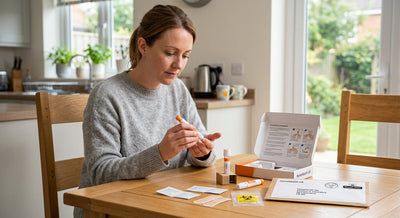
Vitall Check uses at-home finger-prick collection for its home testing service. Some people find this simple. Others need more time, warmer hands or help from another person.
Before collecting either sample:
- Drink water unless your test instructions say otherwise.
- Warm your hands.
- Follow the official collection guide carefully.
- Check whether fasting or a particular collection time is needed.
- Avoid testing soon after unusual illness or very intense exercise if the instructions advise this.
- Post the sample promptly using the return method provided.
You can read Vitall Check’s official guide to doing a home blood test before you begin.
A finger-prick sample is not magic. If the tube is underfilled, delayed or collected incorrectly, the laboratory may not be able to process every marker. That is not a personal failure. Home collection has a learning curve, just like using a new kitchen gadget without reading the instructions.
Which service gives results faster?
Thriva’s current product pages state that results can be available in as little as 48 hours after the laboratory receives the sample. Its help centre says results are usually uploaded within two working days, although some specialised tests may take longer.
Vitall Check states that digital results are delivered within 48 hours after lab receipt.
In both cases, the full journey also includes:
- Kit delivery.
- Sample collection.
- Return postage.
- Laboratory receipt.
- Processing and report preparation.
So “48 hours” normally refers to the time after the laboratory receives a usable sample. It does not necessarily mean you will order a kit on Monday morning and have the report by Monday evening.
How clear are the reports?
Thriva provides doctor-reviewed reports and trend charts. This is useful if your main goal is to repeat the same tests and see how results change over time.
Its Compass programme adds a more structured layer, including a broader baseline, follow-up testing and optional consultations.
Vitall Check takes a different approach. Its Insight Report is designed as a manual for your results. It translates raw data such as “ferritin: 42 µg/L” into clear explanations, shows where the result sits against the laboratory’s reference range and provides a personalised health action plan.
That does not make the report a diagnosis. It makes the numbers easier to understand before you speak with your GP or another qualified healthcare professional.

How important is laboratory accreditation?
Laboratory standards matter more than polished branding.
UKAS explains that ISO 15189 accreditation assesses medical laboratories for quality, competence, integrity and impartiality. It also applies to specific activities within a laboratory’s accreditation scope.
Thriva states on its Compass page that samples are processed by UKAS-accredited laboratories. You should still check the relevant provider information for the test and laboratory scope if that detail is important to your decision.
Vitall Check states that its samples are processed by UKAS-accredited partner laboratories using NHS-grade standards.
Accreditation supports confidence in how a result is produced. It does not turn a consumer report into a diagnosis, and it does not remove the need for clinical context.
If your result concerns you, take the full report to your GP. The NHS explains that private test results may not appear in the NHS App, even when the test was carried out by a reputable provider.
Is Thriva better for athletes and busy professionals?
Thriva may suit you if:
- You want to test every few months.
- You like tracking trends in an app.
- You want to choose individual biomarkers.
- You prefer a doctor-reviewed report.
- You are comfortable with recurring payments.
Vitall Check may suit you if:
- You want a one-off test rather than a subscription.
- You want a specialist panel built around a clear health goal.
- You value results within 48 hours after lab receipt.
- You prefer a plain-English explanation of your results.
- You want a personalised health action plan alongside the raw data.
For athletes, context is especially important. Heavy lifting can affect creatinine, while recent hard training can influence inflammation markers. A single result is a snapshot, not the whole film. If you train regularly, record your recent training load, sleep, hydration and any supplements before testing. That information can help you and your GP interpret the result more sensibly.
For The Data-Driven Patient, the best service is the one that answers your actual question without burying you in unnecessary numbers.

Final verdict: is Thriva worth it?
Thriva is worth considering if you want a structured, repeat-testing service. Its subscription options, broad biomarker menu, trend tracking and doctor-reviewed reports may suit people who want to monitor changes over time.
Vitall Check may be the better fit for a focused one-off test. It offers specialist panels, UKAS-accredited laboratory processing, NHS-grade standards, results in 48 hours after lab receipt and a plain-English Insight Report with a personalised health action plan.
Neither option replaces your GP. Use the results as an informed arrival: bring the report, note any symptoms and ask clear questions. Your GP may decide to repeat a result or arrange further tests, especially if a finding needs clinical follow-up.
Summary
Choose Thriva for:
- Repeat testing.
- Subscription-based tracking.
- A broad, customisable biomarker menu.
- Doctor-reviewed reports.
Choose Vitall Check for:
- One-off testing.
- Specialist health panels.
- Plain-English explanations.
- A personalised health action plan.
- Fast lab-verified results after sample receipt.
FAQs
Q: Is Thriva cheaper than Vitall Check? A: It depends on the panel and how often you test. Thriva offers self-guided testing from £45, while its current general health tests show prices of £109–£117. Vitall Check lists one-off panels from around £105. Compare the exact biomarkers and delivery costs before choosing.
Q: Does Thriva use UKAS-accredited laboratories? A: Thriva states that samples for its Compass programme are processed by UKAS-accredited laboratories. Check the current test information and relevant laboratory scope for the specific panel you plan to buy.
Q: Can a private blood test replace a GP appointment? A: No. Private testing can give you useful laboratory data and help you arrive informed for a GP conversation, but it does not replace diagnosis, treatment or clinical follow-up.
Author
Vitall Check Editorial Team
The Vitall Check Editorial Team is dedicated to empowering individuals with evidence-based health information and clear, actionable insights. Every article is researched using peer-reviewed journals and official health resources, reflecting our commitment to the same high standards of accuracy as our laboratory testing services. Our goal is to make proactive wellness accessible, data-driven, and transparent.
Disclaimer: Vitall Check is not CQC registered. The content provided is for general information only, does not provide a diagnosis, and does not replace advice from a qualified healthcare professional. Our services do not include treatment, prescription, or medical advice that falls under CQC-regulated activities. Always consult with your GP or a qualified clinician before making significant changes to your healthcare regimen.