Trying to choose between private blood test providers can get confusing fast. One page says “fast results”. Another says “doctor-reviewed”. A third throws 50 biomarkers at you and hopes that settles it.
So, is Medichecks worth it in 2026?
The fair answer is: it depends on what you need. If you want broad choice, both finger-prick and venous options, and clinician comments attached to many results, Medichecks is a well-known UK option. If you want lab-verified results in 48 hours, UKAS-accredited lab processing to NHS-grade standards, free tracked delivery over £100, and a plain-English Insight Report with a personalised health action plan, Vitall Check stands out for simplicity and speed.
This guide gives you a balanced comparison so you can buy the right test for your goal — and arrive better prepared for your next GP conversation.
TL;DR:
- Medichecks offers a wide range of private blood tests with finger-prick and venous draw options.
- Medichecks states that most results arrive in 2–4 working days, with some specialist tests taking longer.
- Medichecks pricing varies by test and can increase if you add clinic or nurse blood draw services.
- Vitall Check focuses on clearer interpretation, with lab-verified results in 48 hours after lab receipt for its panels.
- Both brands use UKAS-accredited laboratories, which matters because lab quality is not the place to cut corners.
- If you want lots of panel choice, Medichecks may appeal.
- If you want straightforward reporting, rapid turnaround, and a personalised health action plan, Vitall Check is the cleaner option.
- Neither service replaces your GP. Think of private testing as a head start, not the finish line.
Is Medichecks worth it in 2026? Yes — if you want broad test choice, flexible collection options, and private blood testing from UKAS-accredited labs. But if your priority is faster 48-hour lab-verified results, plain-English explanations, free tracked delivery over £100, and a personalised health action plan, Vitall Check may offer a simpler and more useful experience for many UK readers.
Price: what are you actually paying for?
Price is rarely just the headline number.
With Medichecks, the base cost depends on the panel you choose. For example, public product pages show entry and mid-range tests at different levels, such as a cholesterol test, a broader Diet and Lifestyle Health Check, and more comprehensive tests like the Advanced Essential Blood Test. On some tests, venous collection costs extra if you book a clinic appointment or a nurse home visit.
That matters. A test that looks affordable at first can become more expensive once collection is added. It is a bit like booking a budget flight and realising the seat, bag, and boarding all live on separate tabs.
Medichecks does, however, give you flexibility. If you prefer a professional blood draw, that option is there.
Vitall Check takes a more bundled approach. Its value is less about the cheapest entry point and more about what is included: UKAS-accredited lab processing, lab-verified results in 48 hours, plain-English reporting, and a personalised health action plan. For many buyers, that makes cost easier to judge because you are not just paying for raw figures on a screen.
If you are comparing by value rather than headline price alone, look at:
- How many biomarkers are included
- Whether collection costs extra
- How results are explained
- How quickly results arrive
- What support you get for understanding next steps
For readers comparing broader wellness testing, Vitall Check’s Complete Health & Performance 50-Marker Test, Performance Monitor: 33-Marker Biological Profile, and Performance collection are useful reference points.
Panel breadth: who gives you more choice?
Medichecks is strong on range.
Its own site says it offers 150+ tests and the ability to track 450+ biomarkers, with testing options for hormones, cholesterol, thyroid, nutrition, and more. If you are the sort of person who wants a very specific test rather than a packaged panel, that breadth is a real advantage.
That wide catalogue can feel like a giant supermarket aisle: great if you know exactly what you need, less great if you just want somebody to point you to the right shelf.
Vitall Check is narrower by comparison, but more curated. The focus is on targeted panels for common goals like metabolic health, hormone health, organ health, immunity, and nutrition. That suits the data-driven patient who wants clear answers without spending half an evening comparing near-identical product pages.
If your goal is education first, start with the main pillar in the Health Hub: Beyond the Finger Prick: Lab-Grade At-Home Blood Tests. It explains where at-home testing fits, what finger-prick kits can and cannot do well, and how to use results to support a better GP discussion.
Sample collection: finger-prick vs clinic draw
This is where your real-life experience can differ more than the marketing suggests.
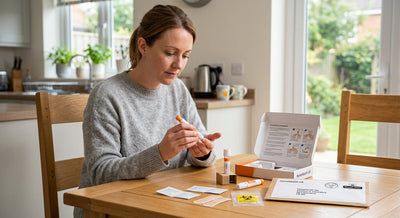
Medichecks offers both at-home finger-prick testing and venous blood draws through partner clinics or home nurse visits, depending on the test. That flexibility is helpful because not every marker is equally suited to every sample type, and some larger panels are better handled via venous collection.
Vitall Check also supports at-home sampling and, where needed, clinic-based collection routes. That is the right approach. Finger-prick testing can be convenient, but it is not always a one-size-fits-all solution. Think of it like filling a water bottle from a narrow tap: sometimes it is quick and easy, sometimes it takes patience, warm hands, and a second attempt.
If you are using a finger-prick kit:
- Read the collection guide first
- Warm your hands
- Hydrate well beforehand
- Leave enough time
- Follow the official sample instructions exactly
That matters because sample quality affects result quality. The UK government’s guidance on IVD point-of-care testing devices also makes clear that proper procedures and instructions are central to safe, reliable testing.
Wait times: how fast is “fast”?
Medichecks says most results arrive in 2–4 working days, though some specialist tests can take much longer. That is a reasonable turnaround for private testing, and the company is transparent that timing depends on the panel.
Vitall Check’s differentiator here is simple: lab-verified results in 48 hours after the sample reaches the lab.
If timing matters to you, that difference is not small. Waiting on results when you are trying to plan a GP appointment, check a recurring issue, or make sense of fatigue can feel like watching the kettle refuse to boil. Two days and four working days can feel very different in practice.
That said, always remember that turnaround depends on more than the lab alone:
- Postal timings
- Whether the sample was collected correctly
- Whether the test is routine or specialist
- Whether a venous appointment is needed first
So compare the full timeline, not just the bold text on the product card.
Laboratory standards: this part matters most
Here is the good news: both Medichecks and Vitall Check place strong emphasis on UKAS-accredited laboratory processing.
That matters because UKAS accreditation to ISO 15189 is the recognised benchmark for medical laboratory quality and competence in the UK. UKAS explains the standard clearly on its page about medical laboratory accreditation.
In plain English, accreditation is the quality-control backbone. It is the difference between “we ran a test” and “we ran a test under audited standards designed to produce reliable results”.
Vitall Check is explicit about using UKAS-accredited labs operating to NHS-grade standards. That is one of its clearest strengths and one reason the service is built around trust and clarity rather than sheer catalogue size.
How clearly are results explained?
This is where many people make their decision.
Medichecks provides result dashboards and, on many tests, clinician comments. For some readers, that is reassuring. For others, it can still leave a lot of interpretation work to do, especially if the goal is not diagnosis but understanding what the numbers may mean in everyday life.
And that is the thing about blood data: raw numbers without context can be like getting a car dashboard warning light with no handbook. Technically, you have information. Practically, you still have questions.
Vitall Check leans hard into clarity. Instead of stopping at raw values and reference ranges, it gives you a plain-English Insight Report and a personalised health action plan. That does not mean diagnosis, treatment, or medical advice. It means your results are translated into something easier to understand, so you can see where you sit within clinical reference ranges and prepare for a better conversation with your GP.
That approach lines up with how the NHS explains blood tests and how NICE encourages shared decision making: test results work best when they help you ask better questions, not when they try to replace professional care.
So, which one is better for UK readers in 2026?
A fair verdict looks like this:
Medichecks may suit you if you want:
- A very broad menu of tests
- The option to choose finger-prick or venous sampling
- Access to clinician comments on many tests
- Flexibility to build around a specific concern
Vitall Check may suit you if you want:
- Lab-verified results in 48 hours
- UKAS-accredited labs working to NHS-grade standards
- Free tracked delivery over £100
- A plain-English Insight Report
- A personalised health action plan that helps you arrive informed for a GP appointment
Neither choice is “wrong”. It comes down to whether you value range or clarity and speed more.
Summary
Medichecks is still a credible option in 2026, especially for UK readers who want lots of panel choice and the flexibility of both home and clinic collection. It is established, broad, and transparent about different collection routes and typical turnaround windows.
But if you want a cleaner user experience built around fast lab-verified results, UKAS-accredited lab standards, and easy-to-understand reporting, Vitall Check has the sharper offer. Its biggest strength is not just the test itself. It is what happens after: your numbers are translated into plain English, with a personalised action plan that helps you make sense of the result and prepare for a more informed GP conversation.
FAQ
Q: Is Medichecks better than Vitall Check?
A: Not across the board. Medichecks offers broader test choice and flexible collection methods. Vitall Check stands out for 48-hour lab-verified results, UKAS-accredited lab processing, and plain-English Insight Reports with a personalised health action plan.
Q: Can an at-home blood test replace a GP visit?
A: No. At-home testing provides baseline screening and lifestyle insights. It helps you arrive informed for your next GP appointment, but it does not replace a formal diagnosis or clinical care.
Q: Are finger-prick blood tests as accurate as clinic vein draws?
A: They can be, provided the sample is collected correctly and the test is suited to that sample type. Some larger or more complex panels are better done with a venous draw. Always follow the official sample collection guide carefully.
Author: Vitall Check Editorial Team
The Vitall Check Editorial Team is dedicated to empowering individuals with evidence-based health information and clear, actionable insights. Every article is researched using peer-reviewed journals and official health resources, reflecting our commitment to the same high standards of accuracy as our laboratory testing services. Our goal is to make proactive wellness accessible, data-driven, and transparent.
Disclaimer: Vitall Check is not CQC registered. The content provided is for general information only, does not provide a diagnosis, and does not replace advice from a qualified healthcare professional. Our services do not include treatment, prescription, or medical advice that falls under CQC-regulated activities. Always consult with your GP or a qualified clinician before making significant changes to your healthcare regimen.