A full blood count sounds technical. It is not.
At its core, an FBC checks the main working parts of your blood: oxygen carriers, immune defenders and clotting cells. Your GP may order one when you have unexplained tiredness, repeated infections, unusual bruising or other symptoms.
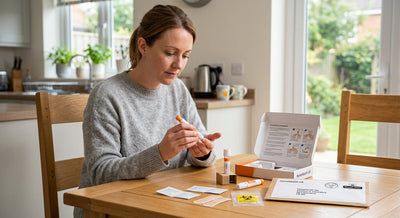
You can also choose a private full blood count test at home in the UK, depending on the panel you select. The sample is collected by finger-prick and sent to a laboratory for analysis. The key is understanding what the numbers mean , and what they do not mean.
TL;DR:
- An FBC measures red blood cells, haemoglobin, haematocrit, white blood cells and platelets.
- GPs use it to investigate symptoms and monitor certain conditions or treatments.
- Red cells carry oxygen. White cells support your immune response. Platelets help blood clot.
- A result outside the laboratory reference range is not automatically a diagnosis.
- At-home testing needs careful preparation, a clean sample and same-day posting.
- Vitall Check samples are processed by UKAS-accredited laboratories, with results and plain-English Insight Reports provided through a secure portal.
- Use your results to arrive informed for a better GP conversation.
What does a full blood count test check? A full blood count checks your red blood cells, haemoglobin, haematocrit, white blood cells and platelets to provide a broad picture of oxygen transport, immune activity and blood clotting.
What is a full blood count?
A full blood count, or FBC, is a common blood test that measures the number and features of several blood cell types.
The NHS explains that an FBC measures the number of blood cells in your blood. It may help a GP investigate symptoms such as tiredness, or check for conditions including iron deficiency anaemia.
Think of your blood as a busy transport network:
- Red blood cells are the delivery vans carrying oxygen.
- Haemoglobin is the part inside them that holds the oxygen.
- White blood cells are your security team.
- Platelets are the repair crew that helps seal leaks.
An FBC checks whether these teams are present in the expected numbers and whether their basic features need a closer look.
What does an FBC measure?
1. Red blood cells
Red blood cells carry oxygen from your lungs around your body. Your FBC may show:
- Red blood cell count (RBC): The number of red blood cells in a given amount of blood.
- Mean cell volume (MCV): The average size of those cells.
- Mean cell haemoglobin (MCH): The average amount of haemoglobin inside each cell.
- Red cell distribution width (RDW): How much the cells vary in size.
These extra measurements can help a GP understand the pattern if your red blood cell results need further investigation.
Small red blood cells can be seen with some forms of iron deficiency. Larger cells can occur for several reasons, including vitamin B12 or folate deficiency. However, no single FBC marker explains the cause by itself.
2. Haemoglobin
Haemoglobin, often shown as Hb or HGB, is the oxygen-carrying protein inside red blood cells.
If haemoglobin is below the laboratory reference range, your GP may consider anaemia. Anaemia can be linked with tiredness, weakness, pale skin or breathlessness, but symptoms and causes vary.
Haemoglobin is like the number of seats available on your oxygen buses. If there are fewer buses or fewer seats, less oxygen may be carried around your body. That comparison helps explain the result, but it cannot tell you why the number changed.
Your GP may look at your diet, symptoms, menstrual history, medicines and other tests. They may request iron, vitamin B12 or folate tests if appropriate.
3. Haematocrit
Haematocrit, or HCT, shows the proportion of your blood made up of red blood cells.
It is reported as a fraction or percentage, depending on the laboratory. Haematocrit is read alongside haemoglobin and the red cell count, not in isolation.
Hydration can also affect how concentrated your blood appears. This is one reason preparation and context matter. A blood result is more like a photograph than a full documentary: it captures one moment, not every factor affecting your body.
4. White blood cells
White blood cells help your body respond to infections and inflammation. An FBC may show:
- Total white blood cell count (WBC)
- Neutrophils
- Lymphocytes
- Monocytes
- Eosinophils
- Basophils
The breakdown is called a white cell differential.
A raised or lowered result can happen for many reasons. Recent illness, inflammation, stress, medicines and other health conditions may all play a part. The type of white cell affected can provide more context, but it does not confirm a diagnosis on its own.
Imagine checking how many security staff are working at a building. A larger team may mean there is an incident to manage. It may also mean the building is preparing for an expected event. You need more information before deciding what is happening.
5. Platelets
Platelets help your blood form clots after an injury. Your FBC checks the number of platelets and, in some cases, their size.
A lower platelet count may be linked with bruising or bleeding. A higher count can occur after infection, inflammation, bleeding or other changes. Your GP will consider the result alongside your symptoms, medical history and any previous blood tests.
Platelets are the emergency repair crew of your bloodstream. They help patch a damaged wall, but the number of workers alone does not explain why a repair was needed.
For a detailed breakdown of the markers included in an FBC, see this Gloucestershire Hospitals NHS Foundation Trust FBC guide.

Why does your GP order an FBC?
Your GP may request an FBC to:
- Investigate persistent tiredness or breathlessness.
- Look for clues linked with anaemia.
- Review repeated infections or fever.
- Investigate unexplained bruising or bleeding.
- Monitor an existing condition.
- Check the effects of certain medicines.
- Support pre-operative checks.
- Compare your latest results with earlier tests.
The Lab Tests Online UK FBC guide explains that doctors may request an FBC as part of a routine check, when symptoms are present, before surgery or when monitoring treatment.
An FBC is a broad screening test. It can show that something needs a closer look, but it rarely explains the whole story alone. Your GP may compare it with your symptoms, examination, previous results and other tests.
How does a full blood count test at home work in the UK?
At-home FBC testing uses a small capillary blood sample collected from your fingertip.
When you choose a Vitall Check panel that includes full blood count markers, the process is:
- Order your panel: Select the test that matches the information you want to review.
- Prepare at home: Read the instructions before starting. Wash and dry your hands.
- Warm your hands: Cold fingers can make collection harder. Warm them under running water, then dry them fully.
- Use the safety lancet: Choose the side of your middle or ring finger. You may feel a brief pinch.
- Fill the tube: Let the blood drops fall into the collection tube up to the marked line. Avoid hard squeezing, which can affect sample quality.
- Seal and mix: Close the tube and gently invert it as instructed.
- Post it promptly: Place the sample in the biohazard bag and prepaid envelope. Follow the official Vitall Check sample collection guide and post it the same day.
Some people find finger-prick collection straightforward. Others find it difficult to collect enough blood. That is normal. Hydration, warm hands and a clean, well-lit workspace can help. If you feel faint or uneasy, stop, sit down and ask someone to stay with you.
Check your kit instructions carefully. An FBC alone may not need fasting, but a wider panel may have preparation requirements.
Why do UKAS-accredited laboratories matter?
After your sample is posted, it is processed by a laboratory rather than interpreted at home.
Vitall Check uses UKAS-accredited laboratory partners operating to NHS-grade standards. UKAS accreditation is specific to the laboratory’s accredited scope. It means the relevant testing activities have been assessed against quality and competence requirements.
The UKAS medical laboratory accreditation page explains that ISO 15189 accreditation assesses factors including laboratory competence, impartiality and quality management.
That matters because reliable results depend on more than the analyser. Sample handling, storage, staff processes and reporting all form part of the journey.
Vitall Check provides results in a secure portal, alongside an Insight Report that translates raw laboratory data into clear, plain-English explanations. It helps you understand where a result sits against the laboratory reference range and prepare questions for your GP.
For a broader panel containing blood count, nutritional, metabolic and organ health markers, see the Complete Health & Performance Blood Test.
What should you do with an FBC result?
Do not treat one result as a final answer.
Instead:
- Check the laboratory reference range shown on your report.
- Note whether the result is slightly or clearly outside that range.
- Compare it with previous results if available.
- Think about recent illness, exercise, hydration, medicines and supplements.
- Write down questions for your GP.
- Contact your GP about results outside the reference range, especially if you have symptoms.
A result within the reference range does not rule out every health problem. A result outside it does not automatically mean something serious. Your GP is the right person to interpret the result in your full clinical context.
For more guidance on reading blood results without jumping to conclusions, read Why context matters more than the number.
Summary
An FBC gives your GP a useful overview of your blood cells.
It checks the cells that carry oxygen, support immune responses and help blood clot. That makes it a valuable starting point when investigating symptoms or monitoring health.
An at-home FBC can make sample collection more convenient, but careful preparation still matters. Follow the official collection guide, warm your hands, avoid forceful squeezing and post your sample promptly.
Most importantly, use the result as information , not a diagnosis. Clear laboratory data can help you arrive informed for a better conversation with your GP.
FAQ
Q: Can I do a full blood count test at home in the UK? A: Yes. Some private UK testing panels include FBC markers collected by finger-prick at home and processed by an accredited laboratory. Check exactly which markers are included before ordering.
Q: Does an FBC test need fasting? A: An FBC alone usually does not require fasting. If it is included within a wider panel, follow that kit’s preparation instructions because other markers may have different requirements.
Q: Are at-home finger-prick blood tests accurate? A: They can provide useful results when the sample is collected correctly and processed by a suitable laboratory. Warm your hands, follow the instructions carefully and post the sample promptly.
Q: What does an abnormal FBC mean? A: It means one or more results sit outside the laboratory reference range. It does not provide a diagnosis by itself. Your GP will consider your symptoms, medical history and any other tests.
Author
Vitall Check Editorial Team
The Vitall Check Editorial Team is dedicated to empowering individuals with evidence-based health information and clear, actionable insights. Every article is researched using peer-reviewed journals and official health resources, reflecting our commitment to the same high standards of accuracy as our laboratory testing services. Our goal is to make proactive wellness accessible, data-driven, and transparent.
Disclaimer: Vitall Check is not CQC registered. The content provided is for general information only, does not provide a diagnosis, and does not replace advice from a qualified healthcare professional. Our services do not include treatment, prescription, or medical advice that falls under CQC-regulated activities. Always consult with your GP or a qualified clinician before making significant changes to your healthcare regimen.