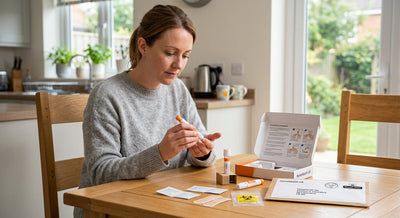
Cortisol is often called your “stress hormone”. That description is not wrong, but it is incomplete.
Cortisol also helps manage energy, blood sugar, blood pressure and your body’s response to physical demands. It follows a daily rhythm, which means when you test matters almost as much as what you test.
Interest in cortisol testing has grown quickly on TikTok and Instagram. A 2026 Society for Endocrinology BES abstract examined how social media marketing can oversimplify cortisol and testosterone, turning complex hormones into explanations for almost every symptom. Read the abstract on cortisol and testosterone misinformation.
The sensible approach is simple: use testing to gather useful information, not to self-diagnose.
TL;DR:
- Cortisol is a useful hormone, not a simple “stress score”.
- Cortisol usually runs higher in the morning and lower later at night.
- At-home testing may use capillary blood or saliva, but these methods are not interchangeable.
- Vitall Check’s cortisol test uses a morning finger-prick blood sample.
- Warm hands, drink water and follow the official collection guide carefully.
- A single result cannot diagnose Cushing’s syndrome, Addison’s disease or “adrenal fatigue”.
- Use your result as an informed starting point for a better GP conversation.
What's a cortisol test at home? A cortisol test at home lets you collect a blood or saliva sample yourself, which is then analysed by a laboratory. The result shows cortisol at a specific time and must be interpreted alongside timing, symptoms, medicines and the laboratory’s reference range.
Key reminders before you test cortisol
Cortisol changes throughout the day. A result taken at 8:00 am is not interpreted in the same way as one taken at 4:00 pm.
Your sleep, illness, exercise, caffeine, medicines and recent stress can also affect the result. The number may be accurate, but it may not represent your usual pattern.
Do not stop prescribed steroid medicines before testing unless your GP tells you to. Steroids can include tablets, inhalers, creams, injections and other treatments.
If you are under 18, pregnant, acutely unwell or being assessed for an adrenal condition, speak with your GP before choosing a private test.
What does cortisol do?
Cortisol is made by your adrenal glands, which sit above your kidneys. It helps your body respond when demand rises. That demand might come from illness, exercise, lack of sleep or emotional pressure.
Think of cortisol as your body’s thermostat. It helps turn certain processes up when needed, then supports a return to normal afterwards.
Cortisol also works like a daily timetable. Levels are generally higher after waking and gradually fall later in the day. This daily rise and fall is called your cortisol rhythm.
That is why “high” or “low” means very little without the collection time. A morning result and a late-evening result are like comparing the temperature at breakfast with the temperature after dark. Both may be correct, but they answer different questions.

How does at-home cortisol testing work?
Blood cortisol testing
Vitall Check’s Cortisol Levels & Daily Rhythm Test uses an at-home capillary blood sample collected by finger-prick.
For this test, the sample should be collected in the morning, before 10:00 am. The product guidance also recommends:
- An eight-hour fast, with water allowed.
- No heavy exercise for 24 hours beforehand.
- Pausing biotin supplements for two days, where appropriate.
- Posting the sample Monday to Thursday.
The sample is sent to an independent UKAS-accredited partner laboratory. Results are usually available within 48 hours of the laboratory receiving the sample.
A blood test gives you a cortisol snapshot at the time of collection. It does not map your full day from waking to bedtime.
Saliva cortisol testing
Saliva testing can be used for specific questions about free cortisol or late-night cortisol. Some clinical investigations use several saliva samples collected at set times.
For suspected Cushing’s syndrome, the NICE Clinical Knowledge Summary on Cushing’s investigations notes that several late-night saliva samples may be needed because cortisol varies from day to day.
Saliva and blood are not interchangeable. They use different sample types, collection methods and reference ranges. Follow the instructions for the exact test you have rather than borrowing timing advice from another kit.
When should you take a cortisol test at home?
For Vitall Check’s home blood cortisol test, collect your sample in the morning before 10:00 am.
Choose a day when you can take your time. Avoid testing straight after a hard training session, a disrupted night or an acute illness if you are trying to understand your usual baseline. If you do test during one of these situations, record it because the information may still help explain the result.
Before collection:
- Drink water. Dehydration can make finger-prick collection harder.
- Warm your hands. Wash them in warm water and dry them fully.
- Read the official how to collect your sample guide.
- Use the lancet exactly as shown.
- Fill the tube to the marked line.
Some people collect a finger-prick sample quickly. Others need more time. Your hands are not a tap that instantly turns on; warmth and blood flow matter.
If you feel faint or uneasy, stop and sit or lie down. Ask someone to stay nearby if that makes you more comfortable. If collection is difficult, contact Vitall Check rather than repeatedly pricking the same finger.

What do cortisol test results mean?
Your result should be read alongside:
- The time and date of collection.
- The laboratory reference range.
- Your sleep, exercise and recent health.
- Medicines and supplements.
- Your symptoms and medical history.
Vitall Check’s Insight Report is designed as a plain-English manual. It translates raw laboratory data into clear explanations and context. It does not diagnose a condition or provide medical advice.
A result within the reference range does not explain every symptom. A result outside the range does not prove that you have a disease.
Think of the result as a dashboard warning light. It may tell you that something deserves attention, but it cannot identify the cause on its own.
Symptoms linked with cortisol concerns can overlap with many other conditions. Tiredness, poor sleep, mood changes, weight changes and reduced exercise tolerance are not specific to one hormone.
If your GP is assessing possible adrenal insufficiency, NICE recommends an 8:00–9:00 am serum cortisol test in appropriate situations, with further decisions based on the result and clinical context. Read the NICE adrenal insufficiency recommendations.
For possible Cushing’s syndrome, the NHS explains that testing may involve blood, urine or saliva, followed by further assessment where needed. Read the NHS guide to Cushing’s syndrome.
Cortisol, testosterone and social media claims
Cortisol and testosterone are both popular subjects online. That does not make them simple to interpret.
Be cautious when a video claims that one cortisol result explains your body shape, motivation, sleep, libido or training performance. Also be cautious when a cortisol result is used to sell supplements or testosterone products.
Do not start, stop or change medicines based on an influencer’s interpretation. Do not treat “adrenal fatigue” as a confirmed diagnosis. If symptoms persist, speak with your GP.
A useful result supports an informed arrival: you bring your report, collection time, symptoms and relevant medication history to the appointment. Your clinician can then decide whether further assessment is appropriate.

Summary: use cortisol testing as context, not a verdict
A cortisol test at home can give you a useful, laboratory-analysed result without a clinic visit. The key is to collect it at the correct time and follow the instructions carefully.
Vitall Check’s cortisol test uses a morning finger-prick blood sample processed by UKAS-accredited partner laboratories. The Insight Report explains the result in plain English, but it does not diagnose, treat, prescribe or provide medical advice.
Use your report to support a better GP conversation, not to replace one.
Frequently asked questions
Q: Is a cortisol test at home accurate? A: A correctly collected sample can be analysed by a UKAS-accredited laboratory. Accuracy still depends on timing, preparation, collection and correct posting.
Q: Can a home cortisol test diagnose Cushing’s syndrome or Addison’s disease? A: No. These conditions require clinical assessment and, where appropriate, specialised testing arranged through a GP or endocrinology service.
Q: Is blood or saliva better for cortisol testing? A: Neither is automatically better. Blood and saliva answer different questions and use different reference ranges. Follow the method and timing instructions for your specific test.
Author
Vitall Check Editorial Team
The Vitall Check Editorial Team is dedicated to empowering individuals with evidence-based health information and clear, actionable insights. Every article is researched using peer-reviewed journals and official health resources, reflecting our commitment to the same high standards of accuracy as our laboratory testing services. Our goal is to make proactive wellness accessible, data-driven, and transparent.
Disclaimer: Vitall Check is not CQC registered. The content provided is for general information only, does not provide a diagnosis, and does not replace advice from a qualified healthcare professional. Our services do not include treatment, prescription, or medical advice that falls under CQC-regulated activities. Always consult with your GP or a qualified clinician before making significant changes to your healthcare regimen.