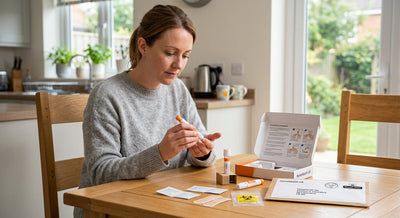
Taking control of your health often starts with understanding the data your body is already sending you. A Full Blood Count (FBC) is perhaps the most fundamental health check available today. It’s frequently the first test a doctor orders because it provides a broad overview of your general wellbeing, acting as an early warning system for everything from simple fatigue to more complex immune responses.
By choosing to perform a Full Blood Count at home, you aren't just skipping a waiting room; you're gathering the clinical-grade data needed for an "informed arrival" at your next GP appointment. This guide will walk you through every component of the FBC, explaining what those technical acronyms actually mean for your longevity and daily energy.
TL;DR:
- An FBC measures red cells (oxygen), white cells (immunity), and platelets (clotting).
- It's a foundational "MOT" for your health, used to screen for anaemia, infection, and inflammation.
- At-home testing allows you to track these markers over time without needing a clinic visit.
- Results help you prepare for a more productive conversation with your GP.
- Correct sample collection is vital, always follow the provided guide carefully.
What's a Full Blood Count?
A Full Blood Count (FBC) is a common clinical test that evaluates the three main types of cells in your blood: red blood cells, white blood cells, and platelets. It's used by healthcare professionals to monitor general health and screen for conditions like anaemia or infection.
What Exactly is a Full Blood Count?
Think of your blood as a complex logistics network flowing through your body. The Full Blood Count is essentially a "fleet inspection." It counts the number of vehicles on the road and checks their condition to ensure the delivery of oxygen and the defence against intruders are both running smoothly.
When you order a Basic Health Check Blood Test, the FBC is the engine room of that report. It provides a snapshot of your physiological state, helping to identify why you might be feeling tired or why your recovery after exercise has slowed down.
The Red Blood Cell Fleet: Your Oxygen Carriers
Red blood cells (RBCs) are the most numerous cells in your blood. Their primary job is to pick up oxygen from your lungs and drop it off at your tissues and organs.
You can imagine red blood cells as a fleet of delivery trucks. To keep your body running, you need a certain number of trucks on the road (RBC count), and each truck needs enough space to carry its cargo (haemoglobin). If the fleet is too small, or the trucks are poorly maintained, your "deliveries" of oxygen will be delayed, leading to the breathlessness and fatigue associated with iron deficiency.
1. Haemoglobin (Hb)
Haemoglobin is the protein inside your red blood cells that actually holds onto the oxygen. It’s the "cargo" in our delivery truck analogy. In the UK, the NHS typical range for adult men is roughly 130–170 g/L, and for women, it's 115–150 g/L. If your levels are below this, you may be anaemic.
2. Red Blood Cell Count (RBC)
This is the total number of red cells in a specific volume of blood. While a high count can sometimes happen due to dehydration or smoking, a low count usually points towards anaemia or nutritional deficiencies, such as a lack of Vitamin B12.
3. Haematocrit (Hct)
Haematocrit measures the percentage of your blood that is made up of red blood cells. Think of this as the "traffic density" on your roads. If your blood is too thick (high haematocrit), it might be harder for your heart to pump. If it's too thin (low haematocrit), it's a sign that your oxygen-carrying capacity is diminished.

Understanding the Red Cell Indices
When you receive your Vitall Insight Report, you'll see several markers with names like MCV and MCH. These are the "Red Cell Indices." They don't just tell us how many cells you have; they tell us about the quality and size of those cells.
- MCV (Mean Cell Volume): This is the average size of your red blood cells. If they're too big (macrocytic), it often suggests a Vitamin B12 or folate deficiency. If they're too small (microcytic), it's a classic sign of iron deficiency.
- MCH (Mean Cell Haemoglobin): This is the average amount of haemoglobin in each red cell. It usually moves in tandem with MCV.
- RDW (Red Cell Distribution Width): This measures the variation in size of your red blood cells. In a healthy person, most red cells should be roughly the same size. If the "trucks" in your fleet are all different shapes and sizes, it’s often an early sign that your body is struggling to produce new, healthy cells.
The White Blood Cell Security Team
If red cells are delivery trucks, white blood cells (WBCs) are your body's security team. They are the primary components of your immune system, patrolling your blood for bacteria, viruses, and other foreign invaders.
A "Total White Cell Count" gives you the overall size of your security force. However, the "differential" is more informative, as it breaks down that force into specialised units.
The Specialised Units
- Neutrophils: These are the first responders. They are the most common type of white blood cell and specialise in fighting off bacterial infections. According to NICE guidelines on neutropenia, a low count can leave you more vulnerable to infections.
- Lymphocytes: These are the "intelligence officers." They produce antibodies and remember past invaders so your body can fight them off faster next time. High levels often indicate a viral infection.
- Monocytes: The "cleanup crew." They arrive after the initial battle to remove dead cells and debris.
- Eosinophils and Basophils: These units deal with "internal protests", namely allergies and parasites. High levels might suggest you are dealing with an allergic reaction or asthma.
Platelets: The Emergency Repair Crew
Platelets are small cell fragments that play a massive role in longevity. Their job is to stop you from bleeding. If you get a cut, platelets rush to the scene and stick together to form a plug.
You can think of platelets as the emergency repair crew that carries bags of quick-setting cement. If they are too low (thrombocytopenia), you might bruise easily or find that small cuts take a long time to stop bleeding. If they are too high, your repair crew might be a bit too enthusiastic, potentially increasing the risk of unwanted clots.

Why a Full Blood Count Matters for Longevity
As we age, our bodies become less efficient at producing and maintaining these vital blood cells. Monitoring your FBC over time allows you to spot trends before they become clinical problems. For those focused on longevity and anti-ageing, the FBC serves as a baseline.
If you're an athlete, these markers are even more critical. Intense training can temporarily alter your white cell count or affect your red cell turnover. By tracking these markers, you can ensure your body is recovering adequately and that your "delivery trucks" are keeping up with the increased oxygen demands of your sport.
How to Test Your Full Blood Count at Home
The process is designed for convenience, but it does require a bit of preparation to ensure the laboratory receives a high-quality sample. Because the FBC looks at the physical cells themselves, the sample must be processed quickly.
1. Preparation is Key
Hydration is the most important factor. Drink one or two glasses of water 30–60 minutes before you collect your sample. This makes your blood flow more easily and ensures you can fill the collection tube to the required line. Warm your hands in warm water for a few minutes; warm hands mean better circulation.
2. The Collection Process
Wipe the chosen finger with the provided swab and use the lancet to make a small prick. It's normal to feel a small pinch. Wipe away the first drop of blood, then gently massage your finger to encourage more drops into the tube. If you encounter any difficulties, we always recommend following our official collection guide to minimise frustration.
3. Rapid Lab Analysis
Once your sample is ready, pop it into the pre-paid envelope and drop it in a post box as soon as possible. Our partner UKAS-accredited labs process the samples to the same high standards as the NHS. You'll receive your results in your secure portal, usually within 48 hours.
Interpreting Your Results: The Informed Arrival
When you receive your Vitall Insight Report, you won't just get a list of raw numbers. We translate the data into plain English, helping you understand where you sit within the clinical reference ranges.
It’s important to remember that a single abnormal result isn't always a cause for panic. For example, if you've recently had a cold, your white cell count might be higher than usual. However, having this data in hand allows you to have a much more productive conversation with your GP. Instead of saying "I feel tired," you can say, "My at-home FBC shows my haemoglobin is at the lower end of the range; could we explore my iron levels?"
This is what we call an "informed arrival", using data-driven insights to advocate for your own health within the clinical system.

Summary: Your Health MOT
The Full Blood Count is the ultimate foundational test. Whether you are tracking your fitness performance, managing your energy levels, or proactively monitoring your health as you age, the FBC provides the clarity you need.
By measuring your red cell "delivery trucks," your white cell "security team," and your platelet "repair crew," you gain a comprehensive view of your internal environment. At-home testing provides a discreet, rapid, and professional-grade way to stay on top of these markers without the wait times often associated with routine primary care.
Key Takeaways:
- Foundation: The FBC is a vital "first-look" test for overall health.
- Clarity: It explains why you might be experiencing fatigue or slow recovery.
- Convenience: At-home testing with UKAS-accredited labs offers clinical accuracy with the comfort of home.
- Advocacy: Use your results to prepare for a better conversation with your doctor.
FAQ: People Also Ask
Q: Can an at-home Full Blood Count replace a visit to my GP?
A: No. At-home testing provides baseline screening and lifestyle insights. It allows for an "informed arrival" at your GP surgery, giving your doctor clinical-grade data to review, but it does not replace a formal diagnosis or a clinical consultation.
Q: Are finger-prick blood tests as accurate as clinic vein draws?
A: Yes, provided the sample is collected correctly. Vitall Check samples are processed in UKAS-accredited laboratories using the exact same standard procedures as traditional venous blood tests used by the NHS.
Q: Why's my white blood cell count higher than the normal range?
A: A high white cell count often means your body is fighting off an infection, inflammation, or an allergy. It’s your immune system’s natural response to a perceived threat. If your levels remain high outside of a recent illness, you should discuss this with your GP.
Q: When's the best time to take an FBC test?
A: For most people, taking the test in the morning while hydrated is best for consistency. If you're tracking your health over time, try to take subsequent tests at roughly the same time of day to keep your data comparable.
Author: Vitall Check Editorial Team
The Vitall Check Editorial Team is dedicated to empowering individuals with evidence-based health information and clear, actionable insights. Every article is researched using peer-reviewed journals and official health resources, reflecting our commitment to the same high standards of accuracy as our laboratory testing services. Our goal is to make proactive wellness accessible, data-driven, and transparent.
Disclaimer: Vitall Check is not CQC registered. The content provided is for general information only, does not provide a diagnosis, and does not replace advice from a qualified healthcare professional. Our services do not include treatment, prescription, or medical advice that falls under CQC-regulated activities. Always consult with your GP or a qualified clinician before making significant changes to your healthcare regimen.