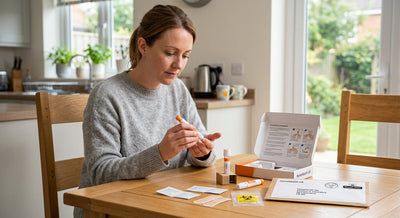
A blood test used to mean booking an appointment, sitting in a waiting room and having blood taken from your arm. Today, many people in the UK can collect a small finger-prick sample at home and send it to a laboratory for testing.
But how does an at-home blood test work? What does it cost? And can the results actually help you speak with your GP?
TL;DR:
- At-home blood tests use a small lancet to collect capillary blood from your fingertip.
- Your sample is posted to a laboratory for analysis.
- Choose a provider using a UKAS-accredited laboratory.
- Preparation may include hydration, warm hands, fasting and avoiding hard exercise.
- Vitall Check provides lab-verified results within 48 hours, plus a plain-English Insight Report.
- At-home testing supports an informed GP conversation. It does not diagnose or replace medical care.
What's an at-home blood test in the UK? It’s a finger-prick blood test you collect at home and send to a laboratory for analysis. Results can help you understand your blood markers and prepare for a more informed conversation with your GP.
How does an at-home blood test work?
An at-home blood test uses a single-use lancet to make a tiny puncture on the side of your fingertip. You then collect several drops of blood into a small tube.
The sample is sent to a laboratory. Depending on the panel, the lab may measure markers linked to areas such as:
- Nutritional health
- Hormonal health
- Metabolic health
- Liver and kidney function
- Cholesterol and cardiovascular risk
- Immune and inflammation markers
It is best to think of the result as a snapshot, rather than the whole film. It shows what your blood looked like when you took the sample. Sleep, hydration, recent exercise, illness, alcohol and medication can all affect certain markers.
The NHS explains that blood tests can be used to check general health, investigate symptoms and monitor certain conditions. An at-home test follows the same broad idea, but you collect the sample yourself.
STEP 1: Choose the right test
Start with your reason for testing.
You may want a broad picture of your health. Or you may be interested in a specific area, such as vitamins, hormones or kidney markers.
Read the marker list before ordering. Do not choose a panel simply because it has the largest number of results. More numbers do not always mean more useful information.
For example, Vitall Check’s Complete Health & Performance Blood Test includes 50 biomarkers across areas such as liver health, kidney function, blood sugar, hormones, cholesterol, vitamins and blood cells.
A smaller panel may make more sense if you have one clear area of interest. The test page should explain:
- Which markers are included
- Whether fasting is needed
- What time of day to collect your sample
- Whether finger-prick collection is suitable
- How and when to return the sample
Some tests are not suitable for home finger-prick collection. Certain investigations need a larger volume of blood or specific handling. If a provider recommends a venous blood draw, follow that guidance.
STEP 2: Prepare properly
Preparation can make collection easier and reduce the chance of a sample problem.
Before testing, check your specific instructions. General preparation may include:
- Drink water: Stay well hydrated before collecting your sample.
- Warm your hands: Run them under warm water for around two minutes if they feel cold.
- Fast if required: Some panels may need an eight-hour fast. Water is usually allowed, but follow your kit instructions.
- Avoid alcohol: Your instructions may advise avoiding alcohol for 24 hours.
- Avoid hard exercise: Intense training can affect some markers, so check whether you should rest for 24 hours.
- Check supplements and medicines: Never stop prescribed medication without speaking to your GP. If your instructions mention supplements such as biotin, follow the guidance provided.
Warmth matters because cold fingers can make blood flow slower. It is a little like trying to squeeze toothpaste from a tube that has been left in a cold garage. The job is possible, but it takes more effort.
Set up on a clean, well-lit surface. Lay out everything before you start. Read the official Vitall Check sample collection guide from beginning to end.

STEP 3: Collect the finger-prick sample
Most kits contain safety lancets, alcohol wipes, a collection tube, a biohazard bag and a return envelope.
Follow these steps:
- Wash and dry your hands thoroughly.
- Choose the side of your middle or ring finger on your non-dominant hand.
- Clean the area with the supplied alcohol wipe and allow it to dry.
- Hang your arm down for around 30 seconds to encourage blood flow.
- Press the lancet firmly against the side of your fingertip.
- Wipe away the first drop if your instructions tell you to do so.
- Gently massage from the base of your finger towards the tip.
- Let the drops fall into the tube.
- Fill to the marked line.
- Seal and mix the tube exactly as instructed.
Do not squeeze aggressively or scrape your finger against the tube. This can affect the sample.
Some people collect enough blood quickly. Others find it difficult, particularly if their hands are cold or they feel nervous. That is normal. Take a pause, warm your hands again and use the spare lancet if your kit includes one. If you feel faint or uneasy, stop and sit down.
STEP 4: Post the sample on time
Once your tube is sealed, place it into the biohazard bag. Put this into the return envelope and post it according to your instructions.
Vitall Check provides prepaid return postage. Samples should be posted on the same day, and the current guidance recommends posting Monday to Thursday so the sample does not sit in transit over the weekend.
Your sample then goes to a UKAS-accredited laboratory for analysis.
UKAS explains that accreditation assesses the technical competence, reliability and integrity of organisations carrying out testing and other conformity assessments. In simple terms, it is an independent quality check on the laboratory’s systems and technical work.
Vitall Check samples are processed by UKAS-accredited partner laboratories to NHS-grade standards. The laboratories, rather than Vitall Check, carry out the blood analysis.

What can and can’t you test at home?
At-home blood testing can be suitable for many common health markers. These may include:
- Vitamin D, B12 and folate
- Iron-related markers
- Cholesterol and triglycerides
- HbA1c, which reflects average blood sugar over recent months
- Thyroid markers
- Testosterone and other reproductive hormones
- Liver and kidney markers
- Some blood count and inflammation markers
However, no home test can answer every health question.
You may need a GP, nurse or hospital service if you have concerning symptoms, need an urgent assessment or require tests that depend on a larger venous sample. A private home test is also not a substitute for an NHS investigation when your GP believes one is needed.
Research into microsampling is ongoing. A Health Research Authority study is examining patient experience and the accuracy of finger-prick blood testing kits compared with standard venous samples.
How long do results take?
Turnaround depends on the provider and the panel.
Vitall Check provides lab-verified results within 48 hours of the laboratory receiving your sample, alongside an Insight Report. Posting time is separate, so the total time from collection to results may be longer.
The Insight Report is designed as a manual for your results. It translates raw data into plain English, explains where markers sit against the laboratory’s clinical reference ranges and highlights points you may wish to discuss with a qualified healthcare professional.
It does not diagnose you or tell you to change medication.
What does an at-home blood test cost in the UK?
Private prices depend on the number and type of markers included.
As current examples:
- Vitall Check’s Essential Vitamins & Nutritional Health Test is listed at £95 and includes four nutritional markers.
- The Complete Health & Performance Blood Test is listed at £199 and includes 50 biomarkers.
- Delivery is free on orders over £100, while return postage to the laboratory is prepaid.
Prices can change, so check the product page before ordering. Also compare what is included, whether the sample is processed by a UKAS-accredited laboratory and whether the report explains your results clearly.
A cheap test with little explanation may leave you with a page of abbreviations and more questions than answers. A useful report should act more like a map: it cannot take you to a destination, but it can help you understand where you are before you speak with your GP.
How can results support a GP conversation?
Take your full report with you. Include:
- The name of the laboratory
- The date and time of collection
- The sample type
- Units and reference ranges
- Any symptoms you have noticed
- Relevant medication and supplements
- Recent illness, alcohol or hard training
Your GP may decide that a result needs repeating with a standard venous blood test. That does not mean your home test was pointless. It means your GP is checking the result in the wider clinical picture.
Summary
An at-home blood test in the UK can give you convenient access to laboratory-verified information without visiting a clinic for collection.
The key is to choose the right panel, prepare carefully, follow the official collection guide and use a UKAS-accredited laboratory. Your results are most useful when you read them as part of a wider picture and take sensible questions into your next GP conversation.
FAQ
Q: Are at-home blood tests accurate in the UK? A: They can provide useful results when the correct panel is used, the sample is collected properly and it is processed by a suitable laboratory. Some tests may still need confirmation using a standard venous sample.
Q: How much does an at-home blood test cost in the UK? A: Private prices vary by panel. Current Vitall Check examples range from £95 for a four-marker nutritional test to £199 for a 50-marker health and performance panel.
Q: Can an at-home blood test replace a GP appointment? A: No. It can help you arrive informed with useful results and questions, but it does not diagnose, treat or replace advice from your GP or another qualified healthcare professional.
Author
Vitall Check Editorial Team
The Vitall Check Editorial Team is dedicated to empowering individuals with evidence-based health information and clear, actionable insights. Every article is researched using peer-reviewed journals and official health resources, reflecting our commitment to the same high standards of accuracy as our laboratory testing services. Our goal is to make proactive wellness accessible, data-driven, and transparent.
Disclaimer: Vitall Check is not CQC registered. The content provided is for general information only, does not provide a diagnosis, and does not replace advice from a qualified healthcare professional. Our services do not include treatment, prescription, or medical advice that falls under CQC-regulated activities. Always consult with your GP or a qualified clinician before making significant changes to your healthcare regimen.