Autumn is nearly here. The days are getting shorter, sunlight is weaker and your vitamin D supply may be changing before you notice anything.
That is why a vitamin D test UK search becomes more useful at this time of year. A simple blood test can show your measured vitamin D status and give you clearer information to take to your GP.
TL;DR:
- Vitamin D is measured using 25-hydroxyvitamin D, written as 25(OH)D.
- UK guidance uses below 25 nmol/L as low vitamin D status linked with increased risk to bone and muscle health.
- The NHS advises most people to consider 10 micrograms of vitamin D daily during autumn and winter.
- A finger-prick home test measures vitamin D from a small capillary blood sample.
- Warm your hands, drink water, follow the collection guide and post your sample the same day.
- Your result is a useful starting point for an informed GP conversation, not a diagnosis.
What's a vitamin D test in the UK? A vitamin D test measures 25-hydroxyvitamin D in your blood to show whether your vitamin D status sits within, below or above the laboratory’s clinical reference range.
Why vitamin D matters before winter
Vitamin D helps your body regulate calcium and phosphate. These minerals support healthy bones, teeth and muscles.
Think of vitamin D as a key that helps your body use the materials it already has. Without enough of that key, calcium cannot do its job as effectively.
Your body makes vitamin D when sunlight reaches your skin. However, the UK does not get enough of the right type of sunlight during much of the colder part of the year. The NHS explains that most people can make vitamin D from sunlight between late March or early April and the end of September, but sunlight is not strong enough from October to early March.
The NHS vitamin D guidance advises most people to consider a daily supplement containing 10 micrograms during autumn and winter.
That advice is population-wide. It does not tell you what your own blood level is.
How common is low vitamin D in the UK?
The latest National Diet and Nutrition Survey data found that 18% of UK adults aged 19 to 64 had 25(OH)D below 25 nmol/L.
That is close to one in five working-age adults.
The same report found a clear seasonal pattern. Vitamin D levels were lowest between January and March. Among people aged 11 and over, the proportion below 25 nmol/L ranged from 21% to 38% across different age and sex groups during those months.
A separate UK Biobank analysis published in BMJ Open found that around 55% of adults had levels below 50 nmol/L overall. This rose to roughly 68% to 71% during winter and spring.
These figures do not mean that everyone needs a blood test. They do show why a winter vitamin D check may be useful if you want personal information rather than a general assumption.
A population statistic is like a weather forecast for the whole country. It tells you what may be happening broadly, but it cannot tell you whether it is raining in your garden.

What does a vitamin D test measure?
A vitamin D test usually measures 25-hydroxyvitamin D, or 25(OH)D.
This is the main form of vitamin D measured in blood. It reflects vitamin D available in your body from sunlight, food and supplements.
It is not the same as measuring how much sunlight you have had recently. Nor does it explain every symptom you may have. It is one piece of health information.
UK guidance commonly uses these broad categories:
- Below 25 nmol/L: low vitamin D status. This level is linked with increased risk of poor bone and muscle health at a population level.
- 25 to 50 nmol/L: may be described as inadequate or insufficient in some clinical guidance.
- Above 50 nmol/L: often described as adequate for most people, although interpretation depends on the individual and the laboratory.
These categories are not a diagnosis. Your GP may consider your symptoms, medical history, medicines, diet, time of year and other blood results.
The UK Scientific Advisory Committee on Nutrition report explains that the 25 nmol/L threshold is a population risk marker. It should not be treated as a complete answer about your health.
Should you take a vitamin D test before winter?
A test may be worth considering if you want to understand your personal starting point before the darker months.
It can be especially useful if you:
- Spend little time outdoors.
- Usually cover most of your skin outdoors.
- Have dark skin.
- Live a mostly indoor lifestyle.
- Follow a diet with few vitamin D sources.
- Want to understand whether a previous low result has changed.
- Are a data-driven patient who prefers measured information to guesswork.
The NHS recommends year-round vitamin D supplements for some higher-risk groups, including people who are rarely outdoors and people with dark skin. Speak with your GP or pharmacist if you have a medical condition, take regular medicines, are pregnant or are unsure which supplement is suitable for you.
Do not use a test result to start, stop or change treatment without professional advice.
How does a vitamin D home blood test work?
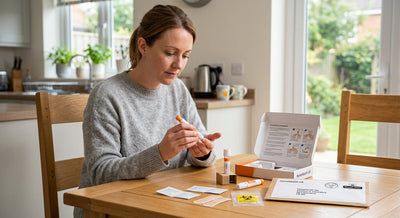
An at-home test uses a small finger-prick capillary sample rather than a traditional blood draw from a vein.
The sample is collected into a tube and sent to a laboratory for analysis. With Vitall Check, samples are processed by UKAS-accredited partner laboratories using NHS-grade standards, with results delivered through a secure portal.
The Essential Vitamins & Nutritional Health Test includes vitamin D alongside vitamin B12, active B12 and folate.
A finger-prick test is convenient, but it is not effortless for everyone. Some people collect a sample quickly. Others need more preparation or find it difficult to fill the tube. That is normal.
A small sample can still provide useful information, much like taking one carefully chosen page from a large book. The key is collecting it correctly.

STEP-BY-STEP: Prepare for your vitamin D test
STEP 1: Read the instructions first
Check whether your panel needs fasting or a particular collection time. Do not assume that every vitamin D test has the same preparation requirements.
STEP 2: Warm and hydrate
Drink water before testing. Wash your hands in warm water and dry them fully. If your fingers are cold, warm them for around two minutes.
Warm hands usually make blood flow easier. Cold fingers can turn a simple collection into a frustrating one.
STEP 3: Choose and clean your finger
Use the middle or ring finger of your non-dominant hand. Clean the side of your fingertip with the alcohol wipe. Let it air-dry before using the lancet.
You may feel a quick pinch. If you feel faint or uneasy, stop, sit or lie down and ask someone to stay with you.
STEP 4: Fill the tube carefully
Use the side of the finger rather than the centre. Keep your hand below your heart. Gently massage from the base of the finger towards the fingertip.
Fill the tube to the marked line. Avoid squeezing hard, as this can affect the sample.
Always follow Vitall Check’s official how to collect your sample guide to reduce errors and frustration.
STEP 5: Seal and post the sample
Close the tube securely. Place it in the biohazard bag and prepaid envelope. Post it on the same day, following the instructions supplied with your kit.
If you cannot collect enough blood, re-warm your hand and use the spare lancet on another suitable finger if instructed. Contact the support team if you continue to struggle.
What should you do with your result?
Treat your result as a starting point for a better GP conversation.
Write down:
- Your vitamin D result and unit.
- The laboratory reference range.
- The date and time of collection.
- Any supplements you take.
- Relevant symptoms or health concerns.
- Any medicines or medical conditions.
Your Insight Report is designed as a manual for your results. It translates raw laboratory data into clear, plain-English explanations and helps you understand where a result sits against the stated clinical reference range.
For more help understanding health results in context, read our guide to making sense of blood test results.
Do not compare your result with a friend’s result or an online influencer’s number. Different laboratories may use different methods and reference ranges. Your GP can interpret the result alongside your full medical picture.

The takeaway
A vitamin D test before winter can replace guesswork with a clearer starting point.
UK guidance recommends that most people consider daily vitamin D supplementation during autumn and winter. A test can show your measured 25(OH)D level, while your GP can explain what it means in the context of your health.
Prepare carefully, follow the official sample collection guide and use your result to arrive informed for your next GP appointment.
Frequently asked questions
Q: When should I take a vitamin D test in the UK? A: You can test at any time, but testing before or during winter may show your vitamin D status as sunlight becomes less available. Follow the timing instructions for your chosen panel.**
Q: Can I take a vitamin D test at home? A: Yes. An at-home finger-prick test collects a small capillary blood sample for laboratory analysis. Correct preparation and collection are important, and some people may find filling the tube challenging.**
Q: What vitamin D level is considered deficient in the UK? A: UK public health guidance uses below 25 nmol/L as low vitamin D status linked with increased risk of poor bone and muscle health. This threshold is not a diagnosis, so discuss your result with your GP.**
Author
Vitall Check Editorial Team
The Vitall Check Editorial Team is dedicated to empowering individuals with evidence-based health information and clear, actionable insights. Every article is researched using peer-reviewed journals and official health resources, reflecting our commitment to the same high standards of accuracy as our laboratory testing services. Our goal is to make proactive wellness accessible, data-driven, and transparent.
Disclaimer: Vitall Check is not CQC registered. The content provided is for general information only, does not provide a diagnosis, and does not replace advice from a qualified healthcare professional. Our services do not include treatment, prescription, or medical advice that falls under CQC-regulated activities. Always consult with your GP or a qualified clinician before making significant changes to your healthcare regimen.