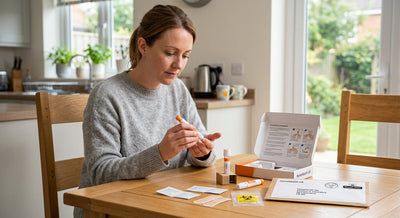
Feeling tired, cold, wired, shaky or unlike yourself? Your thyroid may be one possible reason , but symptoms alone cannot tell you what is happening.
A thyroid blood test looks at the hormones that help control your body’s energy use, temperature, heart rate and other everyday functions. With a thyroid blood test at home, you can collect a sample privately and send it to a UKAS-accredited laboratory for analysis.
Here is what the main markers mean, what results can suggest and how to use them to prepare for a better GP conversation.
TL;DR:
- TSH is the signal from your brain telling your thyroid how hard to work.
- FT4 is the main thyroid hormone circulating in your blood.
- FT3 is the more active thyroid hormone used by your cells.
- TPO and Tg antibodies can point towards an autoimmune thyroid condition, but they do not show thyroid function by themselves.
- High TSH with low FT4 can fit an underactive thyroid pattern. Low TSH with high FT4 or FT3 can fit an overactive thyroid pattern.
- Reference ranges vary by laboratory. Always use the range printed on your own report.
- Vitall Check’s Thyroid Health & Function Test measures TSH, FT3 and FT4 through a UKAS-accredited laboratory.
- An at-home result does not diagnose or replace medical care. It can help you arrive informed for your next GP appointment.
What’s the best thyroid blood test at home in the UK? A lab-analysed panel measuring TSH, FT4 and FT3 gives a broader view than a TSH-only self-test. Results should be read alongside your symptoms, medical history and the reference ranges on your report.
What does your thyroid do?
Your thyroid is a small, butterfly-shaped gland at the front of your neck. It makes hormones that help set the pace for many body systems.
Think of it like the thermostat in your home. If the setting is too low, the heating system receives a signal to work harder. If the setting is too high, the signal eases off.
Your thyroid system works in a similar way:
- Your brain’s pituitary gland releases TSH.
- TSH tells your thyroid how much hormone to make.
- Your thyroid mainly produces T4.
- Your body converts some T4 into T3, the more active form.
The balance is not judged by one number alone. It is more like checking the thermostat, the boiler and the temperature in the room together.

TSH, FT4 and FT3: what do the results mean?
TSH: the thyroid’s instruction signal
TSH, or thyroid-stimulating hormone, is made by the pituitary gland.
It tells your thyroid how hard to work. This can seem counter-intuitive:
- Higher TSH can suggest that the thyroid is not producing enough hormone, so the pituitary is sending a stronger signal.
- Lower TSH can suggest that there is already a high level of thyroid hormone in the blood, so less signal is needed.
TSH is often the first test used when thyroid problems are suspected. NICE guidance describes a TSH-first approach for many adults, with FT4 or FT3 added when needed. Read the NICE guidance on thyroid disease assessment and management.
FT4: the main circulating thyroid hormone
T4, or thyroxine, is the main hormone produced by the thyroid. FT4 means free T4 , the part available to your body rather than attached to blood proteins.
A common pattern is:
- High TSH with low FT4: this can fit an underactive thyroid pattern.
- Low TSH with high FT4: this can fit an overactive thyroid pattern.
That is a pattern, not a diagnosis. Your GP will also consider symptoms, medication, previous results and other health factors.
FT3: the more active form
T3, or triiodothyronine, is the more active thyroid hormone. Much of it is made when the body converts T4 into T3.
FT3 may be especially useful when overactive thyroid function is being investigated. It is not always measured in a routine NHS thyroid check. Some NHS laboratories use a cascade system: TSH is tested first, then FT4 and/or FT3 are added when the result suggests they may be useful. The Severn Pathology thyroid function test guide explains this approach.
What are TPO and Tg antibodies?
Thyroid antibodies are different from thyroid hormones. They do not directly measure how well your thyroid is working.
Instead, they can show whether your immune system may be reacting against parts of the thyroid.
TPO antibodies
TPO antibodies, or thyroid peroxidase antibodies, are linked with autoimmune thyroid conditions.
They may be raised in conditions such as:
- Hashimoto’s thyroiditis, which is commonly linked with an underactive thyroid
- Graves’ disease, which is commonly linked with an overactive thyroid
A positive result does not automatically mean that you have a thyroid disorder or need treatment. Some people have thyroid antibodies without abnormal thyroid hormone results.
Tg antibodies
Tg antibodies, or thyroglobulin antibodies, target thyroglobulin. This is a protein involved in storing thyroid hormone.
Tg antibodies may be found in autoimmune thyroid disease. They are also important in some specialist thyroid cancer follow-up because they can affect the interpretation of thyroglobulin testing.
TPO and Tg antibodies are best thought of as clues about the possible cause, not a measure of the thyroid’s current output. They are like smoke alarms: they may suggest that something needs a closer look, but they do not tell you the full condition of the building.
The British Thyroid Foundation’s guide to thyroid function tests explains how TSH, FT4, FT3 and thyroid antibodies are used together.
Underactive thyroid symptoms
An underactive thyroid is also called hypothyroidism. Symptoms can develop slowly, and they are not specific to thyroid problems.
Possible symptoms include:
- Tiredness
- Feeling cold more than usual
- Weight gain
- Constipation
- Difficulty concentrating
- Low mood
- Dry skin or dry hair
- Hair loss
- A hoarse voice
- Heavy or irregular periods
These symptoms can have many causes. The NHS guide to underactive thyroid symptoms and diagnosis explains why symptoms need to be considered alongside blood tests.
Overactive thyroid symptoms
An overactive thyroid is also called hyperthyroidism. Possible symptoms include:
- Feeling nervous, anxious or irritable
- Difficulty sleeping
- Feeling unusually hot
- Sweating more than usual
- Weight loss despite eating normally or more than usual
- Muscle weakness
- Trembling or shaky hands
- A fast or irregular heartbeat
- Loose stools or diarrhoea
- Eye symptoms in some people
The NHS notes that symptoms can appear gradually or suddenly and may vary from person to person. Read the NHS information on diagnosing an overactive thyroid.
Seek urgent medical help for chest pain, severe breathlessness, confusion or a very fast heartbeat.

What does a thyroid test at home measure?
Not every home thyroid test is the same.
Some are rapid, TSH-only tests. These may provide a simple screening result, but they do not show FT4, FT3 or antibodies.
A laboratory-analysed thyroid blood test at home gives you more detailed information from a finger-prick sample. Vitall Check’s Thyroid Health & Function Test measures:
- TSH
- Free T3
- Free T4
The sample is sent to a UKAS-accredited partner laboratory. Results are provided securely within 48 hours of laboratory receipt, with an Insight Report that translates the raw data into clear, plain-English information.
The report is designed to help you understand where results sit against the laboratory’s reference ranges. It is not a diagnosis and does not tell you to change medication or treatment.
If you want to understand how context matters when reading blood results, see our Health Hub pillar post: Biohacking Blood Test Results: Why Context Matters More Than the Number.
How to prepare for an at-home thyroid blood test
Finger-prick testing is convenient, but it still needs careful preparation. A small sample can be challenging for some people, so do not be surprised if it takes patience.
For Vitall Check’s current thyroid test instructions:
- Fast for 8 hours. Water is allowed.
- Take your sample in the morning, before 10:00 am.
- Avoid heavy exercise for 24 hours beforehand.
- Pause biotin supplements for two days, unless your GP has told you otherwise.
- Warm your hands before collecting the sample.
- Post the sample on the same day, Monday to Thursday.
Use the official Vitall Check sample collection guide before you start. Warm hands improve blood flow, much like warming up an engine before asking it to work hard.
If you feel faint or uneasy, stop and sit or lie down. Ask someone you trust to stay nearby if that would make you more comfortable. If you cannot collect enough blood, follow the troubleshooting instructions and contact Vitall Check for support.
Tell your GP about any thyroid medication, other medicines, supplements, recent illness, pregnancy or planned pregnancy. These details may affect how your results are understood.
How should you use your results?
Start by checking:
- The result for each marker
- The laboratory reference range
- Whether the result is marked within or outside that range
- Your symptoms and recent health history
- Any previous thyroid results
Do not compare your number with a screenshot from social media. Laboratories use different testing methods and reference ranges. Your report is the correct place to start.
Your result is a snapshot, not the whole film. A GP may decide that you need repeat testing, additional antibody testing or another form of assessment. Bring your report to your appointment and write down your main symptoms and questions beforehand.
Summary
A thyroid blood test at home can give you useful information about TSH, FT4 and FT3 without needing to collect a sample at a clinic. TPO and Tg antibody testing can provide further information about possible autoimmune thyroid disease, but antibodies do not show thyroid function by themselves.
Vitall Check’s thyroid test is processed by a UKAS-accredited laboratory and includes a clear Insight Report to translate raw laboratory data into plain English. Use those results to support a better conversation with your GP , not as a replacement for clinical assessment.
FAQ
Q: Can I get a thyroid blood test at home in the UK? A: Yes. You can order a laboratory-analysed finger-prick test from a private provider. Check which markers are included, how the sample is processed and whether the laboratory is UKAS-accredited.
Q: Does the Vitall Check thyroid test include thyroid antibodies? A: No. The Vitall Check Thyroid Health & Function Test measures TSH, FT3 and FT4. If you need TPO or Tg antibody testing, speak with your GP or choose a test that specifically includes those markers.
Q: Can an at-home thyroid test diagnose an underactive or overactive thyroid? A: No. It provides laboratory results that may help you prepare for a GP discussion. Diagnosis depends on your results, symptoms, medical history and, where needed, further assessment.
Q: Should I stop taking thyroid medication before testing? A: No. Do not change or stop prescribed medication unless your GP or another qualified healthcare professional tells you to. Tell the healthcare professional about all medicines and supplements you take.
Author
Vitall Check Editorial Team
The Vitall Check Editorial Team is dedicated to empowering individuals with evidence-based health information and clear, actionable insights. Every article is researched using peer-reviewed journals and official health resources, reflecting our commitment to the same high standards of accuracy as our laboratory testing services. Our goal is to make proactive wellness accessible, data-driven, and transparent.
Disclaimer: Vitall Check is not CQC registered. The content provided is for general information only, does not provide a diagnosis, and does not replace advice from a qualified healthcare professional. Our services do not include treatment, prescription, or medical advice that falls under CQC-regulated activities. Always consult with your GP or a qualified clinician before making significant changes to your healthcare regimen.