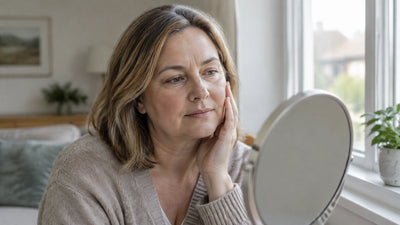
A change in your face can make you wonder what is going on. Could puffy eyelids, thinning eyebrows or a new wide-eyed look have something to do with your thyroid?
Sometimes thyroid disease affects your appearance. But a face cannot tell you what is happening with your hormones on its own. The same change can have several causes, so it is important to look at the wider picture: your symptoms, blood tests and a conversation with your GP.
TL;DR:
- An underactive thyroid can be linked with a puffy face, dry skin, hair thinning, tiredness, feeling cold and weight gain.
- An overactive thyroid, often caused by Graves’ disease, can be linked with thyroid eye disease: eye swelling, irritation, bulging eyes or double vision.
- Thyroid face is not a medical diagnosis. Appearance alone cannot confirm a thyroid condition.
- Thyroid blood tests can measure TSH, free T4 and free T3. Antibody tests may help show whether an autoimmune condition is involved.
- Speak to your GP about persistent symptoms, unexplained weight change, a neck lump, new eye changes or thyroid concerns during pregnancy.
- At-home testing can give you results to discuss with your GP. It does not diagnose or replace medical care.
What does thyroid face look like? “Thyroid face” is an informal term for facial changes sometimes linked to thyroid disease, such as puffiness with an underactive thyroid or swollen, prominent eyes with thyroid eye disease. These changes have other possible causes, so they need medical assessment rather than diagnosis by appearance.
What do people mean by “thyroid face”?
“Thyroid face” is a search term, not a diagnosis. People usually use it to describe facial changes they have noticed alongside other possible thyroid symptoms.
With an underactive thyroid, some people notice a generally puffy face or puffiness around the eyes. Their skin may feel dry, and hair may become thinner. With an overactive thyroid, particularly Graves’ disease, the eyes can be affected by a separate condition called thyroid eye disease.
These patterns are not interchangeable. General facial puffiness is different from swelling and changes around the eyes caused by thyroid eye disease. And neither appearance proves that your thyroid is the cause.
Your face is more like a clue than a test result. A GP will consider how long changes have been present, other symptoms, your medical history and blood tests.
How can an underactive thyroid change your appearance?
An underactive thyroid, or hypothyroidism, means the thyroid gland is not making enough thyroid hormones. These hormones affect how quickly many parts of the body work.
Some people with hypothyroidism develop a puffy-looking face or bags under the eyes. Other possible changes include:
- Dry, rough or pale skin
- Hair that feels dry or becomes thinner
- Thinning eyebrows
- A hoarser voice
- Weight gain
- A generally tired or less animated appearance
These changes often develop gradually. You may notice them alongside tiredness, feeling colder than usual, constipation, low mood or difficulty concentrating. The NHS overview of underactive thyroid describes symptoms such as tiredness, weight gain, sensitivity to cold, dry skin and hair loss.
Imagine your body as a house with a heating system. If the system is running more slowly, you might notice the temperature dropping in several rooms. Thyroid hormones work across the body too, so a change may show up in more than one place.
Still, dry skin, hair thinning and a puffy face are common for many reasons. Ageing, skin conditions, sleep changes, medicines and other health issues can all play a part. A single change does not point clearly to one cause.
Underactive thyroid symptoms to notice alongside facial changes
If you are concerned, note whether facial changes are happening with other symptoms, such as:
- Feeling tired for weeks without a clear reason
- Feeling cold when other people are comfortable
- Weight gain that is unexplained
- Low mood or difficulty concentrating
- Constipation
- Changes to your skin or hair
The NHS advises speaking to a GP if you think you may have an underactive thyroid. Many of these symptoms can also have other causes, so it is worth explaining the full picture rather than focusing on one feature.
Thyroid eye disease: a different kind of “thyroid face”
Thyroid eye disease (TED) affects the tissues around and behind the eyes. It is most often linked with Graves’ disease, an autoimmune condition that commonly causes an overactive thyroid.
The immune system mistakenly reacts with tissue around the eyes. This can lead to swelling and irritation, and in some cases the eyes may look more prominent or “staring”. TED can also occur when thyroid levels are normal or when the thyroid is underactive, so it is not simply a sign of an overactive result.
Possible symptoms include:
- Swollen or red eyelids
- A feeling of fullness around the eyes
- Dry, gritty or watery eyes
- Sensitivity to bright light
- Pain or pressure in or behind the eyes
- Eyes that seem more prominent
- Blurred or double vision
- Difficulty moving the eyes comfortably
The NHS page on overactive thyroid complications says eye problems affect around one in four people with Graves’-caused hyperthyroidism. They range from mild irritation to more serious problems. The British Thyroid Foundation’s thyroid eye disease guide explains the possible signs and why new eye symptoms should be discussed with a doctor.
Some swelling around the eyes can also occur with an underactive thyroid, but that is not the same thing as TED. If you have new changes to your eye appearance, pain, double vision or vision problems, contact your GP promptly. Sudden vision loss or rapidly worsening vision needs urgent medical assessment.

What appearance changes can happen with an overactive thyroid?
An overactive thyroid, or hyperthyroidism, means the thyroid is producing too much hormone. Graves’ disease is a common cause.
The hormone changes can affect how quickly your body works. Alongside possible eye symptoms, you might notice:
- Unexplained weight loss
- A racing or irregular heartbeat
- Shaky hands or tremor
- Feeling anxious, restless or irritable
- Sweating or feeling unusually warm
- Tiredness or muscle weakness
- A swelling at the front of the neck
The NHS guide to overactive thyroid lists weight loss, tremor, palpitations and neck swelling among possible symptoms. Not everyone has the same combination.
Think of thyroid hormones as the pace-setting signal for many body systems. When the signal is too strong, some systems may seem to run faster: your heart may race, you may feel shaky, and your weight may change. That analogy can help explain the idea, but it cannot tell you whether your thyroid is the cause.
A new bulge or staring appearance around the eyes deserves particular attention. It is different from general puffiness and may need an eye assessment as well as thyroid checks.
The thyroid hormone system, in plain English
Your thyroid is a small, butterfly-shaped gland at the front of your neck. It produces hormones that affect how your body uses energy, regulates temperature and supports other everyday functions.
The system involves a few key signals:
TSH: the messenger
TSH stands for thyroid-stimulating hormone. It is made by the pituitary gland, which sits below your brain. TSH tells your thyroid how much hormone to make.
If thyroid hormone levels fall, the pituitary may send more TSH to encourage the thyroid to produce more. That is why a higher TSH can be seen with an underactive thyroid. If thyroid hormone levels are high, TSH may fall.
It is a bit like a thermostat sending a message to a boiler. The thermostat is not the boiler itself; it is the signal asking for more or less heat.
Free T4 and free T3: the hormones
T4, or thyroxine, is the main hormone made by the thyroid. Some of it is changed into T3, or triiodothyronine, a more active form used by the body.
“Free” T4 and “free” T3 refer to the part of each hormone that is not attached to proteins in the blood. These measurements help show the amount available for the body to use.
Antibodies: possible signs of an immune response
Some thyroid conditions happen when the immune system reacts against the thyroid or nearby tissue. Antibody tests can help a clinician understand whether this may be involved.
- TPO antibodies may be linked with Hashimoto’s disease, a common autoimmune cause of an underactive thyroid.
- TRAb, or TSH-receptor antibodies, may help identify Graves’ disease.
Antibodies are not a diagnosis by themselves. The result needs to be read alongside thyroid hormone tests, symptoms and your health history.
What do thyroid blood tests measure?
A thyroid blood test may include one or more of the following:
| Test | What it measures, in simple terms |
|---|---|
| TSH | The signal from the pituitary gland asking the thyroid to work |
| Free T4 | The main thyroid hormone available in the blood |
| Free T3 | The more active thyroid hormone available in the blood |
| TPO antibodies | One type of antibody that may be linked with autoimmune thyroid disease |
| TRAb | Antibodies that can support investigation of Graves’ disease |
NICE guidance explains that testing is selected according to the situation. For many adults with suspected thyroid problems, a clinician may start with TSH and add free T4 or free T3 depending on the result. TSH and free T4 may be checked together when a pituitary problem is suspected. NICE also recommends considering TPO antibodies for adults with a raised TSH, and TRAb testing when investigating confirmed thyrotoxicosis for Graves’ disease. See the NICE recommendations on assessing thyroid disease.
So, does a full panel always beat TSH alone? Not necessarily. A clinician may use a step-by-step testing approach, and the right set of tests depends on your symptoms and circumstances. But TSH is only one part of the hormone system. Free T4, free T3 and relevant antibodies can add useful context and help explain a pattern. The British Thyroid Foundation’s guide to thyroid function tests gives a plain-English overview of these markers.
Reference ranges also vary between laboratories. Results need to be interpreted against the range shown on your report and in the context of your health. A result outside a range is not a diagnosis, and a result within range does not automatically explain every symptom.
Why appearance and symptoms are not enough
It is understandable to search for a visual answer when your face or eyes look different. But many things can cause puffiness, dry skin, hair loss or weight change.
For example, tiredness can be linked with sleep, stress, low mood, hormonal changes, medicines and other health conditions. The NHS guidance on tiredness and fatigue recommends contacting a GP when tiredness lasts for weeks, affects daily life or comes with other concerning symptoms.
There can also be overlap with menopause and perimenopause. Changes in sleep, mood, energy and body weight may happen during this stage of life. NICE notes that symptoms of thyroid problems can be mistaken for menopause; the NHS menopause and perimenopause information covers common changes during this time.
A symptom list works like a set of signposts, not a map of the final answer. It can help you decide what to discuss, but it cannot identify the cause by itself.
When should you speak to your GP?
Arrange a GP conversation if you have persistent symptoms that concern you, especially if you have several at once. Mention changes in your appearance, but also explain when they started and what else has changed.
Speak to your GP about:
- A lump or swelling in your neck
- New changes around your eyes, especially pain, bulging or double vision
- Unexplained weight gain or weight loss
- Ongoing tiredness, feeling unusually cold or feeling unusually hot
- A racing or irregular heartbeat, or a new tremor
- Persistent symptoms that affect everyday life
- A thyroid concern during pregnancy, or if you are planning a pregnancy
A neck lump is not automatically thyroid disease, but it should be checked. Mention difficulty swallowing or breathing, a hoarse voice or a lump that is growing quickly. New or worsening vision problems also need prompt attention.
If you are preparing for an appointment, jot down your main symptoms, when they began, and any changes you have noticed in your eyes, skin, hair or weight. Bring details of medicines and supplements too. This makes it easier to talk through the whole picture instead of trying to remember everything on the spot.
How common are thyroid problems?
The British Thyroid Foundation says around one in 20 people has some kind of thyroid disorder. Thyroid conditions are more common in women than men, although they can affect people of any sex and age. The NHS also says overactive thyroid is about ten times more common in women than men.
You may see estimates of around two in 100 people for an underactive thyroid specifically. That is a narrower estimate than the one-in-20 figure for thyroid disorders overall. Prevalence depends on which thyroid conditions are counted and how they are measured. The British Thyroid Foundation’s explanation of thyroid disorders offers further background.
What can you do with thyroid test results?
Use your results to help prepare for a conversation with a qualified healthcare professional, not to diagnose yourself or change any treatment.
Before speaking to your GP, it can help to write down:
- The date of the test and the markers measured
- The results and the laboratory’s reference ranges
- Any symptoms you have noticed and when they began
- Changes in your face, eyes, hair or skin
- Medicines and supplements you take
- Whether you are pregnant, planning pregnancy or recently gave birth
Ask your GP what the results mean alongside your symptoms, and whether any follow-up is needed. If your eyes are changing, say so clearly rather than assuming it is just a cosmetic issue.

How at-home thyroid panels can support an informed GP conversation
An at-home thyroid panel can offer a convenient way to check selected thyroid markers. Vitall Check offers a Thyroid Health & Function Test and an Advanced Thyroid Health & Metabolism Panel. You can also view the Hormones & Thyroid collection.
The advanced panel lists TSH, free T4, free T3 and thyroid antibodies among its markers. The simpler test measures TSH, free T4 and free T3. Check each test page for the current panel details before ordering.
Samples are processed by UKAS-accredited laboratories working to NHS-grade standards. Results are provided in 48 hours, with an Insight Report designed as a plain-English manual for understanding the numbers and their reference ranges. It does not diagnose a condition or provide medical advice.
Finger-prick collection can be convenient, but it may take preparation and not everyone finds it straightforward. Warm hands and hydration can help with collection. Follow the official how to collect your sample guide carefully, and contact Vitall Check support if you have difficulty.
A test result can help you arrive informed for your next GP appointment. It does not replace an examination, a GP-requested test or care from a qualified clinician. For more detail on thyroid testing, read the Health Hub’s Underactive Thyroid Test UK: The Complete Guide to TSH, T4 and Antibodies.
Summary: what to remember about thyroid face
Thyroid disease can sometimes affect your face, skin, hair and eyes. An underactive thyroid may be linked with facial puffiness, dry skin and hair thinning. Thyroid eye disease can cause swollen or irritated eyes, a prominent appearance or double vision, often in connection with Graves’ disease.
But thyroid face is not a diagnosis. These changes can have many causes, and appearance alone cannot tell you whether your thyroid is involved. Pay attention to changes over time, note other symptoms and speak to your GP about persistent concerns, neck swelling, new eye symptoms, unexplained weight changes or pregnancy-related thyroid questions.
Thyroid blood tests may include TSH, free T4, free T3 and relevant antibodies. At-home testing can provide results to discuss with your GP, with UKAS-accredited laboratory processing and NHS-grade standards. Use the results to support an informed conversation, not as a substitute for clinical care.
FAQ
Q: Can an underactive thyroid make your face puffy? A: It can be linked with a puffy face or puffy eyelids, but these changes can have other causes. A GP can consider them alongside your symptoms and blood test results.
Q: What are the signs of thyroid eye disease? A: Possible signs include swollen or red eyelids, dry or gritty eyes, light sensitivity, prominent-looking eyes, pain and double vision. New or worsening eye symptoms should be discussed promptly with a healthcare professional.
Q: Can a thyroid blood test diagnose thyroid disease? A: Thyroid blood tests can show hormone and antibody patterns that help a clinician assess your thyroid. A test result needs to be interpreted with your symptoms and medical history; it does not diagnose itself.
Author
Vitall Check Editorial Team
The Vitall Check Editorial Team is dedicated to empowering individuals with evidence-based health information and clear, actionable insights. Every article is researched using peer-reviewed journals and official health resources, reflecting our commitment to the same high standards of accuracy as our laboratory testing services. Our goal is to make proactive wellness accessible, data-driven, and transparent.
Disclaimer: Vitall Check is not CQC registered. The content provided is for general information only, does not provide a diagnosis, and does not replace advice from a qualified healthcare professional. Our services do not include treatment, prescription, or medical advice that falls under CQC-regulated activities. Always consult with your GP or a qualified clinician before making significant changes to your healthcare regimen.