Turning 50 is often described as a milestone, but for many men, it feels more like a subtle shift in the weather. You might notice that your recovery after a Saturday morning run takes a little longer, or that the sharp focus you once relied on in boardrooms feels slightly muffled by a persistent, quiet fatigue. In the UK, these changes are frequently brushed off as "just getting older," a standard part of the ageing process that you are expected to accept. However, while some decline in vitality is natural, your hormones often tell a more specific story. Understanding your hormones isn't about chasing youth; it's about having the data to support your next 50 years.
A testosterone test is the first step in moving from guesswork to clarity. When you reach your fifties, the "normal" range quoted by laboratories becomes a broad and often confusing spectrum. What is considered "normal" for a 50-year-old might be very different from what you need to feel like yourself. By taking control of this data, you aren't just looking at a number on a screen; you are preparing yourself for a much more informed conversation with your GP.
TL;DR:
- Testosterone naturally declines by about 1% per year after the age of 30, but sudden drops can indicate underlying health issues rather than just ageing.
- NHS "normal" ranges for men over 50 are broad (typically 6.7–25.7 nmol/L), meaning you can be "in range" but still feel significantly symptomatic.
- The "grey zone" (8–12 nmol/L) is where symptoms like low mood, brain fog, and muscle loss often appear, even if your results aren't flagged as "low."
- At-home finger-prick testing offers a discreet, clinical-grade way to check your levels and prepare for a more productive clinical consultation.
- Free testosterone is often a more accurate marker for men over 50 than total testosterone alone, as it shows what your body can actually use.
What's a normal testosterone level for a 50-year-old man? In the UK, most laboratories consider a total testosterone level between 6.7 and 25.7 nmol/L as normal for men over 50. However, levels below 12 nmol/L are often considered a "grey zone" where symptoms can occur, and levels below 8 nmol/L are generally classified as a deficiency requiring clinical review.
The "Normal" Trap: Why One Number Doesn't Fit All
When you receive blood test results, the first thing you likely look for is whether your number sits inside the "normal" reference range. This range is essentially a statistical average of the population, designed to capture the middle 95% of healthy individuals. For men over 50, this range is remarkably wide. You could sit at the very bottom of that range, feeling sluggish, irritable, and noticing a decline in physical strength, and still be told by a standard lab report that your levels are "normal."
Think of your testosterone levels like a dimming light switch rather than a simple on-off toggle. As you age, the light might not go out completely, but the room becomes harder to navigate. If the light is turned down to 20%, you are technically still in a "lit" room, but you’ll probably find yourself squinting. Similarly, being at the lower end of the clinical reference range can leave you feeling "off" even if you haven't crossed the threshold into a clinical deficiency.
The British Society for Sexual Medicine (BSSM) notes that many men experience significant symptoms when their total testosterone drops below 12 nmol/L. This "grey zone" is where the distinction between "statistically normal" and "personally healthy" becomes critical. Relying on a single number without considering your symptoms, such as a loss of morning erections or a sudden increase in abdominal fat, can lead to these signs being dismissed as inevitable parts of the ageing process.

Ageing vs. Low T: Recognising the Red Flags
It is a common misconception that testosterone falls off a cliff the moment you blow out fifty candles. In reality, according to the NHS, the decline is steady and gradual, roughly 1% per year from your thirties onwards. Because this change is so slow, it can be difficult to tell the difference between the standard effects of ageing and a genuine hormonal imbalance.
While general ageing might make you feel a little less "explosive" in the gym, true testosterone deficiency (hypogonadism) often brings more specific, persistent challenges. For instance, if you find that you are training just as hard as you did five years ago but your muscle mass is visibly shrinking while your waistline expands, your hormones may be playing a role. This isn't just about aesthetics; testosterone is a key driver of metabolic health and bone density.
Cognitive symptoms are also frequently overlooked. Many busy professionals in their fifties report a persistent "brain fog" or a lack of motivation that they attribute to burnout or work stress. Imagine your brain is like a high-performance engine that has been running on the wrong grade of fuel for a few months. It still starts, and it still gets you from A to B, but it stutters under load and lacks the "zip" it once had. Checking your levels with an Ultimate Testosterone test can help you determine if that mental fatigue is purely lifestyle-based or if your "fuel" levels need attention.
The Library Analogy: Total vs. Free Testosterone
One of the most important concepts to understand when testing in your fifties is the difference between total testosterone and "free" testosterone. This is where a basic test can sometimes miss the full picture.
Imagine your body’s testosterone is like a large public library. The "Total Testosterone" is the total number of books the library owns. However, most of those books are currently checked out, tucked away in bags, or sitting on people’s bedside tables, they are "bound" to proteins like Sex Hormone-Binding Globulin (SHBG). These bound books are in the library's records, but you can't actually read them.
"Free Testosterone" represents the books that are currently sitting on the shelves, ready for you to pick up and read. These are the hormones that are biologically active and available for your tissues to use. As you get older, your "library" might keep the same number of total books, but more of them tend to get "checked out" (bound by rising levels of SHBG). This means your total testosterone looks fine on paper, but your body is struggling because the "free" portion, the part that actually does the work, is too low. This is why a comprehensive Male Hormone Check that measures SHBG and calculates free testosterone is so valuable for men over 50.

From Insight to Action: Using Your Results
The goal of at-home testing isn't to replace your doctor; it’s to provide you with a high-definition map of your health so that you can arrive at your next appointment fully informed. When you use a service that processes samples through UKAS-accredited labs, you are getting NHS-grade data from the comfort of your own home.
Once your results are ready, usually within 48 hours, you receive an Insight Report. Rather than just giving you a list of raw data like "ALT: 45 IU/L," these reports translate the numbers into plain English. They help you understand where you sit within the clinical ranges and how your lifestyle, training, or diet might be influencing those markers.
This report acts as a "pressure valve" for the healthcare system. Instead of going to your GP with a vague feeling of being "unwell," you can present a clear, lab-verified summary of your hormonal health. This fast-tracks the conversation, helping your clinician rule out certain issues and focus on the most likely causes of your symptoms. Whether your results indicate you are perfectly within range or suggest a need for further clinical investigation, you have moved from a state of uncertainty to a state of knowledge.
Preparation: The Key to an Accurate Sample
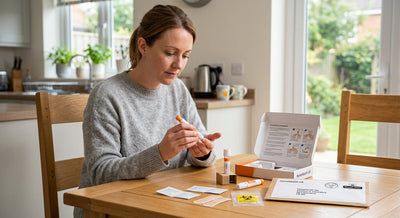
To get the most reliable insights from your testosterone test, preparation is essential. Your hormone levels aren't static; they fluctuate significantly throughout the day, peaking in the early morning. This is why it is critical to collect your finger-prick sample before 11:00 am.
- Ensure you are well-hydrated by drinking one or two large glasses of water about 30 to 60 minutes before you plan to collect your sample.
- Warm your hands thoroughly under a warm tap or by moving around; blood flows much more easily when you are warm.
- Follow the official "how to collect your sample" guide included in your kit to ensure the process is smooth and the sample is of the highest quality.
- If you feel nervous or have difficulty with the collection, don't worry, it’s normal to feel a small pinch, and the lancets are designed for ease of use.
By following these simple steps, you ensure that the data you receive is a true reflection of your health, giving you the confidence to make informed decisions about your wellness.

Takeaway: Knowledge is Your Best Defence
Reaching your fifties isn't a signal to slow down; it's an invitation to monitor your "engine" more closely. Just as you wouldn't ignore a warning light on your car's dashboard after it passes 50,000 miles, you shouldn't ignore the subtle signals your body sends you. A testosterone test provides the data you need to distinguish between the natural passage of time and a health marker that requires attention.
By moving beyond the broad "normal" ranges and understanding the nuances of free testosterone and symptom tracking, you empower yourself. You become a proactive participant in your own health journey, ready to have better conversations with your GP and better outcomes for your future.
FAQ: Testosterone at 50
- Can I test my testosterone at any time of day? No. Testosterone levels are highest in the morning and drop as the day progresses. To ensure your results can be accurately compared to clinical reference ranges, you should always collect your sample before 11:00 am.
- What if my results are "normal" but I still feel tired? It is very common. You may be in the "grey zone" (8–12 nmol/L) or have low free testosterone despite a normal total level. It’s also important to check other markers, such as thyroid function or vitamin D levels, which can cause similar symptoms.
- Does a high SHBG level matter? Yes. If your Sex Hormone-Binding Globulin (SHBG) is high, it "locks up" more of your testosterone, leaving less "free" for your body to use. This is why testing both total and SHBG is vital for men over 50.
- Is an at-home finger-prick test as accurate as a clinic test? Yes, provided you collect the sample correctly. Vitall Check samples are processed by the same UKAS-accredited labs used by the NHS, ensuring clinical-grade accuracy.
- Will my GP accept these results? Most GPs value lab-verified data from accredited facilities. Our Insight Reports are designed to help you have a more informed discussion with your clinician, though they may choose to run their own confirmatory tests.

Author: Vitall Check Editorial Team The Vitall Check Editorial Team is dedicated to empowering individuals with evidence-based health information and clear, actionable insights. Every article is researched using peer-reviewed journals and official health resources, reflecting our commitment to the same high standards of accuracy as our laboratory testing services. Our goal is to make proactive wellness accessible, data-driven, and transparent.
Disclaimer: Vitall Check is not CQC registered. The content provided is for general information only, does not provide a diagnosis, and does not replace advice from a qualified healthcare professional. Our services do not include treatment, prescription, or medical advice that falls under CQC-regulated activities. Always consult with your GP or a qualified clinician before making significant changes to your healthcare regimen.