Movember starts on 1 November. It’s a useful prompt to get familiar with prostate health, but PSA results can be easy to misread. A higher number isn’t a cancer diagnosis, and a lower one doesn’t rule everything out.
TL;DR:
- PSA is a protein made by prostate cells. A blood test measures how much is in your blood.
- PSA can rise for reasons other than cancer, including age, an enlarged prostate, infection, cycling and recent exercise.
- There’s no single PSA number that means the same thing for everyone. Your age, symptoms, medicines and other details matter.
- New Oxford research found blood proteins associated with prostate cancer many years before diagnosis. These are research findings, not a test that can predict your personal risk today.
- A raised result is a reason to speak with your GP, not to self-diagnose.
What does a PSA blood test measure? It measures prostate-specific antigen, a protein made by prostate cells. A higher level can have several causes, so it cannot diagnose prostate cancer on its own.
What is PSA, and what does a PSA test check?
PSA stands for prostate-specific antigen. It’s a protein made by normal prostate cells and by prostate cancer cells. A PSA blood test measures the amount in your blood.
Think of PSA like a smoke alarm: it can alert you that something needs a closer look, but it cannot tell you exactly what caused the signal. An enlarged prostate, infection and other factors can raise PSA too.
The NHS explains what a PSA test can check, including some prostate conditions. It also makes clear that a high result does not mean you have cancer. Equally, a result that isn’t raised cannot rule out every prostate problem.
What does a PSA number mean?
Results are usually reported in nanograms per millilitre (ng/mL). There isn’t one cut-off that means the same thing for every person. PSA tends to rise with age, and it can also be affected by prostate size, symptoms, medicines and recent activity.
Your PSA result is more like a snapshot than a full film. It gives information from one point in time, not the whole story. Your GP may consider your symptoms, health history and previous results, and decide whether any follow-up is needed.
What can raise PSA besides cancer?
A raised PSA can have several explanations. These include:
- Benign prostate enlargement: The prostate can grow with age. This is not cancer, but it can affect PSA and cause changes in urination. Read the NHS guide to an enlarged prostate.
- Prostatitis or a urine infection: Infection or inflammation can affect PSA. If you have a urine infection, the NHS advises waiting until it has cleared before having a test.
- Cycling or vigorous exercise: These may affect results for a short time. The NHS recommends avoiding cycling and strenuous exercise for 48 hours before a PSA test.
- Ejaculation: Avoid it for 48 hours before testing, as it can temporarily affect your PSA level.
- Some medicines and recent procedures: Tell your GP about medicines you take and any recent prostate or urinary procedures. Some medicines can lower PSA, while procedures may affect results.
For more information about preparation and possible causes of a raised result, see Prostate Cancer UK’s PSA blood test guide.
If you have urinary symptoms, don’t rely on a PSA test alone to explain them. Speak to your GP. Blood in your urine, pain when urinating or being unable to urinate need prompt attention. The NHS lists prostate cancer symptoms and what to do next.

What does the new Oxford prostate protein research add?
A study published online in European Urology on 21 October 2026-and reported by the University of Oxford on 22 October, looked at thousands of proteins in blood samples. The researchers found 12 proteins associated with prostate cancer diagnosed more than 15 years after the blood sample was taken.
The published study is an important research step. But it does not mean a new test can tell an individual that they will develop prostate cancer 15 years from now.
The researchers describe candidate markers that need further study and validation. These results are not currently a clinical test and don’t replace PSA testing or a conversation with your GP. Think of the findings as new clues for researchers to investigate, not a personal forecast.
Who might consider a PSA test, and when?
There is no routine NHS PSA screening programme for everyone. But you can ask your GP about the possible benefits and limits of testing, particularly if you have symptoms or concerns about your risk.
Prostate cancer risk increases with age. Prostate Cancer UK advises speaking with your GP about PSA testing from age 45 if you’re Black or have a family history of prostate cancer. Your GP can help you weigh up your personal circumstances.
A PSA test can be part of a wider discussion, not a substitute for one. Before deciding, you might ask:
- What could a raised or lower result mean for me?
- Do my symptoms or family history affect the discussion?
- Could my medicines or recent activity affect the result?
- If my result is raised, what might happen next?
If you want wider men’s health context, visit the Vitall Check Men’s Health collection or read our testosterone blood test guide.
How does an at-home PSA blood test work?
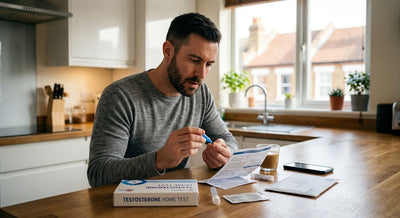
A Vitall Check Prostate Health & PSA Blood Test uses a finger-prick sample collected at home and sent to a laboratory. The product page lists total PSA, free PSA and the free-to-total PSA ratio. Samples are processed by UKAS-accredited laboratories using NHS-grade standards, with results listed as available within 48 hours.
Finger-prick collection can be straightforward, but it may take preparation, and some people find it difficult. Follow the official how to collect your sample guide carefully. Warm hands and good hydration can help with collection.
For PSA preparation, follow NHS guidance: avoid cycling, vigorous exercise and ejaculation for 48 hours before your test. The product page also lists an eight-hour fast and morning collection before 10am. Check your kit instructions and contact the provider if you’re unsure which preparation applies to your test. The NHS says fasting is not needed for a PSA test by itself.

A finger-prick sample is a small drop of blood, but getting enough can take time. If you feel faint or uneasy, stop, sit down and ask someone to stay with you. If you can’t collect the sample, follow the kit guidance for support rather than repeatedly trying without a break.
Your Insight Report is a manual for understanding your results. It translates raw lab data into plain English and shows the laboratory reference range. It does not diagnose cancer or tell you what treatment you need.
What should you do if your PSA is raised?
Start with a GP conversation. A raised result is not a diagnosis, and it does not tell you the cause by itself. Your GP may consider your symptoms, medicines, health history and the test conditions. They may recommend repeating the test or discuss whether further assessment is appropriate.
Bring your result and note when you collected the sample, whether you cycled or exercised recently, and any relevant symptoms or medicines. That context can help you have a clearer discussion. Don’t delay speaking to your GP about symptoms while waiting to take or repeat a test.

Key takeaways
A PSA blood test measures a prostate-related protein. It can help inform a conversation, but it cannot diagnose prostate cancer on its own. Age, prostate enlargement, infection, medicines, cycling and recent exercise can all affect the result.
The Oxford protein study offers new research clues, not a test that can predict your individual future. If you’re considering testing or have symptoms, speak with your GP and use your result to support an informed discussion.
FAQ
Q: What PSA level is considered high in the UK? A: There isn’t one cut-off that applies to everyone. Age, symptoms, medicines and the laboratory’s guidance all matter, so ask your GP to interpret your result in context.
Q: Can cycling or exercise affect a PSA blood test? A: Yes. The NHS advises avoiding cycling and vigorous exercise for 48 hours before testing because these may affect the result.
Q: Does a raised PSA mean prostate cancer? A: No. An enlarged prostate, infection and other factors can raise PSA. A raised result needs a conversation with your GP, not self-diagnosis.
Author
Vitall Check Editorial Team
The Vitall Check Editorial Team is dedicated to empowering individuals with evidence-based health information and clear, actionable insights. Every article is researched using peer-reviewed journals and official health resources, reflecting our commitment to the same high standards of accuracy as our laboratory testing services. Our goal is to make proactive wellness accessible, data-driven, and transparent.
Disclaimer: Vitall Check is not CQC registered. The content provided is for general information only, does not provide a diagnosis, and does not replace advice from a qualified healthcare professional. Our services do not include treatment, prescription, or medical advice that falls under CQC-regulated activities. Always consult with your GP or a qualified clinician before making significant changes to your healthcare regimen.