Your hormones do not suddenly flip like a light switch.
Perimenopause is usually messier than that. One month your period turns up early. The next it vanishes. Sleep gets patchy. Mood feels unfamiliar. You might feel hot for no reason, then freezing an hour later. And once you start searching online, things can get weird fast.
That matters right now. In September 2026, the BBC reported that some menopausal women were buying testosterone online because NHS prescribing was inconsistent in some areas, raising obvious safety concerns around unsupervised hormone use. At the same time, the Society for Endocrinology has continued pushing back against hormone misinformation online and promoting trusted, evidence-based education through its public resources and media work. In plain English: there is a lot of noise out there, and not all of it is safe.
A good at-home hormone test can help you cut through some of that noise. But it only helps if you use it properly, understand its limits, and place the numbers beside your symptoms, cycle timing, and wider health picture.
TL;DR:
- Perimenopause is the transition before menopause, when hormone levels start fluctuating and periods often become less predictable.
- A single hormone reading is not diagnostic. Hormones can shift across the month like the British weather.
- NICE says menopause is usually identified from symptoms in people aged 45+ with typical symptoms, not from routine hormone testing alone.
- Useful markers may include FSH, LH, oestradiol, progesterone, testosterone, SHBG, and thyroid markers, plus ferritin, iron status, vitamin D, and B12 for helpful context.
- Timing matters. Some markers are best checked on specific cycle days if you still have periods.
- At-home finger-prick testing can be a practical first step when processed by UKAS-accredited partner labs to NHS-grade standards.
- With Vitall Check, your sample is analysed by UKAS-accredited partner laboratories, with lab-verified results in 48 hours, plus an easy-to-understand Insight Report and a personalised health action plan.
- Your results should help you arrive informed for your next GP appointment, not self-diagnose or self-prescribe.
What's a perimenopause hormone test at home? It’s an at-home blood test that checks hormone and related health markers linked to perimenopause, but it does not diagnose perimenopause on its own because hormone levels can change across the cycle and NICE says menopause is usually identified from symptoms in people aged 45+ with typical symptoms.
What is perimenopause, exactly?
Perimenopause is the stage before menopause, when your ovaries begin changing how they release eggs and produce hormones. The main hormones involved are oestrogen and progesterone, but the ripple effect can touch other markers too.
Think of it like a car that still runs, but the dashboard lights have started flickering. The engine has not stopped. Things are just becoming less predictable.
According to the NHS overview of menopause and perimenopause, this stage often starts in your 40s, though it can begin earlier. Common symptoms include:
- irregular periods
- hot flushes
- night sweats
- sleep problems
- mood changes
- low libido
- vaginal dryness
- brain fog
- headaches
- joint aches
Menopause itself is reached when you have gone 12 months without a period. Perimenopause is the run-up to that point.
That distinction matters because many people search for a “menopause blood test” when what they are really dealing with is perimenopause, where hormones can swing up and down rather than simply dropping in a straight line.
Why one hormone test cannot diagnose perimenopause
This is the bit that gets missed on social media.
A hormone result is a snapshot, not a full film. It shows what was happening when your sample was taken. It does not tell the whole story on its own.
NICE is very clear here. In its guidance on menopause identification and management, menopause in people aged 45 and over with typical symptoms is generally identified from symptoms and menstrual pattern, not from routine lab tests. NICE also advises that routine blood testing is not usually needed to diagnose menopause in this group.
Why? Because hormone levels can bounce around. FSH may be raised one week and less striking the next. Oestradiol can dip, recover, then dip again. Progesterone changes depending on whether ovulation happened that cycle.
It is a bit like checking traffic with one photo from a motorway bridge. You might catch a jam. You might catch an empty stretch. Neither image tells you what happened all day.
So why test at all?
Because the right test can still be helpful for:
- building context around your symptoms
- checking whether your cycle timing fits the result
- ruling in or ruling out related issues
- supporting a more focused GP conversation
- spotting other causes of tiredness, poor mood, low energy, or hair changes
That is especially useful for the data-driven patient who wants something more solid than “I think something’s changed” before speaking to a clinician.
Which markers may be worth checking?
A perimenopause-focused panel should not just chase one hormone. It should give you a wider view.
FSH
FSH stands for follicle-stimulating hormone. It helps drive the ovary to mature follicles.
As ovarian function changes, FSH can rise because the brain is effectively pressing the accelerator harder to get a response.
A higher FSH can fit with perimenopause, but it is not definitive on its own. One raised result does not equal a diagnosis, and one normal result does not rule perimenopause out.
LH
LH, or luteinising hormone, also helps regulate the menstrual cycle and ovulation.
LH can add context when viewed with FSH, but on its own it is rarely the magic answer people hope for.
Oestradiol
Oestradiol is one of the main forms of oestrogen.
During perimenopause, oestradiol can be low, normal, or sometimes surprisingly high depending on where you are in the cycle and whether the ovaries are having a more active month. That is why interpreting it without cycle timing is like reading half a sentence.
Progesterone
Progesterone rises after ovulation. If ovulation is inconsistent, progesterone can be lower or more erratic.
This marker is often most useful when timed properly, because random testing may simply catch the wrong phase.
Testosterone
Yes, testosterone matters in women too. It can affect libido, motivation, and energy, but it is also one of the most overhyped hormones online.
That is part of why the September 2026 BBC report matters. It highlighted women buying testosterone online when prescribing access was patchy. That is a safety issue, not a shortcut.
Testing testosterone can provide context, but a result should never be used as a reason to self-source hormones online.
SHBG
SHBG stands for sex hormone-binding globulin. Think of it as a taxi service for hormones in your blood. It binds to hormones like testosterone and affects how much is available in circulation.
If you only look at total testosterone without SHBG, you may miss the bigger picture.
Thyroid markers
Thyroid problems can overlap with perimenopause symptoms in a very annoying way. Tiredness, low mood, dry skin, poor concentration, weight changes, and heavier periods can also fit with an underactive thyroid.
That is why thyroid markers can be useful supporting tests when the picture is unclear.
Ferritin and iron status
If your periods are becoming heavier, irregular, or longer, ferritin matters.
Ferritin is your stored iron. Think of it as the pantry, not the plate. You can still be eating enough iron on paper while the cupboard is running low.
Low ferritin can contribute to:
- tiredness
- low exercise tolerance
- hair shedding
- poor concentration
- feeling washed out
This is one reason perimenopause symptoms can blur into other issues.
Vitamin D
Low vitamin D can overlap with low mood, fatigue, and aches. The NHS vitamin D guidance also notes that everyone aged 4 and over should consider a 10 microgram supplement, especially when sunlight exposure is limited.
Vitamin B12
Low B12 can muddy the picture too. The NHS page on vitamin B12 deficiency anaemia highlights symptoms such as tiredness, weakness, memory issues, and pins and needles.
In other words, if you only look at sex hormones, you may miss the supporting cast.
When should you test across the cycle?
This is where many home tests go wrong.
If you still have periods, timing matters.
If your cycle is still fairly regular
A common approach is:
- FSH, LH, and oestradiol: often checked early in the cycle, usually around day 2–5
- Progesterone: often checked in the mid-luteal phase, commonly around 7 days before your expected period rather than blindly on “day 21”
- Testosterone, SHBG, thyroid, ferritin, vitamin D, and B12: timing may be more flexible, but follow the specific kit instructions
Why not just test any day? Because hormones do not behave like static numbers on a utility bill. They move. A lot.
If your cycles are irregular
This gets trickier. If your periods are all over the place, exact cycle-day timing may be less useful or harder to plan.
In that case:
- track the first day of your last period
- note whether you think you ovulated
- record symptoms at the time of testing
- be ready to interpret the result with that context, not in isolation
If you have not had periods for several months, the way a result is interpreted changes again.
If you are 45 or over with typical symptoms
This is where the NICE point becomes important again. Testing may still be helpful for context, but routine hormone testing is not usually how menopause is identified in this age group. Symptoms and cycle history often carry more weight.
That can feel unsatisfying if you want one neat answer. But it is also more honest.
How at-home finger-prick hormone testing works
At-home testing is convenient, but it is not magic. You still need a good sample.
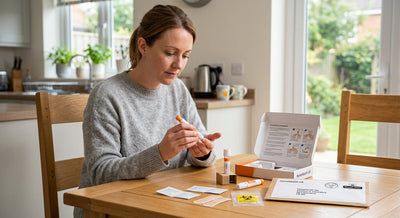
With Vitall Check, the process is designed to be simple:
- Choose the right panel for your symptoms and goals.
- Collect a finger-prick blood sample at home using the kit instructions.
- Post your sample to a UKAS-accredited partner laboratory using the return packaging provided.
- Your sample is processed to NHS-grade standards.
- You receive lab-verified results in 48 hours after lab receipt.
- Your Insight Report translates raw numbers into plain English, with a personalised health action plan to help you understand what to discuss next.
If you want to explore the relevant testing options, start with Vitall Check’s Women’s Health collection, the Menopause Health & Hormonal Profile, and the broader cluster pillar on Menopause Test Kit UK: Navigating Perimenopause with UKAS-Accredited Precision.
Important point: finger-prick testing is convenient, but some people do find blood collection fiddly. That is normal. Warm hands, hydration, and careful prep make a big difference.
How to prepare for an at-home finger-prick test
You want a clean sample, not a stressful wrestling match with a tiny lancet.
Before you test
- Hydrate well in the hours beforehand
- Warm your hands with warm water or gentle movement
- Read the collection guide fully before starting
- Set everything out first on a clean surface
- Avoid rushing just before work, the school run, or a train
Think of it like baking. If you only start looking for the mixing bowl halfway through, the whole thing gets more chaotic than it needs to be.
During the collection
- Wash and dry your hands fully
- Use the recommended finger
- Keep your hand warm and below heart level
- Let blood fall into the collection tube or spot naturally as directed
- Follow the official sample guide carefully to reduce errors
Key reminders
- ⚠️ Do not squeeze aggressively if the instructions advise against it
- ⚠️ Do not test with cold hands if you can avoid it
- ⚠️ Do not ignore the timing guidance for hormone markers
- 💡 Tip: If you are nervous, have someone nearby and sit down while collecting
- 💡 Tip: Post the sample as soon as instructed for the best chance of smooth processing
How to interpret results in context
This is the part people often want to skip to. Fair enough. But context is everything.
A useful report should help you understand:
- what the marker is
- where your result sits within the lab reference range
- why timing may affect it
- which symptoms may or may not fit
- what might be worth raising with your GP
It should not diagnose you. It should not tell you to buy hormones online. And it should not pretend one result explains every symptom.
What context might look like
A single higher FSH result plus irregular periods and hot flushes in your late 40s may fit the wider picture of perimenopause.
A lower ferritin with heavier periods and fatigue may point towards iron depletion contributing to how you feel.
A thyroid result outside range may suggest a conversation about whether something other than perimenopause is in the mix.
That is why a broad panel can be helpful. It is less like guessing from one puzzle piece and more like finally finding the corner pieces and the edge.
Why social media hormone advice can go wrong
Hormone content online often sounds certain because certainty sells.
“Your testosterone is low.”
“This one supplement fixes perimenopause.”
“You need this exact hormone stack.”
Real life is rarely that tidy.
The Society for Endocrinology has repeatedly backed better public hormone education through its You and Your Hormones resources and outreach work, precisely because misinformation spreads fast online.
That matters if you are vulnerable, exhausted, and just want answers.
Good testing can help you ask better questions. It should not turn you into your own prescriber.
How to use your results to support an informed GP conversation
This is the smart way to use at-home testing.
Bring:
- your symptom list
- your cycle pattern or missed periods
- the date and timing of your test
- your results report
- any family history that matters
- a list of current medicines or supplements
Then keep the conversation practical.
You could ask:
- “Do these results fit the symptoms I’m having?”
- “Could thyroid, iron, B12, or vitamin D be part of this too?”
- “Based on NICE guidance, do my symptoms suggest perimenopause?”
- “Are there any other tests or follow-up steps you’d recommend?”
That is what informed arrival looks like. Not turning up with a diagnosis from TikTok. Turning up prepared.
If you want related reading, explore Vitall Check’s Women’s Health collection, the Advanced Thyroid Health & Metabolism Panel, and the core cluster pillar post on menopause testing and perimenopause navigation.
When to seek medical advice sooner
Please speak to your GP promptly if you have:
- very heavy bleeding
- bleeding after sex
- bleeding after 12 months without periods
- severe low mood
- chest pain
- fainting
- sudden unexplained weight loss
- symptoms that are rapidly worsening
Testing is there to support you with information. It is not a substitute for urgent assessment when something clearly needs attention.
Summary
Perimenopause can feel confusing because it is confusing. Hormones do not decline in a neat, orderly line. They fluctuate, and symptoms can overlap with thyroid issues, low iron, low vitamin D, and low B12.
That is why the best at-home approach is not to chase one “magic” hormone. It is to test thoughtfully, time the sample properly where possible, and read the results in context.
Vitall Check helps you do that with clinical-grade at-home blood testing, analysed by UKAS-accredited partner laboratories to NHS-grade standards, with lab-verified results in 48 hours and an easy-to-understand Insight Report that translates raw data into clear next-step talking points and a personalised health action plan.
Most importantly, use your results to support a better GP conversation. That is where testing is most powerful: not as a diagnosis, but as a clearer starting point.
FAQ
Q: Can an at-home hormone test diagnose perimenopause?
A: No. A home hormone test can add useful context, but it cannot diagnose perimenopause on its own. NICE says menopause is generally identified from symptoms in people aged 45+ with typical symptoms.
Q: Are finger-prick hormone blood tests as accurate as clinic vein draws?
A: They can be reliable when the sample is collected correctly and processed by UKAS-accredited laboratories using standard laboratory procedures. Always follow the official sample collection guide carefully.
Q: Should I buy testosterone online if I think my symptoms are hormone-related?
A: No. Do not self-source hormones online. If testosterone or any other hormone is relevant to your symptoms, discuss this with your GP or a qualified clinician and use your test results as supporting information.
Author
Vitall Check Editorial Team
The Vitall Check Editorial Team is dedicated to empowering individuals with evidence-based health information and clear, actionable insights. Every article is researched using peer-reviewed journals and official health resources, reflecting our commitment to the same high standards of accuracy as our laboratory testing services. Our goal is to make proactive wellness accessible, data-driven, and transparent.
Disclaimer: Vitall Check is not CQC registered. The content provided is for general information only, does not provide a diagnosis, and does not replace advice from a qualified healthcare professional. Our services do not include treatment, prescription, or medical advice that falls under CQC-regulated activities. Always consult with your GP or a qualified clinician before making significant changes to your healthcare regimen.