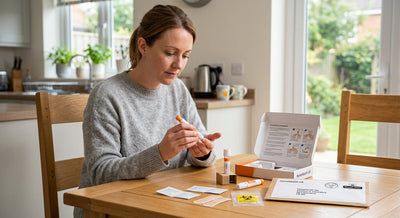
You likely know the feeling of a "sugar crash" after a heavy meal, or the buzz after a morning coffee. But while those daily fluctuations feel dramatic, they only tell a tiny part of your metabolic story. If you’re serious about your health, you need to look at the bigger picture. That’s where the HbA1c test comes in. It’s not just a snapshot of right now; it’s a three-month highlight reel of your blood sugar management. By testing your HbA1c at home, you gain the data needed to understand your risk of prediabetes and type 2 diabetes, all without waiting for a GP appointment.
TL;DR:
- HbA1c measures your average blood sugar levels over the past 8 to 12 weeks.
- It is more reliable than a standard glucose test because it isn't affected by what you just ate.
- The test identifies prediabetes and diabetes risk using UK-standard ranges (mmol/mol).
- High results indicate a need for lifestyle changes or a conversation with your GP.
- At-home testing offers a convenient, clinical-grade way to monitor your metabolic health.
What's a HbA1c test?
An HbA1c test, also known as the glycated haemoglobin test, measures the average amount of glucose (sugar) that has been attached to your red blood cells over the last two to three months. Unlike a finger-prick glucose test that shows your sugar levels at a single moment, HbA1c provides a long-term view of how your body manages sugar, making it the primary tool for diagnosing and monitoring prediabetes and type 2 diabetes.
The Video vs. The Snapshot: Why HbA1c Matters
Imagine you’re trying to judge a film’s quality. If you only look at one single frame, you might see a blurry image or a dark scene that doesn't represent the whole movie. A standard finger-prick glucose test is like that single frame, it shows your blood sugar at that exact second. If you just ate a doughnut, it’ll be high. If you just finished a workout, it might be lower.
HbA1c is the entire video. Because red blood cells live for about 120 days, the glucose that sticks to them stays there for the duration of the cell's life. By measuring this "glycated haemoglobin," we can see the average story of your blood sugar over the last few months. This makes it a much more stable and reliable marker for your metabolic health. It doesn't matter if you had a salad or a pizza for lunch today; the HbA1c result won't change based on one meal.
This stability is why the NHS uses HbA1c as the gold standard for monitoring diabetes risk. It cuts through the "noise" of daily life and shows the underlying trend of how your body handles energy. For the data-driven patient, this is the most critical metric for long-term wellness.

Understanding Your Numbers: The UK Ranges
When you receive your HbA1c results, the numbers are usually presented in mmol/mol (millimoles per mole). This can look like a foreign language if you aren't used to it, but the categories are actually quite straightforward.
According to Diabetes UK, the thresholds used by clinicians in the UK are:
- Normal (Low Risk): Below 42 mmol/mol. This suggests your body is effectively managing sugar and your risk of diabetes is currently low.
- Prediabetes (High Risk): Between 42 and 47 mmol/mol. This is often called "non-diabetic hyperglycaemia." It means your blood sugar levels are higher than they should be, and you are at a significantly increased risk of developing type 2 diabetes in the future.
- Diabetes: 48 mmol/mol or above. This is the level at which a clinical diagnosis of type 2 diabetes is usually made.
Think of these ranges like a traffic light system. Below 42 is green, you’re on the right track. Between 42 and 47 is amber, it’s a warning light telling you to slow down and check your lifestyle habits before you hit the red zone. Once you hit 48, it’s a red light that requires immediate attention and a conversation with a healthcare professional.
It is important to remember that these aren't just arbitrary numbers. Every point increase in your HbA1c represents a higher level of glucose circulating in your blood, which can eventually lead to damage in your blood vessels, nerves, and organs. Knowing where you sit within these clinical ranges allows you to take proactive steps before permanent damage occurs.
Why You Should Check Your HbA1c at Home
In the past, getting an HbA1c test meant booking a GP appointment, taking time off work, and waiting in a clinic. For many busy professionals and athletes, this friction is enough to keep "health checks" at the bottom of the to-do list. However, modern at-home testing has flipped the script.
Testing at home serves as a "pressure valve" for the NHS. By taking control of your own data, you can arrive at your next GP appointment informed and ready for a productive conversation. You aren't just saying "I feel tired"; you're saying "My HbA1c is 44 mmol/mol, and I want to discuss a plan to lower my diabetes risk."
At-home testing also offers a level of privacy and convenience that a busy clinic cannot match. You can collect your sample in minutes, post it to a UKAS-accredited lab, and receive a report that explains your results in plain English. For those who prioritize proactive wellness, this data-driven approach is the ultimate tool for staying ahead of metabolic issues.
Our Female Metabolic & Hormonal Health Panel includes HbA1c alongside other critical markers like cholesterol and thyroid function, giving you a comprehensive view of your internal health without the clinic visit.

How the Finger-Prick Test Works
The idea of collecting your own blood sample can be a bit daunting if you've never done it before. However, the process is designed to be as simple as possible. It’s a finger-prick test, which means you only need a few drops of blood, not a full vial like you might give at a hospital.
Think of it like checking the oil in your car. You don't need to drain the entire engine to see if the oil is clean; you just need a small dipstick sample to get the information you need.
- Preparation: You’ll want to make sure your hands are very warm. Warmth increases blood flow to your fingertips, making the collection much easier. A quick soak in warm water or a few minutes of jumping jacks can make a huge difference.
- The Prick: You use a small, sterile device called a lancet to make a tiny prick on the side of your finger. It feels like a small pinch, similar to a quick flick of a rubber band.
- Collection: You gently massage your finger to encourage a few drops of blood into a small collection tube.
- The Lab: Once you’ve filled the tube to the line, you pop it into the pre-paid envelope and send it off.
All Vitall Check samples are processed by labs that meet ISO 15189 standards, which are the same high standards used by the NHS. This ensures that the results you get at home are just as accurate as those you would get in a clinical setting.
What High Results Actually Mean
If your results come back in the "Prediabetes" range (42–47 mmol/mol), it is not a reason to panic, but it is a reason to act. Prediabetes is a reversible state. It’s like catching a small leak in your roof before the entire ceiling collapses. By making changes now, you can often bring your levels back into the normal range.
High HbA1c is usually a sign of "insulin resistance." This is when your body’s cells stop responding effectively to insulin, the hormone that unlocks your cells to let sugar in for energy. When the "locks" get rusty, the sugar stays in your bloodstream, leading to higher HbA1c levels.
For athletes, high HbA1c can sometimes be a confusing marker. While exercise generally improves insulin sensitivity, intense training loads and high-carbohydrate diets can occasionally impact blood sugar readings. It is vital to look at your results within the context of your lifestyle. This is why our Basic Health Check is so popular; it provides the context you need to understand if your numbers are a result of your training or a sign of an underlying metabolic shift.

Actionable Next Steps: Lowering Your Risk
If you find yourself in the prediabetes range, your health action plan should focus on three main pillars: diet, movement, and monitoring.
- Refine Your Carbohydrates: You don't necessarily need to cut out all carbs, but moving away from "simple" sugars (like white bread and sugary drinks) towards "complex" carbohydrates (like oats, lentils, and vegetables) can slow down the release of sugar into your blood.
- Muscle is a Glucose Sponge: Muscles are the biggest consumers of glucose in your body. By engaging in resistance training or even brisk walking, you help your muscles "soak up" the extra sugar from your blood, naturally lowering your HbA1c over time.
- Consistent Monitoring: Because HbA1c is a three-month average, you won't see changes overnight. It is usually recommended to re-test every three to six months to see if your lifestyle adjustments are working.
Your Vitall Insight Report will translate your raw data into clear next steps. We don't just give you a number and leave you to Google it; we provide a manual for your body that helps you prepare for a more informed conversation with your GP.
Preparing for an Informed GP Conversation
The goal of at-home testing isn't to bypass medical care; it’s to accelerate it. When you have your HbA1c data in hand, you can skip the "wait and see" phase. If your results are in the diabetes range (48+ mmol/mol), you should book an appointment with your GP immediately.
Bring your Insight Report with you. It provides a clear, lab-verified record of your levels, which helps your doctor make faster decisions about your care. According to NICE guidelines, clinicians use these exact same markers to determine the best course of action. By showing up with your data already in hand, you are demonstrating that you are a proactive partner in your own healthcare.

Summary: Knowledge is the Best Medicine
The HbA1c test is one of the most powerful tools in your wellness toolkit. It moves the conversation from "how I feel" to "what is actually happening" inside your body. Whether you are an athlete looking to maintain metabolic efficiency or a busy professional wanting to avoid the pitfalls of a sedentary lifestyle, knowing your numbers is the first step toward lasting health.
Don't wait for symptoms to appear. By the time you feel the effects of high blood sugar, the damage may have already begun. Proactive testing allows you to see the "amber light" of prediabetes and make the necessary turns to get back onto a healthy path.
Author Section
Vitall Check Editorial Team
The Vitall Check Editorial Team is dedicated to empowering individuals with evidence-based health information and clear, actionable insights. Every article is researched using peer-reviewed journals and official health resources, reflecting our commitment to the same high standards of accuracy as our laboratory testing services. Our goal is to make proactive wellness accessible, data-driven, and transparent.
FAQ
Do I need to fast before an HbA1c test?
No, you do not need to fast. Because the HbA1c test measures a three-month average, what you ate today or yesterday does not significantly impact the result. This makes it much more convenient than a fasting glucose test.
How often should I check my HbA1c?
For most people concerned about their metabolic health, once or twice a year is sufficient. However, if you are in the prediabetes range (42–47 mmol/mol) and making lifestyle changes, testing every three months allows you to see the impact of those changes.
Can exercise affect my HbA1c result?
Regular exercise generally lowers HbA1c over time by improving insulin sensitivity. However, very intense exercise right before a test might slightly affect your immediate blood glucose, but it typically won't change your three-month HbA1c average.
What's the difference between blood glucose and HbA1c?
Blood glucose is a snapshot of the sugar in your blood at this very moment. HbA1c is a measure of the sugar that has "stuck" to your red blood cells over the last few months, providing a long-term average.
Can I do this test if I'm pregnant?
Pregnancy can change the lifespan of red blood cells, which may make HbA1c a less reliable marker for some women. If you are pregnant or suspect you have gestational diabetes, you should always consult your midwife or GP for specific testing.
Is an at-home test as accurate as the hospital?
Yes. As long as the sample is processed by a UKAS-accredited lab (like ours), the clinical standards and testing methods are identical to those used by the NHS.
Disclaimer: Vitall Check is not CQC registered. The content provided is for general information only, does not provide a diagnosis, and does not replace advice from a qualified healthcare professional. Our services do not include treatment, prescription, or medical advice that falls under CQC-regulated activities. Always consult with your GP or a qualified clinician before making significant changes to your healthcare regimen.