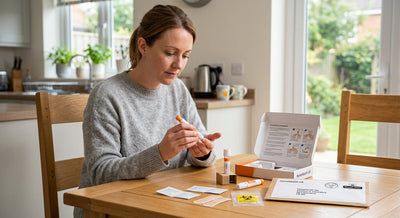
Hormones can affect your energy, sleep, sex drive, periods, mood, body temperature and more. But they are not fixed settings. They rise, fall and respond to age, stress, illness, exercise, medication and timing.
That is why a hormone blood test at home in the UK can provide useful information, but only when you understand what the numbers can and cannot tell you.
This guide explains the main markers used in menopause, testosterone and thyroid testing. You will also learn how finger-prick testing works, what reference ranges mean, when testing may make sense and why one result should never be treated as a diagnosis.
TL;DR:
- Hormones act as chemical messengers across your body. They work together rather than sitting at one fixed “balance” point.
- Menopause-related panels may include oestradiol, FSH and LH, while thyroid panels commonly include TSH, free T4 and sometimes free T3.
- Testosterone testing can be relevant to men and women, but age, sex, symptoms, medication, cycle stage and test timing all matter.
- NICE says people aged 45 or over with typical menopause symptoms should usually be assessed from symptoms and menstrual changes, without routine hormone testing.
- An at-home finger-prick test involves preparation. Warm hands, hydration and careful sample collection can make a difference.
- Vitall Check samples are processed by UKAS-accredited partner laboratories using ISO 15189 standards. Lab-verified results are available in 48 hours from laboratory receipt.
- Your Insight Report translates raw laboratory data into plain English. It does not diagnose, treat or replace a GP consultation.
What does an at-home hormone blood test check? An at-home hormone blood test checks selected markers such as oestradiol, FSH, LH, testosterone, TSH, free T4 and free T3. It provides a snapshot of your hormone levels, not a diagnosis or complete explanation of your symptoms.
Key reminders before you test
Before ordering any hormone panel, keep these points in mind:
- A single result is a snapshot. Hormones can change from one day to the next.
- Timing matters. Some markers follow a daily rhythm. Others change during the menstrual cycle.
- Reference ranges are not universal. Always use the range printed on your laboratory report.
- Hormone testing does not replace clinical care. Use your results to support a better GP conversation.
- Finger-prick collection may feel fiddly. Some people collect a sample quickly. Others need more preparation or a second attempt.
- Do not stop prescribed treatment because of a test result. Speak with your GP or another qualified clinician first.
If you feel nervous about collecting blood, ask someone you trust to stay nearby. It is normal to feel a small pinch from the lancet. If you feel faint or uneasy, stop, sit or lie down safely and ask for help.

Why hormone health matters
Hormones are chemical messengers. They carry instructions between organs and tissues, helping your body coordinate processes such as reproduction, metabolism, growth, stress response and temperature control.
Think of them like an orchestra. Each instrument has its own part, but the music depends on timing and teamwork. A single loud or quiet instrument does not tell you whether the whole performance is going well.
This is why “hormone balance” does not mean finding one perfect number. It means understanding how your results fit with:
- Your age
- Your sex and reproductive stage
- Your symptoms
- Your menstrual cycle, if applicable
- Your medication and supplements
- Your recent training, sleep and illness
- The laboratory method and reference range
Hormone testing can be useful when you want a clearer starting point for a healthcare conversation. It can also help you record a baseline or compare results over time when testing is repeated consistently.
However, hormone results are not a scoreboard. A number outside a reference range does not automatically mean something is wrong. A number within a range does not prove that every cause of a symptom has been ruled out.
Menopause hormone testing: oestradiol, FSH and LH
Menopause is a natural life stage linked to changes in ovarian hormone production. The transition can affect periods, sleep, mood, temperature regulation, sexual health and more.
A menopause blood test UK search often leads people to panels containing three key hormones:
Oestradiol
Oestradiol is the main form of oestrogen during the reproductive years. It is involved in the menstrual cycle and affects tissues throughout the body.
Oestradiol levels can change significantly during the cycle:
- Levels may be lower at some points in the cycle.
- They may rise before ovulation.
- They may fluctuate more widely during perimenopause.
- They are generally lower after menopause.
A single oestradiol result cannot tell you the whole menopause story. The result needs to be read alongside your age, symptoms, cycle history and any hormonal treatment.
FSH
FSH stands for follicle-stimulating hormone. It is produced by the pituitary gland, a small gland at the base of the brain.
FSH helps stimulate the ovaries during the menstrual cycle. When ovarian hormone production changes, the body may produce more FSH in an attempt to encourage a response.
FSH can be useful in some situations. It can also be misleading if you treat one result as final because levels may fluctuate during perimenopause.
NICE recommends considering serum FSH to confirm menopause only in specific situations, including people aged 40 to 45 with menopause-associated symptoms and menstrual cycle changes, or people under 40 where premature ovarian insufficiency is suspected. NICE also says not to diagnose premature ovarian insufficiency from one blood test alone.
LH
LH stands for luteinising hormone. It works with FSH to help regulate the menstrual cycle and trigger ovulation.
LH can rise around ovulation. It may also become more variable as ovulation becomes less regular during perimenopause.
Like FSH and oestradiol, LH is not a stand-alone menopause test. It is one part of a wider picture.
What NICE says about menopause testing
For otherwise healthy women, trans men and non-binary people registered female at birth who are aged 45 or over and have typical menopause-associated symptoms, NICE recommends identifying perimenopause or menopause without laboratory tests.
The NICE quality standard explains that hormone levels fluctuate during perimenopause, so laboratory tests, particularly FSH, may not help confirm the diagnosis in this age group. You can read the specific recommendation in NICE quality standard QS143.
This does not mean hormone testing is never useful. It means the reason for testing matters. A test may be considered when symptoms occur earlier than expected, the situation is unclear, thyroid concerns are present, or a clinician has asked for specific monitoring.
Menopause testing and HRT
Hormonal contraception, HRT and other hormone treatments can affect your results. Tell the testing provider and your GP about anything you take.
Do not stop HRT, contraception or another prescribed medicine to “get a cleaner result” unless a qualified clinician tells you to do so. The result needs to reflect your real circumstances.
If you are still having periods, your collection day may matter. Some panels recommend testing around a particular cycle day. Others use a different approach. Follow the instructions provided with your chosen panel.
Testosterone testing for men and women
Testosterone is often described as a “male hormone”, but that is too simple. Men and women both produce testosterone. The amount, source and clinical context differ.
Testosterone is produced mainly by the testes in men and by the ovaries and adrenal glands in women. It is involved in sexual function, muscle, bone and general body processes.
Symptoms such as low sex drive, tiredness, reduced strength, mood change or changes in body hair can have many possible causes. Testosterone testing may provide useful information, but the result cannot identify the cause by itself.
Testosterone testing for men
A testosterone test UK search usually refers to a blood test measuring total testosterone. Some assessments may also consider:
- Sex hormone-binding globulin, known as SHBG
- Albumin
- Calculated free testosterone
- LH and FSH
- Prolactin
- Thyroid markers
The exact markers depend on the test panel.
Testosterone follows a daily pattern, so morning collection is often important. Recent illness, poor sleep, heavy exercise, alcohol and some medicines may affect the result.
If a result is unexpectedly low or high, a GP may decide that repeat testing or further assessment is appropriate. A single home result should not be used to start, stop or change hormone treatment.
Testosterone testing for women
Women may consider testosterone testing when exploring symptoms such as low sexual desire, changes in body hair, acne, irregular periods or other concerns. These symptoms can have many explanations, so a testosterone result must be read with care.
Testing methods matter, especially at the lower concentrations commonly seen in women. Results from different laboratories and testing methods may not be directly comparable.
What the August 2026 research adds
A June 2026 study published in the Journal of Endocrinological Investigation analysed testosterone results from a wider dataset of 30,453 women aged 18 to 74. After applying strict criteria, the researchers used a reference cohort of 5,323 women aged 19 to 59 to model age-related testosterone patterns.
The study found that total testosterone declined gradually with age. Its model estimated an average decrease of about 1.4% per year across the studied age range. It also found that the spread of results increased with age, meaning women’s results became more varied.
The researchers highlighted a problem with some existing reference ranges: they may be based on small, older datasets and broad age groups. The paper gives the example of a commonly used manufacturer reference dataset based on only 149 women split into two large age bands.
This matters because a reference range is a comparison tool. It is not a universal definition of health. A range based on a small group may not represent the full variation seen in a larger, more carefully selected population.
The study supports the need for larger datasets and more age-aware interpretation. It does not mean you should compare your result directly with a study table or make a decision from one number. The test method, your circumstances and your laboratory’s own report still matter.
You can read the full open-access research here: Redefining testosterone reference ranges for adult females.

Thyroid blood test at home: TSH, T4 and T3
Your thyroid is a small gland in your neck. It produces hormones that help control how your body uses energy.
A thyroid blood test at home may include:
- TSH: Thyroid-stimulating hormone
- Free T4: Free thyroxine
- Free T3: Free triiodothyronine
TSH
TSH is made by the pituitary gland. It acts like a message telling the thyroid how much hormone to produce.
You can think of TSH as the thermostat signal in a house. It does not represent the room temperature itself. It tells the heating system what to do.
A higher or lower TSH result may be interpreted alongside free T4 and, in some situations, free T3. TSH alone is not the complete thyroid picture.
Free T4
T4 is one of the main hormones produced by the thyroid. “Free” T4 refers to the portion available for the body to use.
The NHS explains that blood tests for an underactive thyroid commonly check TSH and T4. An underactive thyroid can be linked with symptoms such as tiredness, feeling cold, weight gain, constipation, low mood, dry skin and difficulty concentrating. These symptoms can also have other causes.
Free T3
T3 is another thyroid hormone. It is often considered when an overactive thyroid is suspected or when a fuller thyroid assessment is needed.
The NHS describes a thyroid function test as checking TSH, T3 and T4, with results compared against what is expected for someone of a similar age. The NHS guide to diagnosing an overactive thyroid also explains that what counts as normal can vary with age and the laboratory technique used.
Why thyroid testing can be relevant during menopause
Thyroid conditions and menopause can share symptoms. These may include:
- Tiredness
- Mood changes
- Difficulty concentrating
- Changes in weight
- Changes in periods
- Changes in sleep
- Feeling too hot or too cold
That overlap can make it difficult to know what is behind a symptom from symptoms alone. Thyroid testing does not diagnose menopause. It may help identify whether thyroid markers should be discussed with your GP.
If your result is outside the laboratory reference range, bring it to a qualified clinician. You may need a venous blood test, repeat testing or other assessment.
What do “normal” hormone ranges mean?
Your report will usually show:
- The name of the marker
- Your result
- The unit of measurement
- The laboratory reference range
- A flag indicating whether the result is below, within or above that range
A reference range is usually built from results seen in a selected group of people. It is a comparison band, not a pass-or-fail exam.
Imagine a lane on a road. Staying within the lane may be reassuring, but it does not tell you where you are going, how fast you are travelling or what the traffic looks like ahead. Leaving the lane does not automatically tell you why it happened either.
Reference ranges can vary because of:
- The laboratory analyser
- The testing method
- The population used to build the range
- Age and sex
- Menstrual or menopausal status
- Sample type
- The laboratory’s quality processes
For testosterone, ranges may be particularly difficult to compare across people because levels are affected by age, timing, cycle stage, body composition, medicines and the test method.
Use your own report as the starting point. Do not copy a reference range from a website and apply it to a different laboratory result.
For a wider explanation of why context matters when reading any biomarker, read the Health Hub pillar article: Biohacking Blood Test Results: Why Context Matters More Than the Number.
How at-home finger-prick hormone testing works
Vitall Check offers specialist hormone and thyroid panels that can be collected at home. Depending on the panel, you may be able to check menopause-related hormones, testosterone, thyroid markers or a broader group of health markers.
You can explore the Hormones & Thyroid collection before choosing a panel. Always check the marker list and collection instructions carefully because not every test includes the same hormones.
STEP 1: Prepare your timing
Check whether your panel requires:
- Morning collection
- Fasting
- A particular menstrual cycle day
- Avoidance of intense exercise beforehand
- A pause from biotin supplements
Vitall Check’s general process recommends a morning sample after an eight-hour fast when the panel requires it. Water is allowed. Follow the instructions for your specific test.
If you take biotin-containing hair or nail supplements, check the instructions before testing. Biotin can interfere with some laboratory tests. Do not stop a prescribed supplement without checking with a qualified healthcare professional.
STEP 2: Prepare your hands and workspace
Find a clean, well-lit surface. Lay out the safety lancets, alcohol wipes, collection tube, biohazard bag, instruction card and freepost envelope.
Wash your hands in warm water and dry them properly. If your fingers are cold, hold them under warm running water for about two minutes.
Warm hands usually improve blood flow. It is like turning on a tap before filling a bottle: you want the flow to start easily rather than forcing it.
STEP 3: Choose and clean your finger
Use the middle or ring finger on your non-dominant hand, unless your instructions say otherwise.
Clean the side of your fingertip with the alcohol wipe. Let it air-dry fully. Avoid touching the area after cleaning.
STEP 4: Use the safety lancet
Remove the lancet safety cap. Press the lancet firmly against the side of your fingertip and activate it.
You should feel a brief pinch. If the first attempt does not provide enough blood, use the spare lancet on another suitable finger, following the instructions.
STEP 5: Fill the tube carefully
Wipe away the first drop of blood if the instructions tell you to do so. Keep your hand below the level of your heart.
Let the blood drops fall into the collection tube. Gently massage from the base of your finger towards the fingertip. Avoid squeezing hard or scraping your finger against the tube.
Fill the tube to the marked line. Too little blood may mean the laboratory cannot process every marker.
STEP 6: Seal, mix and post
Secure the tube cap. Gently invert the tube the number of times stated in the instructions so the sample mixes with its preservative.
Place it in the biohazard bag, then in the prepaid envelope. Post it as soon as possible, following the official collection guide.
Read Vitall Check’s step-by-step sampling guide before you collect your sample. If you prefer to learn by watching, use the provider’s official video tutorial where available.
Vitall Check samples are processed by UKAS-accredited partner laboratories using ISO 15189 standards. UKAS explains that medical laboratory accreditation provides confidence in quality, performance and competence.
Results are lab-verified and delivered to your secure portal within 48 hours from laboratory receipt, subject to sample quality and processing conditions.

When does at-home hormone testing make sense?
Testing may be useful when you want to:
- Establish a baseline for selected hormone markers
- Explore a specific question about menopause, testosterone or thyroid health
- Prepare for a more informed GP conversation
- Repeat testing consistently over time when appropriate
- Understand several related markers together rather than one isolated result
- Share laboratory data with a qualified healthcare professional
Testing may be less useful when you expect one result to explain every symptom. Hormones are only one part of your health picture.
For people aged 45 or over with typical menopause symptoms, NICE recommends symptom-led assessment rather than routine laboratory confirmation. Testing may be more relevant when menopause is suspected earlier, symptoms are unusual, thyroid concerns are present or a clinician has requested particular markers.
Speak with your GP before testing if you are pregnant, trying to conceive, taking hormone treatment, using hormonal contraception or being investigated for a specific condition. If you are under the provider’s minimum age for testing, do not order without checking eligibility first.
The limitations of a single hormone result
A hormone result can be accurate and still provide only a limited view.
The result may be influenced by:
- The time of day
- Menstrual cycle stage
- Recent exercise
- Sleep
- Stress
- Alcohol
- Illness
- Fasting or hydration
- Hormonal contraception
- HRT or other medicines
- The sample collection method
- The laboratory testing method
One result is like checking the weather through one window for five minutes. You learn something about that moment, but not the whole season.
This is why repeat testing, where appropriate, should be done under similar conditions. Try to use the same laboratory and follow the same timing instructions. That makes results easier to compare.
Do not use home testing to diagnose menopause, thyroid disease, testosterone deficiency, PCOS or another condition. Do not use a result to start, stop or change treatment.
How to read your Insight Report
Your report should make the data easier to understand, not create more confusion.
Vitall Check Insight Reports are designed to translate raw laboratory results into clear explanations. For example, instead of leaving you with a line such as “TSH: 3.2 mIU/L”, the report can explain what TSH is and where your result sits within the laboratory’s stated reference range.
Use the report as a manual for your results:
- Read the marker explanation.
- Check the laboratory reference range.
- Note the collection date and timing.
- Record relevant medicines and supplements.
- Compare with previous results only when the conditions are reasonably similar.
- Write down questions for your GP or qualified clinician.
The report is not a diagnosis. It does not tell you that a hormone is “good” or “bad”, and it should not be used to make treatment decisions alone.

Safety and precautions
⚠️ Speak with a GP promptly if you have symptoms that concern you, a result that is significantly outside the stated range, or symptoms that are getting worse.
⚠️ Seek urgent medical help for severe or sudden symptoms such as chest pain, severe breathlessness, fainting, confusion or a very fast or irregular heartbeat.
⚠️ Do not delay medical care while waiting for a home test kit or result.
⚠️ Do not alter medication or hormone treatment because of an at-home result.
⚠️ Ask for help with collection if you feel faint, have difficulty obtaining a sample or are worried about using a lancet.
If your sample is insufficient or affected during transport, the laboratory may be unable to process it. Contact the provider and follow its replacement instructions.
FAQ
Q: Can an at-home hormone blood test diagnose menopause? A: No. An at-home test provides a snapshot of hormone levels. For people aged 45 or over with typical symptoms, NICE recommends symptom-led assessment rather than routine laboratory confirmation. Testing may have a role in specific situations, such as suspected early menopause or premature ovarian insufficiency, but a clinician must interpret the wider picture.
Q: Is an at-home testosterone test accurate in the UK? A: A properly collected sample processed by a UKAS-accredited laboratory can provide lab-verified results. However, testosterone varies with age, sex, timing, cycle stage, medication and testing method. A single result does not diagnose testosterone deficiency or another condition.
Q: Can I do a thyroid blood test at home? A: Yes, some UK services offer finger-prick thyroid panels that measure markers such as TSH, free T4 and free T3. Results should be read against the laboratory’s own reference ranges and discussed with your GP if they are outside range or you have concerning symptoms.
Summary
At-home hormone testing can give you useful information about selected menopause, testosterone and thyroid markers without requiring a clinic visit for sample collection.
The important word is selected. No panel measures every factor that affects your symptoms. No single reading can diagnose a condition. Hormone results change with timing, age, cycle stage, medication, illness, exercise and sleep.
Use the results as a starting point:
- Choose a panel that matches your question.
- Prepare properly.
- Follow the official sample collection guide.
- Check the laboratory reference range.
- Read the result in context.
- Take questions and relevant results to your GP or qualified clinician.
Vitall Check provides at-home testing with samples processed by UKAS-accredited partner laboratories. Results are lab-verified in 48 hours from laboratory receipt, and Insight Reports translate raw data into plain-English explanations.
That gives you a clearer starting point for an informed healthcare conversation: not a substitute for one.
Author
Vitall Check Editorial Team
The Vitall Check Editorial Team is dedicated to empowering individuals with evidence-based health information and clear, actionable insights. Every article is researched using peer-reviewed journals and official health resources, reflecting our commitment to the same high standards of accuracy as our laboratory testing services. Our goal is to make proactive wellness accessible, data-driven, and transparent.
Disclaimer: Vitall Check is not CQC registered. The content provided is for general information only, does not provide a diagnosis, and does not replace advice from a qualified healthcare professional. Our services do not include treatment, prescription, or medical advice that falls under CQC-regulated activities. Always consult with your GP or a qualified clinician before making significant changes to your healthcare regimen.